
What's Letter E About?
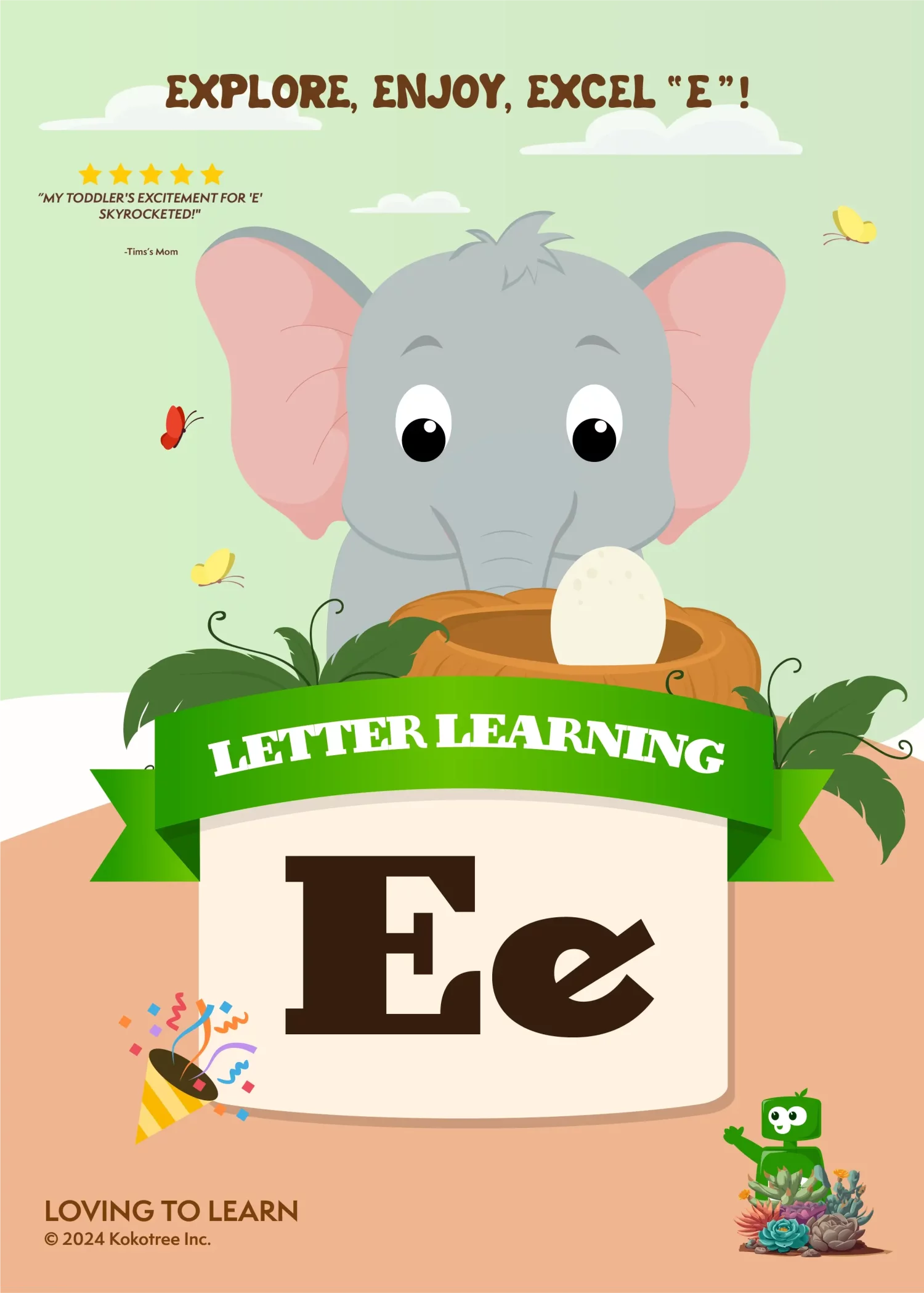
Your little learner joins Miss Meera and the Kokotree Class on an adventure to master the letter E—including both of its sounds! They'll hear an enchanting story about Emily the Elephant, practice writing uppercase and lowercase E, and create their own alliterations.
12 minutes
Ages 3-6
Skill: Letter recognition, phonics, and handwriting
Your kid watches friendly animals explore letter sounds through storytelling. You get 12 minutes to enjoy your coffee while it's still warm.
The video opens with the Kokotree Class playing imaginatively with an empty bottle on the playground. Miss Meera arrives and uses the word "empty" to introduce the letter E. Through an engaging story about Emily the Elephant caring for baby eaglets, children hear dozens of E words naturally woven into the narrative.
What your child learns:
This video teaches the crucial concept that the letter E makes two distinct sounds—the short "eh" sound (as in egg, elephant, empty) and the long "ee" sound (as in eagle, evening, eat). Children also learn letter formation through step-by-step handwriting instruction.
- Recognizes the letter E in both uppercase and lowercase forms
- Distinguishes between short "eh" and long "ee" sounds
- Writes uppercase E using standing and sleeping lines
- Writes lowercase e using a single curved stroke
- Creates alliterations using E words
They'll use these skills when:
- Spotting the letter E on cereal boxes, exit signs, and book covers
- Sounding out simple words while learning to read
- Writing their name if it contains the letter E
- Playing "I Spy" games with letters in the environment
The Story (what keeps them watching)
When the Kokotree Class finds an empty bottle on the playground, their imaginations run wild—Maddy sees a baseball bat, Bobby sees a telescope! Miss Meera uses this "empty" moment to introduce the letter E. The real magic happens when she tells the story of Emily the Elephant, who discovers a fallen nest with eleven eaglets. Emily stays all night to protect them and watches the eleventh egg hatch into a beautiful white eaglet named Emma. The story is packed with E words, making phonics feel like a cozy bedtime tale rather than a lesson.
How We Teach It (the clever part)
- First 3 minutes: The letter E is introduced through relatable play, connecting the "empty" bottle to the short "eh" sound, while an eagle flying overhead demonstrates the long "ee" sound.
- Minutes 3-8: The Emily the Elephant story immerses children in E vocabulary—elephant, evening, eggs, eaglets, eucalyptus, east, echo—reinforcing both sounds through narrative context.
- Final 4 minutes: Children practice creating alliterations ("Ella eats eggplants") and learn step-by-step letter formation for both uppercase and lowercase E.
Teaching trick: Miss Meera breaks down each E word by isolating the sound—"the 'eh' 'eh' in egg"—helping children connect the abstract letter to concrete sounds they can hear and repeat.
After Watching: Quick Wins to Reinforce Learning
- Mealtime activity: "Can you find the letter E on anything at the table?" Point to cereal boxes, napkins, or food labels. Ask if each E makes the short "eh" or long "ee" sound.
- Car/travel activity: "Let's spot E words! Is that an EXIT sign? What sound does that E make?" Practice both sounds as you drive past signs, stores, and vehicles.
- Bedtime activity: "Let's make up a silly sentence where every word starts with E, like 'Eddie eats enormous eggs!'" This reinforces alliteration in a playful, sleepy-time way.
- Anytime activity: Use a finger to trace the letter E on your child's back and have them guess—then switch! Practice both the uppercase E (standing line plus three sleeping lines) and the curvy lowercase e.
When Kids Get Stuck. And How to Help.
- "My child keeps mixing up the two E sounds." This is completely normal! The letter E is tricky because it has two sounds. Keep pointing out examples naturally: "Egg has the 'eh' sound, but we 'eat' with the 'ee' sound." Repetition builds recognition.
- "The lowercase e looks wobbly when my child writes it." The curved stroke takes practice! Try drawing it extra large in sand, shaving cream, or flour first. Big movements help little hands develop the muscle memory for smaller writing later.
- "My child can't think of alliterations on their own." Start by giving them the first two words and letting them add one more: "Emma eats..." Even simple additions like "eggs" count as success and build confidence for longer phrases.
What Your Child Will Learn
Prerequisites and Building Blocks
Before watching, children should have basic familiarity with the concept that letters make sounds and that we use letters to write words. This video builds on foundational alphabet awareness and pairs well with earlier letter videos in the Budding Sprouts program. The Letter E lesson introduces the more advanced concept of letters having multiple sounds, preparing children for the complexity of English phonics. This positions learners for future vowel studies and blending practice.
Cognitive Development and Teaching Methodology
The video employs narrative-based learning, which research shows significantly improves retention in preschoolers. By embedding phonics instruction within Emily the Elephant's story, abstract letter-sound relationships become concrete and memorable. The lesson addresses visual learners through letter formation demonstrations, auditory learners through repeated sound practice ("eh" "eh" in egg), and kinesthetic learners through the invitation to write in sand or flour. Call-and-response repetition reinforces neural pathways.
Alignment with Educational Standards
This video aligns with Common Core Foundational Skills for Kindergarten, specifically RF.K.1d (recognizing uppercase and lowercase letters) and RF.K.3a (demonstrating basic knowledge of letter-sound correspondences). The dual-sound instruction prepares children for RF.K.3b (associating long and short vowel sounds). The alliteration exercises support phonological awareness benchmarks that kindergarten teachers assess during readiness screenings.
Extended Learning Opportunities
Pair this video with printable Letter E tracing worksheets available in the Kokotree app. Extend learning with the "E Sound Sort" game where children categorize picture cards by short or long E sounds. For hands-on practice, create a sensory writing tray with flour or sand for letter formation. The app's "Eagle's Nest" counting game reinforces the video's eaglet theme while building number sense.
Transcript Highlights
- "The Letter E has something special about it. It has not one but two sounds. One is the short sound 'eh'. Like the word empty."
- "Draw a standing line from topline to the base. Then go back to the topline and make a small sleeping line to the right, a second sleeping line on the midline and the third sleeping line on the baseline."
- "Alliteration is when you use the same letter or sound at the beginning of closely connected words."
- "Start halfway between the midline and the baseline. Then slide right to draw a small sleeping line. Now circle back to the left, ending above the baseline."
Character Development and Story Arc
The Kokotree Class models creative thinking when they transform an empty bottle into imaginative play objects—demonstrating divergent thinking for young viewers. Within the story, Emily the Elephant exhibits nurturing behavior and responsibility when she chooses to stay with the abandoned eaglets rather than continue searching for food. This models patience, caregiving, and follow-through. The students demonstrate active participation by volunteering alliterations, showing children that trying—even slowly and uncertainly like Bobby—leads to praise and success.
Phonics Deep Dive: Understanding Vowel Sounds
The letter E presents one of the most important phonics concepts for early readers: vowels can make multiple sounds. This video introduces the short vowel sound ("eh" as in elephant, egg, empty) and the long vowel sound ("ee" as in eagle, evening, eat). Understanding this duality is foundational for decoding words during reading.
Short E appears in CVC (consonant-vowel-consonant) words that children encounter early in reading instruction: bed, red, pet, hen. The long E sound appears in words with specific patterns: words ending in silent E (Pete, these), words with double E (feet, see), and words with EA combinations (eat, read). While this video doesn't teach spelling rules, it builds crucial phonemic awareness—the ability to hear and distinguish sounds.
The alliteration exercises serve a dual purpose: they make phonics playful while training children's ears to identify initial sounds. When children create phrases like "Eric eats eleven eggs everyday," they're practicing phoneme isolation (identifying the first sound) and phoneme identity (recognizing the same sound across different words). These skills directly predict reading success.
The handwriting component connects sound to symbol, reinforcing the abstract concept that these sounds we hear can be represented visually. The "standing line" and "sleeping line" terminology provides child-friendly vocabulary for discussing letter formation, building metalinguistic awareness that supports future writing instruction.