
What's Time of the Day About?
Your little one joins the Kokotree class to discover how the sun's journey across the sky creates morning, afternoon, evening, and night—and why we do different activities at each time! They'll connect their own daily routines to the natural rhythm of the day.
12 minutes
Ages 3-6
Skill: Understanding daily time periods and routines
Your kid watches friendly animals learn about the four times of day. You get 12 minutes to fold laundry or enjoy your coffee.
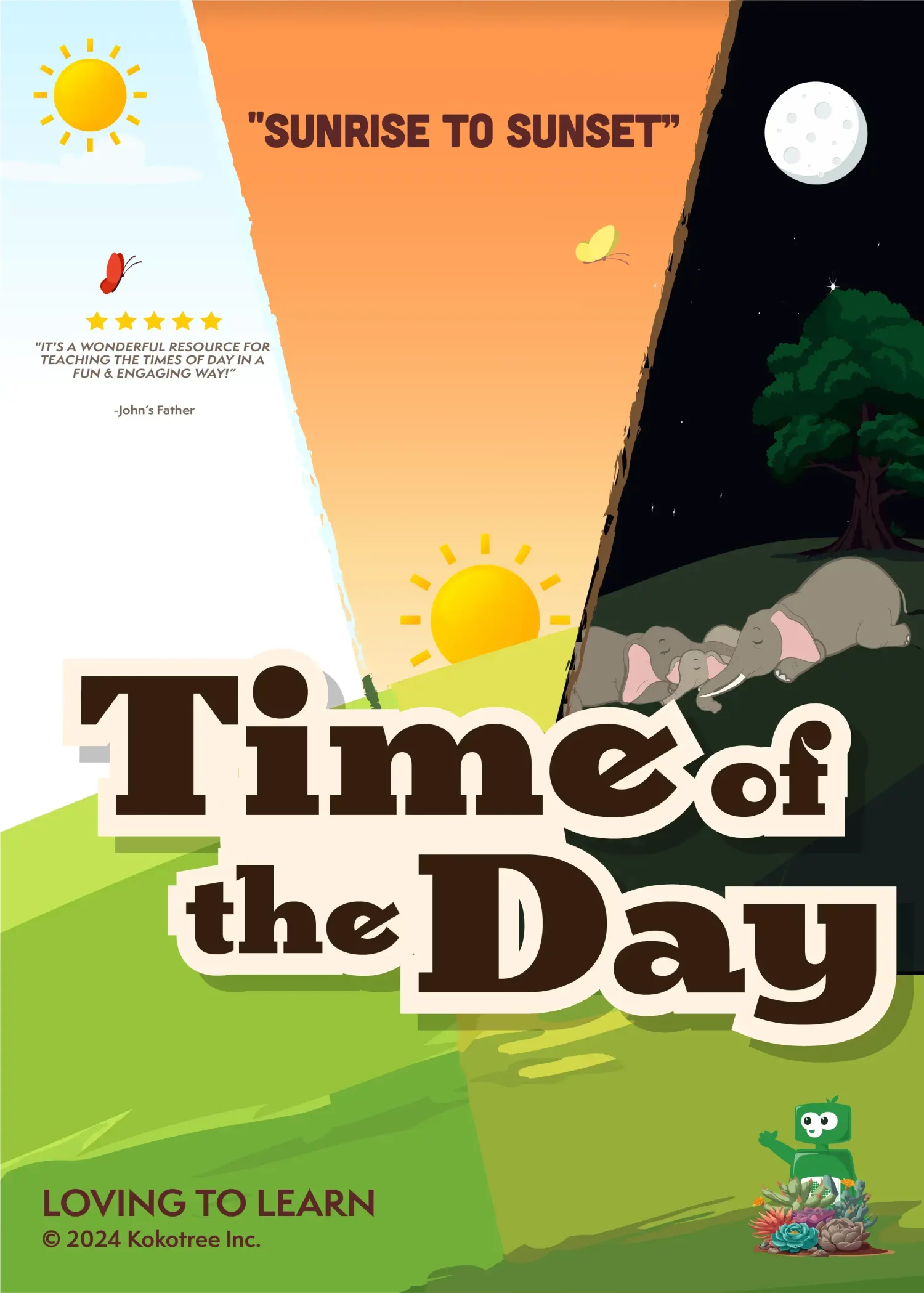
Gina shares a funny story about her cousin in Australia who says "Good Night" when she says "Good Morning"—sparking a whole class discussion about time zones and daily routines. Miss Elizabeth guides the Kokotree friends through each time of day, from sunrise to starry skies, with colorful illustrations showing the sun's position.
What your child learns:
Your child will understand that each day follows a predictable pattern: morning, afternoon, evening, and night. They'll connect familiar activities—like eating breakfast or going to bed—to specific times and learn the proper greetings for each part of the day.
- Names and identifies the four times of day (morning, afternoon, evening, night)
- Connects daily routines to appropriate times (breakfast = morning, dinner = night)
- Uses correct greetings: "Good Morning," "Good Afternoon," "Good Evening," "Good Night"
- Understands the sun's position changes throughout the day
- Recognizes the daily rhythm repeats each day
They'll use these skills when:
- Talking about what happens "after lunch" or "before bedtime" with family
- Understanding why it's time to wake up, eat, or sleep
- Greeting neighbors, teachers, or friends appropriately throughout the day
- Following along with daily schedules at preschool or daycare
The Story (what keeps them watching)
Gina tells her friends about her cousin Gary in Australia—when she says "Good Morning," he says "Good Night"! Miss Elizabeth uses this funny situation to teach the class about the four times of day. Through questions and answers, the Kokotree friends share what they do each morning, afternoon, evening, and night. Bobby brushes his shiny teeth in the morning, Maddy eats bananas at ALL times (especially evening snack time!), and Ronnie loves bedtime stories. The lesson ends with everyone drawing their favorite activities for each time of day on a special "Activity Circle."
How We Teach It (the clever part)
- First 3 minutes: A relatable story about time zones hooks kids' attention and introduces why different times of day matter
- Minutes 3-9: Miss Elizabeth systematically walks through each time period—morning, afternoon, evening, night—connecting the sun's position to familiar activities and greetings
- Final 3 minutes: The drawing activity reinforces learning as each character creates their own "Activity Circle" showing personal routines
Teaching trick: By having each animal character share their own evening and nighttime activities (swimming, cooking, reading), children see that while routines vary, the pattern of the day stays the same—making the concept personal and memorable.
After Watching: Quick Wins to Reinforce Learning
Mealtime activity: "Is this a morning meal, afternoon meal, or nighttime meal?" Have your child identify whether they're eating breakfast, lunch, or dinner—and practice the matching greeting!
Car/travel activity: "Look at the sun! What time of day is it?" Point out the sun's position and have your child guess if it's morning, afternoon, or evening based on where the sun sits in the sky.
Bedtime activity: "Let's say all four greetings!" Before sleep, practice the sequence together: "Good Morning, Good Afternoon, Good Evening, Good Night!" Ask which one fits right now.
Anytime activity: "Draw your Activity Circle!" Grab paper, divide it into four sections, and have your child draw one thing they do in the morning, afternoon, evening, and night—just like the Kokotree friends!
When Kids Get Stuck. And How to Help.
"My child keeps mixing up afternoon and evening." This is totally normal! The difference is subtle. Point out that afternoon is when the sun is still bright and high, while evening is when the sky starts getting pink or orange. Use lunch vs. dinner as anchor points.
"They don't understand why we can't play outside at night." Connect it to what they saw in the video—night is when the moon and stars come out, and our bodies need rest. Remind them that morning comes again tomorrow for more play!
"The time zone concept seems too advanced." Don't worry about them fully grasping time zones—it's just a fun hook! Focus on the main lesson: morning, afternoon, evening, and night happen in order, every single day.
What Your Child Will Learn
Prerequisites and Building Blocks
Children watching this video benefit from prior exposure to the concept of day versus night—understanding that the sun appears during the day and the moon at night. This video builds on that foundation by subdividing the day into four distinct periods. It connects to lessons about the sun, daily routines, and sequencing. This concept prepares children for understanding clocks, schedules, and eventually telling time.
Cognitive Development and Teaching Methodology
This video leverages the concrete operational thinking appropriate for ages 3-6 by anchoring abstract time concepts to tangible daily experiences children already know—eating breakfast, going to school, bedtime. The call-and-response format engages auditory learners, while visual illustrations of the sun's position support visual learners. The drawing activity at the end provides kinesthetic reinforcement, allowing children to process learning through creation.
Alignment with Educational Standards
This lesson aligns with kindergarten readiness standards for understanding time and sequence. Children learn to order events (morning comes before afternoon), a foundational math skill. The video supports language development through proper greeting vocabulary and social conventions. These skills appear in early learning frameworks emphasizing daily living concepts and temporal vocabulary development.
Extended Learning Opportunities
Pair this video with printable "Activity Circle" worksheets where children draw their own routines. Create a simple picture schedule showing your child's day divided into four parts. Play sorting games with picture cards—"Does this happen in the morning or at night?" The Kokotree app offers related content on day and night, the sun, and daily routines that extend this learning.
Transcript Highlights
- "With the movement of the Sun we experience different times of the day. Morning. Afternoon. Evening. And then finally, night."
- "Morning is the time when the Sun rises and wakes everyone up: birds, bees, butterflies, and all of us."
- "Just after the afternoon the sun starts to move down. The sky looks dusky but it is not dark yet. This time of day is called the Evening."
- "So finally we all sleep throughout the night, looking forward to the sunrise again and doing those things again the next Morning, Afternoon, Evening, And Night. And repeating the same rhythm day after day."
Character Development and Story Arc
Each Kokotree character models enthusiastic participation in learning, raising their hands and sharing personal experiences. Maddy's humorous obsession with bananas at every time of day adds levity while demonstrating that routines can be personal. The characters show how different activities fit different times—Tiki does homework, Ruby swims, Ronnie helps cook—modeling that there's no single "right" routine, just appropriate timing.
Understanding Time Concepts in Early Childhood
Temporal understanding develops gradually in young children, and this video addresses a crucial milestone: recognizing that days have predictable segments. Before children can read clocks or understand hours, they must grasp that time passes in a sequence and that certain activities belong to certain periods.
The video wisely anchors each time period to three elements: the sun's position (visual), typical activities (experiential), and appropriate greetings (linguistic). This multi-modal approach creates multiple memory pathways. When a child connects "afternoon" to both "sun is high and bright" AND "when I eat lunch" AND "we say Good Afternoon," the concept becomes robust.
The cyclical nature of time—emphasized when Miss Elizabeth says "repeating the same rhythm day after day"—builds foundational understanding of patterns, a key mathematical concept. Children who understand daily cycles are better prepared to grasp weekly patterns, seasons, and eventually calendar concepts.
The Activity Circle drawing exercise transforms passive viewing into active learning. By representing their own routines visually, children engage in symbolic thinking—using pictures to represent real experiences. This bridges concrete experiences to abstract representation, a cognitive skill essential for later academic success in reading, math, and science.
The social greeting component (Good Morning, Good Afternoon, Good Evening, Good Night) adds practical life skills, helping children navigate social interactions appropriately—a key kindergarten readiness indicator.