
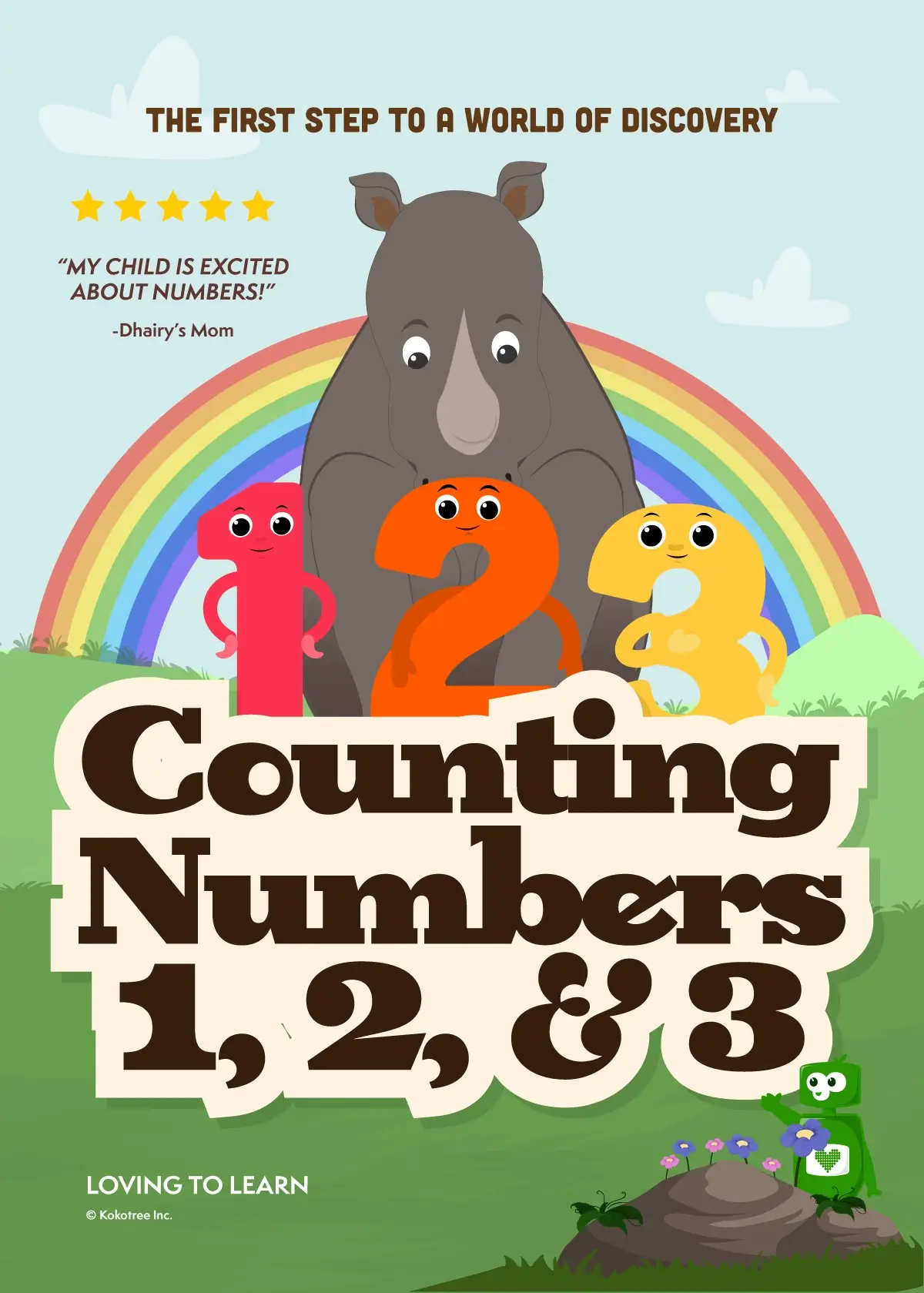
What's Counting Numbers 1, 2, 3 About?
Your little one joins a jungle adventure where friendly Number characters literally jump out of trees to teach counting! They'll follow along as birds gather in a nest, making numbers feel like real friends to meet and remember.
9.5 minutes
Ages 1-4
Skill: Counting objects 1 to 3
Your kid watches animated numbers sing and count jungle animals. You get 9 minutes to finish that cup of coffee.
Rocko Rhino leads his class through a colorful jungle where they discover a bird family growing one by one. Each time a new bird arrives, a bouncy Number character pops out to introduce themselves with catchy songs. The numbers have personalities—Number One is proud to start the count, Number Two loves bringing things together with a clap, and Number Three dances in singing about lucky threes.
What your child learns:
This video builds foundational number recognition and one-to-one correspondence—the understanding that each object gets counted exactly once. Children see numbers both as numerals on screen and as characters with distinct personalities, creating multiple memory pathways.
- Recognizes numerals 1, 2, and 3 by sight
- Counts objects sequentially with one-to-one correspondence
- Understands that adding one more increases the count
- Connects numbers to real objects (birds, berries, body parts)
- Follows counting in a logical sequence
They'll use these skills when:
- Counting snacks at the table ("You get three crackers!")
- Sharing toys with siblings or friends ("One for you, one for me")
- Playing with blocks or stacking cups
- Pointing out birds, cars, or dogs on a walk
The Story (what keeps them watching)
Rocko Rhino's jungle class gets surprise visitors—the Number characters themselves! First, Number One bounces in to explain he starts every count. Then a Baby Bird appears in a nest, and when Mama Bird arrives, Number Two jumps down to celebrate pairs. Papa Bird completes the family of three, bringing Number Three dancing out of the trees. The class helps Papa Bird collect exactly three berries for his family, putting their new counting skills to work. Catchy raps and songs make each number memorable and fun.
How We Teach It (the clever part)
First 3 minutes: Number One introduces himself as the starting point for all counting. Children see single objects highlighted—one bird, one tree, one sun—building the concept that "one" means a single item.
Minutes 3-6: When Mama Bird arrives, Number Two teaches about pairs. The video connects "two" to familiar body parts (two hands, two eyes) so children can look at themselves and practice.
Final 3 minutes: Number Three arrives with the Papa Bird, and children apply their learning by counting berries for the bird family. The counting becomes purposeful—three birds need three berries.
Teaching trick: Each number gets a personality and a song. Number One raps about being first, Number Two claps his hands together to show "bringing things together," and Number Three dances about lucky threes. This gives children emotional hooks to remember abstract concepts.
After Watching: Quick Wins to Reinforce Learning
Mealtime magic: "Can you give me three pieces of fruit?" Let your child count items onto their plate. They practice one-to-one correspondence with real objects they care about.
Car ride counting: "How many red cars can we count? One... two... three!" Point at each car as you count together. This builds the habit of touching or pointing while counting.
Bedtime routine: "Let's count your stuffed animals on the bed. One, two, three!" Use the same slow, deliberate counting style Rocko uses in the video.
Anytime clapping: "Number Two loves to clap! Can you clap two times? Now three times!" This connects counting to physical movement, reinforcing the numbers through their body.
When Kids Get Stuck. And How to Help.
"My child just says random numbers instead of counting." Totally normal! At this age, they're learning that number words go in a specific order. Count slowly with them, touching each object. The video models this perfectly—follow Rocko's lead.
"They can say the numbers but don't understand what they mean." This is the difference between rote counting and true understanding. Use the video's approach: connect numbers to real things. "You have TWO eyes, just like Number Two said!"
"Three seems too easy—shouldn't they learn higher numbers?" Mastering 1-3 builds the foundation for all future math. Children need to deeply understand small quantities before moving on. Celebrate their confidence with these numbers first!
What Your Child Will Learn
Prerequisites and Building Blocks
This video is ideal for children just beginning their number journey. No prior counting knowledge is required—it's designed as an introduction. Children benefit from basic attention skills and familiarity with following a story. This video serves as a foundation for future Kokotree counting videos that extend to higher numbers. It establishes the critical concept of one-to-one correspondence that underlies all counting and early arithmetic.
Cognitive Development and Teaching Methodology
The video leverages concrete-to-abstract learning by showing real objects (birds) alongside numeral representations. Anthropomorphizing numbers as characters uses young children's natural tendency toward animism, making abstract symbols feel friendly and memorable. The repetitive song structure supports auditory learners, while visual numeral displays help visual learners. Kinesthetic learning is encouraged through clapping along with Number Two.
Alignment with Educational Standards
This video addresses Common Core Math Standard K.CC.A.1 (count to 100 by ones—this is the foundation) and K.CC.B.4 (understand the relationship between numbers and quantities). It supports kindergarten readiness by building number recognition and cardinality—understanding that the last number counted represents the total. Teachers expect incoming kindergarteners to count to at least 10; this video builds the essential foundation.
Extended Learning Opportunities
Pair this video with counting worksheets featuring groups of 1-3 objects. Use the Kokotree app's counting games to practice interactive number recognition. Extend learning with a nature walk where children count birds, flowers, or rocks. Create a "counting jar" at home with small objects children can count and recount. Follow up with Kokotree videos covering numbers 4-6 once mastery is demonstrated.
Transcript Highlights
- Number One introduces counting: "I'm special because counting always begins with me! It's so easy to start counting once you know me."
- Rocko models counting: "One...two...three...birds. It's a family of three."
- Number Two explains pairs: "Being two is so much fun. I bring things together. Like my two hands!"
- Applied counting: "We need three berries for three birds. Children, let's count the berries with Maddy Monkey."
Character Development and Story Arc
Rocko Rhino models curiosity and enthusiasm, showing children that learning is exciting. The student characters demonstrate different learning styles—Gina Giraffe is observant and analytical, Maddy Monkey is eager to help hands-on, and Bobby Bear thinks carefully before answering. The Number characters model confidence and friendliness, reducing any anxiety children might have about math. When Ruby Rabbit doubts Number Three will appear, her surprise models openness to learning.
Mathematical Foundations: Early Number Sense Deep Dive
Counting 1-2-3 may seem simple, but it involves sophisticated cognitive processes that form the bedrock of all mathematical thinking. This video teaches three critical concepts simultaneously.
Stable Order Principle: Numbers must be said in the same sequence every time. The video reinforces this through repetition—"one, two, three" is counted multiple times in the same order, building automatic recall of the number sequence.
One-to-One Correspondence: Each object gets exactly one count. When Rocko points to each bird while counting, he demonstrates this principle. The on-screen numerals appearing above individual birds reinforce that each number "belongs" to one object.
Cardinality: The last number counted tells "how many." When Rocko says "three birds" after counting, he's teaching that three isn't just the last word—it represents the total quantity. The berry-gathering activity reinforces this: three birds need three berries, showing that "three" has real meaning.
Subitizing Foundation: The video also builds early subitizing skills—the ability to recognize small quantities without counting. By repeatedly showing groups of 1, 2, and 3, children begin to instantly recognize these quantities, a skill that accelerates future math learning.
The songs serve a mathematical purpose too: they connect numbers to body parts (two eyes, two hands) and familiar objects, building number sense through multiple representations. This multi-modal approach ensures the concept "sticks" regardless of a child's primary learning style.