
What's Triangle and Green About?
Your little one joins a fun farming adventure where they'll plant seeds, discover triangles hiding in everyday tools, and explore the wonderful world of green! After watching, they'll confidently identify triangles and green objects all around them.
9 minutes
Ages 2-5
Skill: Shape recognition and color identification
Your kid watches animal friends plant a garden and find triangles. You get 9 minutes to enjoy your coffee in peace.
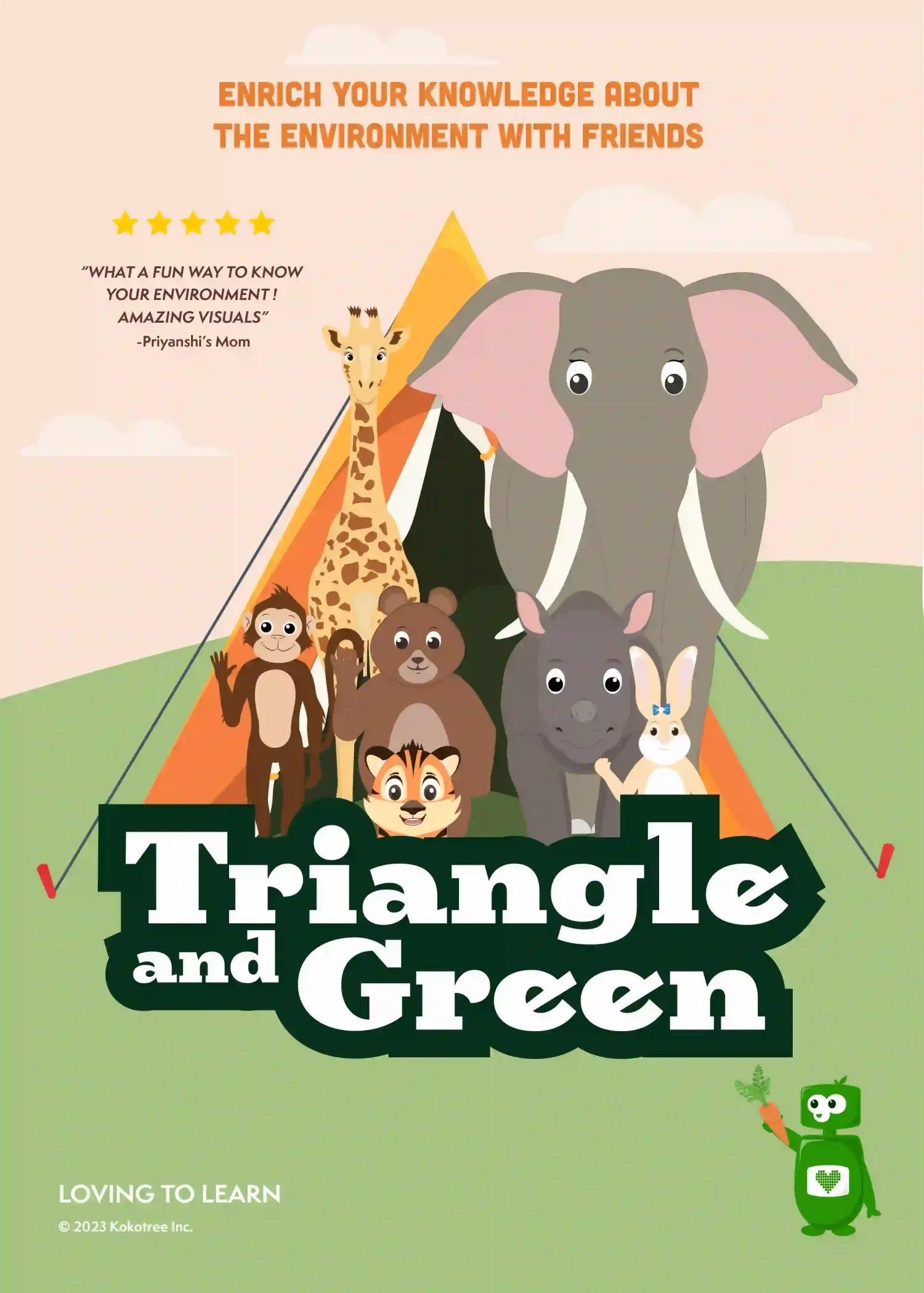
Ruby Rabbit is sad because her carrots aren't sweet anymore, so Elizabeth the Elephant takes the whole class on a gardening adventure! The kids plant seeds using rakes, shovels, and watering cans—and discover that all these tools have triangle shapes. Along the way, catchy songs teach the color green and what makes triangles special.
What your child learns:
This video builds foundational geometry skills by teaching that triangles have three sides—one "sleeping line" and two "slanting lines." Children also learn color recognition through real-world examples of green things in nature.
- Identifies triangles by counting three sides
- Recognizes green in vegetables, plants, and nature
- Understands how seeds grow into food
- Makes triangle shapes with their hands
- Connects shapes to real objects (pizza, rooftops, tools)
They'll use these skills when:
- Pointing out triangle-shaped foods at dinner (pizza slices, nachos, sandwich halves)
- Sorting toys by shape during playtime
- Noticing green vegetables at the grocery store
- Identifying rooftops, flags, and tents on car rides
The Story (what keeps them watching)
Ruby Rabbit is bummed—her beloved carrots just don't taste sweet anymore now that winter's over. But Elizabeth has the perfect solution: it's farming day! The whole class heads to Elizabeth's garden to plant seeds. There's just one problem—they need to clear a triangle-shaped plot first. As the friends grab rakes, shovels, and watering cans, they discover triangles are EVERYWHERE. Maddy Monkey even rolls around in the dirt (and gets sprayed with the watering can!). By the end, Ruby's excited to try new things, and everyone's a triangle-spotting expert.
How We Teach It (the clever part)
First 3 minutes: Elizabeth introduces the farming activity and shows how tiny seeds grow into green vegetables. A catchy song highlights green things in nature—frogs, lettuce, watermelons, and more.
Minutes 3-6: The class discovers the triangle-shaped garden plot. Maddy counts the three sides, and everyone makes triangles with their hands. Each gardening tool reveals another hidden triangle!
Final 3 minutes: A memorable song connects triangles to familiar objects (pizza, mountains, tents, flags). Children see triangles repeated in multiple contexts, cementing the concept.
Teaching trick: Elizabeth uses the phrase "one sleeping line and two slanting lines" to describe triangles—this concrete language helps little ones remember what makes a triangle unique, rather than just memorizing the name.
After Watching: Quick Wins to Reinforce Learning
Mealtime activity: "Can you find the triangle?" Cut sandwiches diagonally and ask your child to count the three sides. Bonus points for pointing out any green foods on their plate!
Car/travel activity: "Triangle hunt!" Challenge your child to spot triangles through the window—rooftops, road signs, flags. Keep a running count together.
Bedtime activity: "Make a hand triangle!" Practice the thumbs-together, fingertips-touching triangle from the video. Shine a flashlight behind it to make shadow triangles on the wall.
Anytime activity: "Green nature walk!" Step outside and count green things together—grass, leaves, bushes. Ask: "What else grows from tiny seeds?"
When Kids Get Stuck. And How to Help.
"My child keeps calling triangles 'pointy circles.'" Totally normal! Focus on counting sides together: "Let's count—one, two, three! Three sides means triangle." The hand-triangle activity really helps this click.
"She can find triangles in the video but not in real life." Real-world transfer takes practice. Start with obvious examples like pizza slices or coat hangers, then gradually point out trickier ones like rooftops.
"He mixes up green and blue." Very common at this age! Compare items side-by-side: "This leaf is green like the grass. This ball is blue like the sky." Repetition with real objects builds confidence.
What Your Child Will Learn
Prerequisites and Building Blocks
Children benefit most from this video if they can already identify basic colors (red, blue, yellow) and have exposure to simple shapes like circles and squares. "Triangle and Green" builds on foundational shape awareness by introducing a three-sided figure with specific attributes. This video fits perfectly after circle and square introductions, preparing children for more complex geometry concepts like rectangles and eventually pattern recognition.
Cognitive Development and Teaching Methodology
At ages 2-5, children learn best through concrete, hands-on examples—which is exactly why Elizabeth uses gardening tools as triangle models. The video employs multi-sensory learning: visual highlighting of shapes, auditory reinforcement through songs, and kinesthetic engagement when children make hand triangles. Repetition across different contexts (rake, shovel, watering can, pizza) builds neural pathways for lasting shape recognition.
Alignment with Educational Standards
This video addresses Common Core Kindergarten Geometry Standard K.G.A.2 (correctly naming shapes regardless of orientation or size) and K.G.B.4 (analyzing shapes by their attributes). Color recognition supports pre-K benchmarks for visual discrimination. Teachers expect incoming kindergarteners to identify basic shapes and colors—skills directly practiced here through engaging, age-appropriate content.
Extended Learning Opportunities
Pair this video with triangle tracing worksheets or shape sorting activities. The Kokotree app offers interactive games where children tap triangles among other shapes. Extend learning by creating a "shape garden" collage using cut paper triangles as trees and green tissue paper as grass. Cooking triangle-shaped foods (quesadilla quarters, watermelon slices) brings math into the kitchen.
Transcript Highlights
- "A triangle has one sleeping line and two slanting lines. One on each side." — Elizabeth's concrete description helps children remember triangle attributes.
- "First, put your thumbs together to form a sleeping line. Now, join the tips of your fingers—like this—to make a triangle." — Kinesthetic learning in action.
- "Green is the color of nature. And growing our own food from these seeds is an excellent way to learn about plants." — Connecting color to real-world context.
- "Try to find triangles at home, school, or wherever you are!" — Encouraging transfer of learning beyond the screen.
Character Development and Story Arc
Ruby Rabbit models openness to new experiences—transforming from sad about tasteless carrots to excited about trying tomatoes. This demonstrates growth mindset in action. Maddy Monkey shows that making mistakes (thinking cucumbers were bananas) is okay and even funny. Elizabeth consistently praises effort and observation, reinforcing that noticing details matters. The characters work together cooperatively, each contributing tools and ideas to the shared garden project.
Shape Recognition and Early Geometry: A Deep Dive
Triangle recognition is a foundational geometry skill that supports mathematical thinking far beyond preschool. When children learn to identify triangles, they're developing spatial reasoning—the ability to understand how objects relate to each other and occupy space. This skill predicts later success in math, science, and even reading.
What makes triangles special for young learners? They're the simplest polygon (three sides, three corners), making them an ideal stepping stone from circles to more complex shapes. The video brilliantly uses the "sleeping line and slanting lines" description because young children understand positional concepts before abstract geometry terms. A horizontal line "sleeps" flat; diagonal lines "slant" like a slide.
The repeated exposure to triangles in different orientations (the garden plot from above, tool shapes from the side, hand triangles at eye level) builds what educators call "orientation independence"—recognizing a shape regardless of how it's turned. Many children initially think a triangle pointing downward is "not a triangle" because they've only seen point-up versions. This video prevents that misconception by showing varied examples.
Color learning pairs naturally with shape recognition because both require visual discrimination—noticing how one thing differs from another. Green is strategically chosen here because it connects to the gardening theme and appears abundantly in nature, giving children countless real-world opportunities to practice. The song's examples (lettuce, frogs, cactus, watermelon, grass, grapes, peas, chilies, broccoli, leaves) create a rich mental category for "green things," strengthening color concept formation through diverse exemplars rather than single instances.