
What's Counting Numbers 1 to 10 About?
Your little one joins the Kokotree class on a playground counting adventure that brings numbers to life through storytelling and song! They'll master counting 1-10 and understand how numbers build on each other.
8 minutes
Ages 2-5
Skill: Counting and number recognition 1-10
Your kid watches friendly animals count flowers and meet number characters. You get 8 minutes to enjoy your coffee while it's still warm.
Bobby Bear and Ruby Rabbit discover flowers on a tree and practice counting them together. Then Mr. Rocko tells an imaginative story where number characters come to life on a playground—and the smallest numbers discover they can team up to become the biggest! The episode wraps up with a catchy song about the number ten and real-world examples kids can relate to.
What your child learns:
This video builds confident counters by combining visual counting practice with memorable storytelling. Children see numbers as friendly characters, making abstract concepts feel tangible and fun.
- Counting objects 1-10 in sequence
- Understanding number order (what comes after 3?)
- Recognizing that numbers can combine (1 + 0 = 10)
- Connecting numbers to real things (10 fingers, 10 toes)
- One-to-one correspondence when counting objects
They'll use these skills when:
- Counting snacks at the table ("How many crackers do you have?")
- Climbing stairs and counting each step out loud
- Playing hide-and-seek and counting to ten
- Sharing toys equally with friends at the playground
The Story (what keeps them watching)
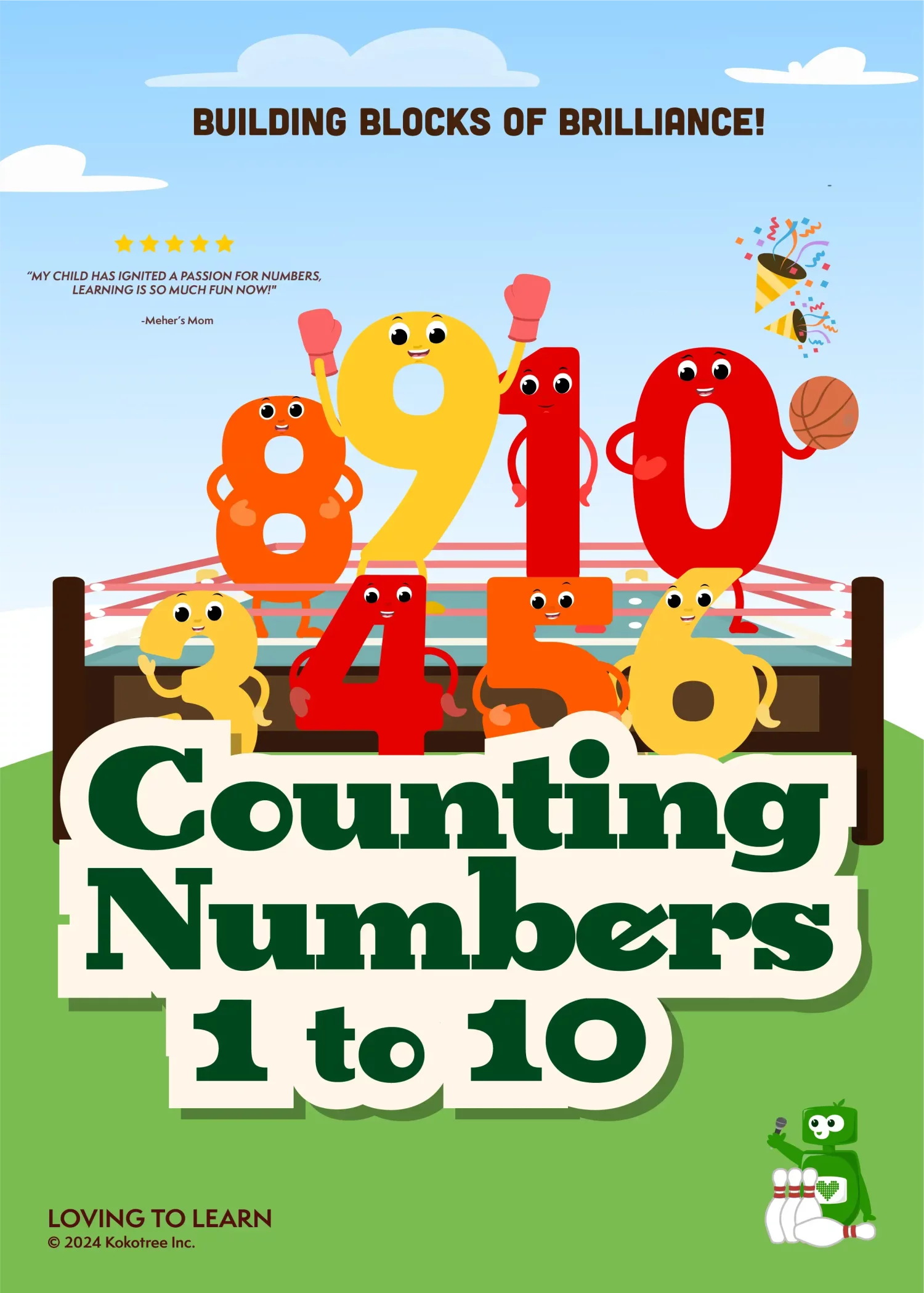
Bobby Bear and Ruby Rabbit are counting flowers when Mr. Rocko shares a magical story. In this tale, Numbers 1-9 live on a playground, but bigger numbers keep bossing around smaller ones. Sad little Number One wanders off and meets cheerful Number Zero, who's perfectly happy being small. Together, they stand side-by-side to become Number Ten—the new biggest number! But instead of being bossy, Ten teaches everyone that size doesn't matter and kindness does. Back in the real world, the class counts a blooming tree and celebrates with a catchy song about all the tens in our world.
How We Teach It (the clever part)
First 2 minutes: Bobby Bear and Ruby Rabbit model counting basics, asking "what comes next?" to build number sequence awareness. The class counts nine flowers together, with each flower highlighted as it's named.
Minutes 2-6: The story introduces numbers as characters, reinforcing order (1 is smallest, 9 is biggest) through playground interactions. Children see how 1 and 0 combine to make 10—a powerful visual of place value basics.
Final 2 minutes: Learning is reinforced through Maddy Monkey's finger-counting, Number Ten's memorable song ("Ten fingers on the hands, ten toes on feet to stand"), and a final group count of all ten flowers.
Teaching trick: Each flower on the tree gets highlighted individually as the class counts, teaching one-to-one correspondence—the understanding that each object gets exactly one number. This prevents the common mistake of counting too fast and skipping objects.
After Watching: Quick Wins to Reinforce Learning
Mealtime activity: "Can you count how many peas are on your spoon?" Start with small amounts (1-5) and work up. Point to each one together as you count—just like the flowers on the tree!
Car/travel activity: "Let's count to ten like Number Ten! Can you hold up your fingers as we go?" This connects the video's finger-counting scene to their own hands.
Bedtime activity: "How many stuffed animals are sleeping with you tonight? Let's count them and tuck each one in." Touch each toy as you count together.
Anytime activity: "Can you find something we have TEN of in this room?" Look for toes, fingers, crayons in a box, or blocks in a tower. Celebrate when they discover tens everywhere!
When Kids Get Stuck. And How to Help.
"My child keeps skipping numbers or saying them out of order." Totally normal! Counting sequence takes lots of repetition. Try singing the numbers slowly together, or watch the flower-counting scene again. The rhythm helps it stick.
"They can recite 1-10 but can't actually count objects correctly." This is super common—it's called one-to-one correspondence, and it develops separately from memorizing the sequence. Practice by physically touching each object as you count, just like the video highlights each flower.
"The story part seems advanced—will they understand the 1+0=10 concept?" They don't need to grasp place value yet! Right now, they're just seeing that Number One and Number Zero standing together makes something new. The visual plants a seed for later math concepts.
What Your Child Will Learn
Prerequisites and Building Blocks
This video is ideal for children who can recognize that quantities exist ("more" vs. "less") and have heard counting in everyday life. It builds on basic number exposure and prepares children for counting beyond 10, simple addition concepts, and understanding that numbers represent quantities. Within the Kokotree learning progression, this foundational counting video supports later videos on number recognition, basic addition, and comparing quantities.
Cognitive Development and Teaching Methodology
The video leverages narrative-based learning, which research shows significantly improves number retention in 2-5 year olds. By personifying numbers as characters with distinct personalities, abstract concepts become concrete and memorable. The multi-sensory approach—visual highlighting of objects, auditory counting practice, and the kinesthetic invitation to count fingers—addresses diverse learning styles and reinforces neural pathways for number sense development.
Alignment with Educational Standards
This video aligns with Common Core Math Standard K.CC.A.1 (count to 100 by ones) and K.CC.B.4 (understand relationship between numbers and quantities). It supports Head Start Early Learning Outcomes in Mathematics Development and kindergarten readiness benchmarks requiring children to count to 10 with one-to-one correspondence. Teachers expect incoming kindergarteners to count objects accurately to at least 10.
Extended Learning Opportunities
Pair this video with Kokotree's number tracing activities for numeral recognition practice. The counting games in the app reinforce one-to-one correspondence with interactive objects. Extend learning with nature walks where children count flowers, leaves, or rocks. Create a "counting jar" at home with 10 small objects children can dump out and count daily for hands-on practice.
Transcript Highlights
Teaching number sequence: "One flower. Then...what's after one?" "Two! Two flowers then...what's after two again?" "Three!" - This call-and-response models how children naturally learn counting order.
Guided group counting: "Let's count them together. One, two, three, four, five, six, seven, eight, nine." - The slow, deliberate pace with visual highlighting teaches proper counting technique.
Real-world connections: "Ten fingers on the hands, ten toes on feet to stand, ten counts in the boxing ring, there are also ten pins in bowling" - Number Ten's song connects abstract numbers to concrete, familiar objects.
Reinforcement through repetition: "Shall we count the flowers together. One, two, three, four, five, six, seven, eight, nine, and ten!" - The final counting sequence adds the newly learned "ten" to solidify the complete sequence.
Character Development and Story Arc
Number One models a growth mindset by walking away from conflict and seeking solutions rather than arguing. Number Zero demonstrates self-acceptance and contentment, showing children that value isn't determined by size. When One and Zero combine to become Ten, they choose kindness over dominance—modeling that capability comes with responsibility to treat others well. The Kokotree class characters (Bobby Bear, Ruby Rabbit, Maddy Monkey) demonstrate curiosity and collaborative learning throughout.
Mathematical Foundations: Building Number Sense in Early Learners
Counting 1-10 represents one of the most critical mathematical milestones in early childhood. This video addresses three distinct counting competencies that develop sequentially: verbal counting (reciting numbers in order), one-to-one correspondence (matching one number word to one object), and cardinality (understanding the last number represents the total quantity).
The flower-counting sequences specifically target one-to-one correspondence by highlighting each flower as it's counted—a visual scaffold that prevents the common error of counting faster than pointing. Research from the National Council of Teachers of Mathematics shows that children who master this skill by age 5 demonstrate stronger mathematical reasoning throughout elementary school.
The Number One and Number Zero story introduces an early, intuitive understanding of place value—the concept that a digit's position determines its value. While preschoolers aren't ready for formal place value instruction, seeing 1 and 0 stand "side-by-side" to create 10 plants a visual foundation. This aligns with Piaget's preoperational stage, where children learn through concrete, visual representations before abstract symbols.
Number Ten's song serves a crucial pedagogical purpose: connecting abstract numbers to quantities children can visualize and verify. "Ten fingers on the hands" is particularly powerful because children can immediately look at their own hands and confirm the count. This self-verification builds mathematical confidence and the understanding that numbers describe real, countable things in their world—the foundation of all future mathematical thinking.