
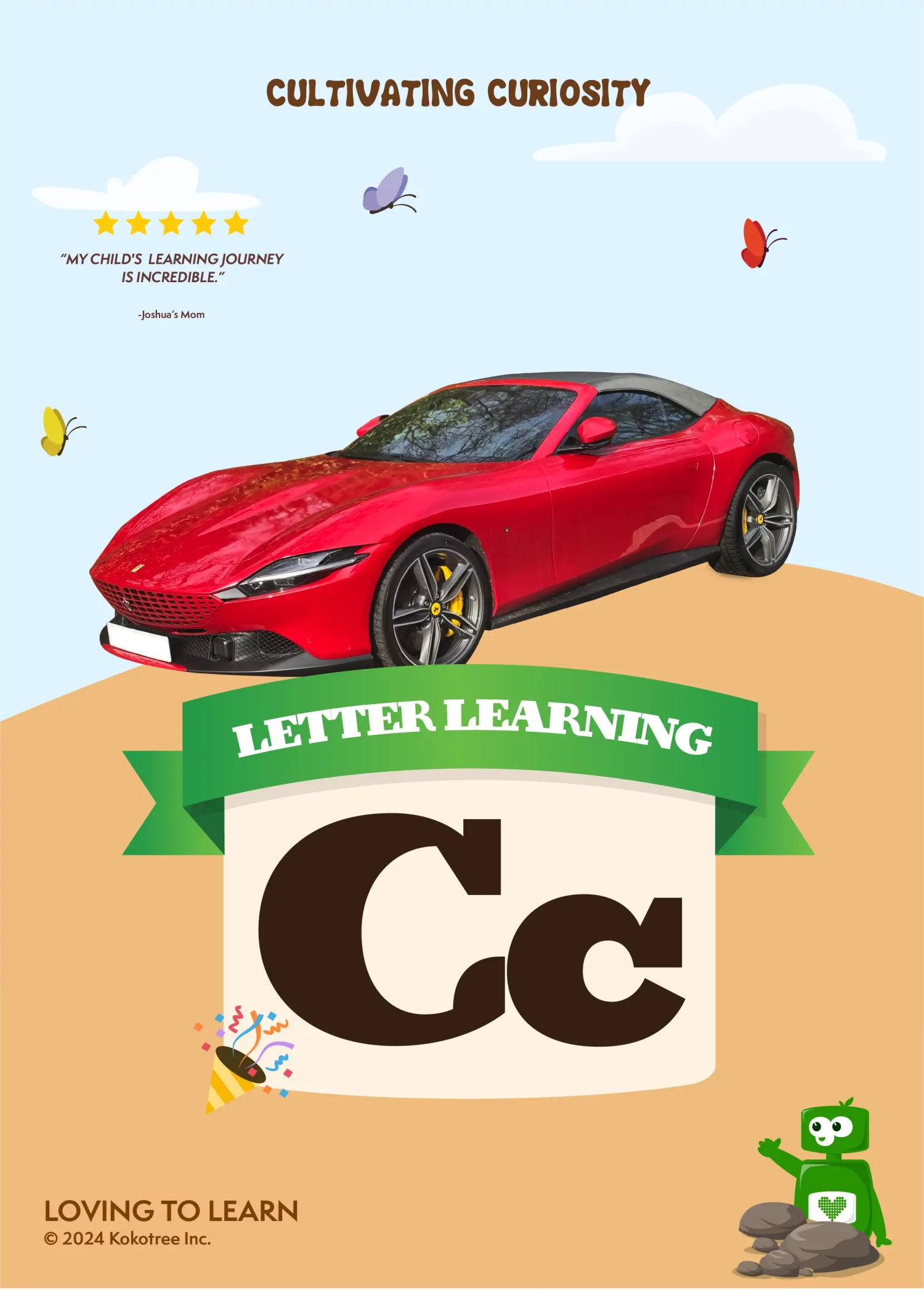
What's Letter C About?
Your little one joins Miss Meera's classroom to discover the letter C through an engaging story about Callie, a curious cat with adorable antics! They'll master the 'cuh' sound, spot C words everywhere, and learn to write the letter with confidence.
11 minutes
Ages 3-5
Skill: Letter recognition and phonics
Your kid watches Miss Meera teach the letter C through storytelling. You get 11 minutes to enjoy your coffee in peace.
Miss Meera reads an entertaining story about Callie the cat who loves cabbage, carrots, and causing cute chaos. The classroom friends like Bobby Bear, Maddy Monkey, and Ruby Rabbit join in practicing the 'cuh' sound together. Kids see the letter C written step-by-step on a chalkboard while spotting C-shaped things in the world around them.
What your child learns:
This video builds essential pre-reading skills by connecting the letter C to its sound through repetition and storytelling. Children practice phonemic awareness by identifying the 'cuh' sound at the beginning of words, then reinforce learning through letter formation.
- Recognizes the letter C in both uppercase and lowercase forms
- Identifies the 'cuh' sound at the beginning of words
- Connects the letter C to familiar objects (cat, car, cloud, comb)
- Practices proper letter formation with clear step-by-step guidance
- Builds vocabulary with 20+ C words introduced naturally through story
They'll use these skills when:
- Pointing out letters on cereal boxes and street signs during breakfast
- Recognizing their friend's name that starts with C at preschool
- Writing their first words and sounding out new vocabulary
- Playing alphabet games and completing letter worksheets
The Story (what keeps them watching)
Miss Meera gathers her animal friends for a special story about Callie, a curious cat who does everything her own way. When her master offers cookies, she wants corn. When he gives her corn, she wants cake! Callie plays with cabbage like a ball, uses carrots as darts, and colors with crayons corner to corner. Her master captures all her cute moments with his camera. After the story, the class discovers that all those fun words share the same 'cuh' sound—the sound of the letter C! They practice together, find more C words in a picture book, and even spot a real cat outside whose curved tail looks just like the letter they're learning.
How We Teach It (the clever part)
First 4 minutes: The story of Callie the cat immerses children in C words naturally—curious, cute, coat, cabinet, cookie, corn, coffee, and more—without explicitly teaching yet. Kids absorb the 'cuh' sound through repetition.
Minutes 4-8: Miss Meera reveals the pattern and leads call-and-response practice: "cuh...cuh...cat," "cuh...cuh...cold." Children hunt for more C words in a picture book, reinforcing sound-letter connection with car, comb, cloud, and curly.
Final 3 minutes: Step-by-step letter writing instruction for both uppercase C and lowercase c, with a memorable visual connection when a real cat's curved tail resembles the letter C!
Teaching trick: The story-first approach lets children hear the 'cuh' sound 30+ times before they even know they're learning. By the time Miss Meera asks "Did you notice the special sound?", kids feel like detectives discovering a pattern—not students being taught a lesson.
After Watching: Quick Wins to Reinforce Learning
Mealtime activity: "Can you find something on the table that starts with 'cuh'?" Point to cups, carrots, crackers, or cheese. Every correct answer builds confidence and reinforces the sound-letter connection.
Car/travel activity: "Let's spot things outside that start with C!" Look for cars, clouds, cats, and colors. This turns any drive into a phonics game without any prep.
Bedtime activity: "Draw a C in the air with your finger, then on my back!" Practice letter formation through touch—start below the top, curve around. Makes handwriting practice feel like a cozy game.
Anytime activity: "What's your favorite C word from Callie's story?" Recall cake, camera, coconut, or cotton candy together. Retelling the story reinforces vocabulary and comprehension.
When Kids Get Stuck. And How to Help.
"My child confuses C with other letters like O or G" - This is completely normal! Point out that C is like a circle that forgot to close. Practice tracing the letter while saying "curve around and stop" to build muscle memory with the movement.
"They can say the 'cuh' sound but can't identify C words on their own" - Sound recognition develops before word identification. Play "I Spy" with C words around your home—cup, couch, clock—and celebrate every correct guess to build confidence.
"Writing the letter C comes out wobbly or backwards" - Little hands are still developing fine motor control! Try writing C in sand, shaving cream, or with a finger in the air first. Large movements help the brain learn the shape before pencils get involved.
What Your Child Will Learn
Prerequisites and Building Blocks
Children benefit most from this video after exposure to letters A and B in the Budding Sprouts program, as Miss Meera references "last time" and the story-based learning approach. Basic listening skills and the ability to repeat sounds are helpful prerequisites. This video builds foundational phonemic awareness—the understanding that letters represent sounds—which is essential for decoding words during reading instruction. The progression from hearing sounds in context to isolated practice to letter formation follows research-backed literacy development sequences.
Cognitive Development and Teaching Methodology
The embedded learning approach—hiding instruction inside an engaging story—aligns with how preschool brains naturally acquire language. Children aged 3-5 learn best through narrative and repetition rather than direct instruction. The video addresses multiple learning styles: visual learners see the letter formed and C-words illustrated, auditory learners hear the 'cuh' sound repeated 30+ times, and kinesthetic learners are invited to practice writing along. The call-and-response format activates participation, which research shows improves retention by 40% compared to passive viewing.
Alignment with Educational Standards
This video addresses Common Core Foundational Skills RF.K.1d (recognize and name uppercase and lowercase letters) and RF.K.3a (demonstrate basic knowledge of letter-sound correspondences). It supports Head Start Early Learning Outcomes in Literacy Knowledge & Skills, specifically LIT-GOAL 4: "Child demonstrates an understanding of the alphabetic principle." Kindergarten readiness benchmarks expect children to recognize most letters and their sounds—this video builds that foundation through the specific focus on hard C pronunciation.
Extended Learning Opportunities
Pair this video with Kokotree's Letter C tracing worksheets for fine motor practice. The "C Word Hunt" printable encourages children to circle objects starting with C. Follow up with the Letter D video as Miss Meera previews, maintaining alphabetic sequence. Extend learning with the Kokotree phonics games featuring sound-matching activities. Parents can create a "C Collection" box at home where children gather small objects (toy car, cotton ball, coin) to reinforce the letter-object connection beyond screen time.
Transcript Highlights
"There is a common sound in the words: Callie, curious, cat, cotton, candy, crayons, cabinet, coconut, carrot." - Miss Meera guides discovery rather than telling.
"Repeat after me: cuh..cuh..cat." - The triple repetition pattern (sound, sound, word) builds phonemic segmentation skills.
"To write the uppercase C, we start below the top headline and circle back around, ending with the baseline." - Clear, sequential instruction for letter formation.
"His tail looks like a letter C too!" - Bobby Bear's observation demonstrates finding letters in the real world, modeling environmental print awareness.
Character Development and Story Arc
Miss Meera models patient, encouraging teaching—she never corrects harshly and celebrates every attempt with "Wonderful!" and "Great job!" The classroom friends demonstrate collaborative learning: Bobby Bear makes the key phonics discovery ("Cuh?"), Eddie Elephant asks for extra practice without embarrassment, and Maddy Monkey connects learning to personal experience. Callie the cat within the story models curiosity and playfulness, showing that being different and exploring are positive traits. The real cat's appearance creates a delightful moment where learning connects to the unexpected world outside.
Phonics and Early Literacy Deep Dive
The letter C presents a unique teaching opportunity in English phonics because it represents multiple sounds—the hard 'cuh' as in cat and the soft 's' as in city. This video wisely focuses exclusively on the hard C sound, which is developmentally appropriate for preschoolers. Introducing one sound-letter correspondence at a time prevents cognitive overload and builds a solid foundation before addressing phonetic exceptions.
The story-based approach leverages what literacy researchers call "phonemic flooding"—surrounding children with target sounds in meaningful context. Callie's tale contains over 30 hard C words, allowing children to internalize the sound pattern before conscious instruction begins. This mirrors natural language acquisition, where babies hear thousands of examples before producing sounds themselves.
The video's progression from receptive learning (listening to the story) to productive learning (repeating sounds) to written representation (forming the letter) follows the research-supported sequence for literacy instruction. Children must hear and distinguish sounds before they can connect them to symbols.
Letter formation instruction emphasizes the continuous curved stroke of C, which builds fine motor patterns needed for related letters (O, G, Q, S). The "Mother C" and "Baby C" terminology makes uppercase and lowercase memorable and relatable for young learners while avoiding abstract grammatical terms.
The environmental print moment—spotting the cat's C-shaped tail—teaches a crucial pre-reading skill: recognizing that letters exist everywhere in the world, not just in books. This awareness predicts later reading success and encourages children to become active observers of print in their daily lives.