
What's Counting Numbers 4, 5, & 6 About?
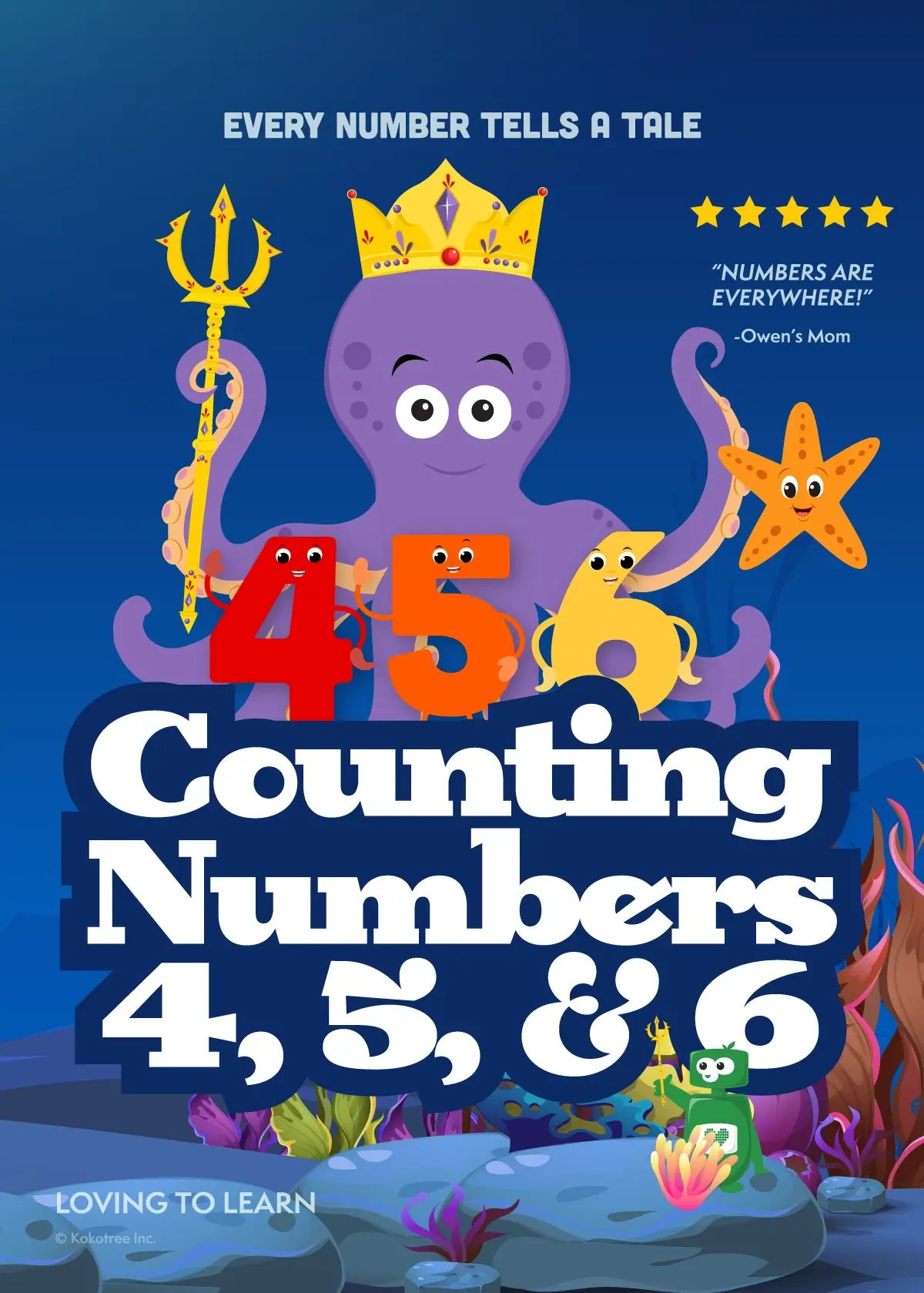
Your child joins friendly animal friends and a magical starfish named Leela on an underwater counting adventure! They'll master numbers 4, 5, and 6 through catchy songs and an enchanting story about a starfish who grows new limbs.
11 minutes
Ages 3-5
Skill: Counting and number recognition (4, 5, 6)
Your kid watches a starfish grow magical limbs while learning numbers. You get 11 minutes to finish that coffee.
Tiki Tiger, Ruby Rabbit, and their animal friends gather on a soccer field where Mr. Rocko tells them an enchanting story about Leela, a special starfish. Leela starts with four limbs, receives a magical fifth limb (a brain!) from the Sea King, and eventually earns a sixth limb—a magic wand—for being kind and thoughtful. Each time Leela gains a limb, kids count along with catchy songs.
What your child learns:
This video builds on counting 1-3 to introduce the next set of numbers. Children practice counting sequences, connect numbers to real objects, and discover that numbers appear everywhere in their world.
- Counting from 1 to 6 with confidence
- Recognizing what quantities of 4, 5, and 6 look like
- Connecting numbers to everyday objects (table legs, fingers, guitar strings)
- Understanding that numbers follow a predictable sequence
- Spotting number patterns in nature (starfish limbs, ant legs)
They'll use these skills when:
- Counting out four crackers for snack time
- Holding up five fingers to show their age
- Setting the table with six plates for dinner
- Counting friends at the playground
The Story (what keeps them watching)
Mr. Rocko gathers the Kokotree gang after their soccer ball pops (oops, Ronnie Rhino!) and tells them about Leela, a starfish born with just four limbs instead of five. But Leela doesn't mind—she's happy! The Sea King notices her cheerful spirit and gifts her a fifth limb containing a brain. When Leela uses her new thinking power to light up the dark ocean for other sea creatures, the King rewards her with a sixth limb—a magic wand! Each new limb means a new counting song, and kids count along as Leela transforms.
How We Teach It (the clever part)
- First 3 minutes: Reviews counting 1, 2, 3 with familiar examples (one nose, two eyes, three birds) before introducing the new challenge
- Minutes 3-9: Introduces 4, 5, and 6 progressively through Leela's story, with a dedicated song and counting activity for each number
- Final 2 minutes: Reinforces all three numbers with fun starfish facts and a final song connecting 6 to everyday objects like dice, cubes, and guitar strings
Teaching trick: Each number gets its own memorable song listing real-world examples—"four seasons," "five fingers make a fist," "six strings of the guitar"—so kids have mental hooks to remember what each quantity looks like.
After Watching: Quick Wins to Reinforce Learning
- Mealtime activity: "Can you count out five pieces of cereal?" (Practices one-to-one correspondence and the number 5)
- Car/travel activity: "Let's find things with four—look for cars with four wheels or animals with four legs!" (Reinforces quantity recognition in the real world)
- Bedtime activity: "Let's count your stuffed animals. Do you have four, five, or six?" (Practices counting familiar objects)
- Anytime activity: "Show me six fingers! Now show me four!" (Builds number-quantity connection using their own hands)
When Kids Get Stuck. And How to Help.
"My child keeps skipping numbers when counting to 6" - This is completely normal! The sequence takes practice. Try slowing down and tapping each object as you count together. Physical touch helps lock in the pattern.
"They can say the numbers but don't understand what '5' actually means" - Reciting numbers and understanding quantity are different skills that develop separately. Use the "give me" game: "Give me 4 blocks" helps connect the word to the amount.
"Six seems too hard—should we just focus on smaller numbers?" - If 6 feels like a stretch, that's okay! Mastering 4 and 5 first is great progress. Come back to 6 when those feel solid—Leela will wait!
What Your Child Will Learn
Prerequisites and Building Blocks
Children watching this video should already recognize numbers 1, 2, and 3 and understand basic one-to-one correspondence (touching one object while saying one number). This episode builds directly on earlier Kokotree counting content, extending the number sequence while reinforcing the foundational counting they've already learned. The video's structure—reviewing 1-3 before introducing 4-6—ensures children with emerging counting skills can follow along while more advanced counters are appropriately challenged.
Cognitive Development and Teaching Methodology
This video leverages narrative transportation—children become emotionally invested in Leela's story, which makes the counting practice feel purposeful rather than rote. The progressive structure (4, then 5, then 6) respects working memory limitations in preschoolers. Musical encoding through catchy songs activates auditory learning pathways, while visual labeling of Leela's limbs supports visual learners. Kinesthetic learners benefit from the invitation to count along aloud.
Alignment with Educational Standards
This content aligns with Common Core Math Standard K.CC.A.1 (count to 100 by ones) and K.CC.B.4 (understand the relationship between numbers and quantities). It supports Head Start Early Learning Outcomes in Mathematics, specifically "Child knows number names and the count sequence." Kindergarten readiness assessments typically expect children to count to 10 with one-to-one correspondence—this video builds the 4-6 portion of that essential skill.
Extended Learning Opportunities
Pair this video with Kokotree's counting games that focus on quantities 4-6. Print simple worksheets where children circle groups of 4, 5, or 6 objects. Create a "number hunt" around your home—find things that come in fours (chair legs), fives (fingers), and sixes (egg carton half). The starfish theme extends beautifully to ocean-themed counting activities or playdough starfish with varying numbers of arms.
Transcript Highlights
- Building on prior knowledge: "We are now ready to go beyond one, two, and three. Do you think you are ready for that?"
- Interactive counting: "Shall we all count Leela's limbs together? One, two, three, four. Four limbs of Leela!"
- Real-world connections in song: "Five fingers make a fist, five elements in the nature, five senses are the major"
- Number spotting: "It is so easy to find numbers, just about everywhere. Isn't it?"
Character Development and Story Arc
Leela models a growth mindset beautifully—she's content with four limbs, doesn't compare herself negatively to five-limbed starfish, and earns new abilities through kindness rather than competition. Mr. Rocko demonstrates patient teaching, building on what children already know before introducing new concepts. The Kokotree kids model curiosity by asking follow-up questions ("What else?"), showing children that wanting to learn more is natural and welcomed.
Mathematical Foundations: Understanding Quantity and Cardinality
This video addresses a critical mathematical milestone: cardinality—understanding that the last number counted represents the total quantity. When children count Leela's limbs and declare "Four limbs of Leela!" they're practicing this essential concept.
The numbers 4, 5, and 6 present unique cognitive challenges. Four is the largest quantity humans can "subitize" (instantly recognize without counting), making it a bridge number. Five connects to the powerful "anchor" of one hand's fingers—a built-in manipulative every child carries. Six requires true counting for most children and represents their first venture into quantities that feel "big."
The video's use of consistent objects (Leela's limbs) for counting practice supports the abstraction principle—understanding that we can count anything. Meanwhile, the songs listing diverse examples (table legs, dice faces, guitar strings) build flexible thinking about where numbers appear.
The progressive structure—four limbs, then five, then six—respects the hierarchical nature of number learning. Each number builds on the previous, and the repeated counting sequences ("One, two, three, four, five, and six!") reinforce the stable order principle: numbers always come in the same sequence.
For preschoolers, connecting abstract numbers to concrete, countable objects is essential. Leela's limbs provide perfect visual anchors—distinct, countable, and memorable. The emotional investment in Leela's story means children genuinely care about how many limbs she has, transforming counting practice from drill into discovery.