
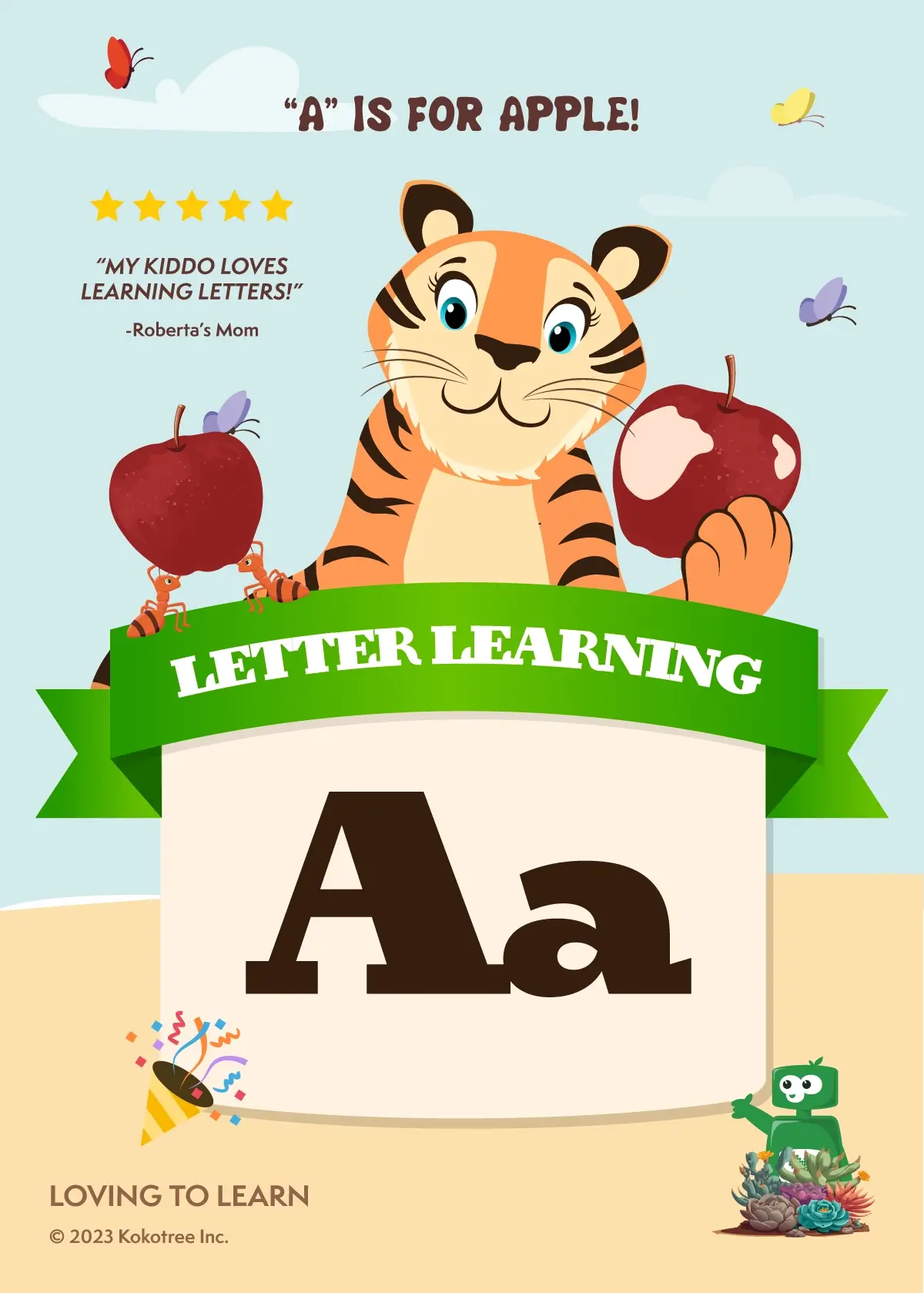
What's Letter A About?
Your little one joins Miss Meera and adorable animal friends to unlock the secrets of the very first letter of the alphabet! They'll discover that letter A has two special sounds, spot A-words hiding in nature, and practice writing both uppercase and lowercase A.
15 minutes
Ages 3-6
Skill: Letter recognition and phonics
Your kid watches friendly animals discover letter sounds in nature. You get 15 minutes to enjoy your coffee in peace.
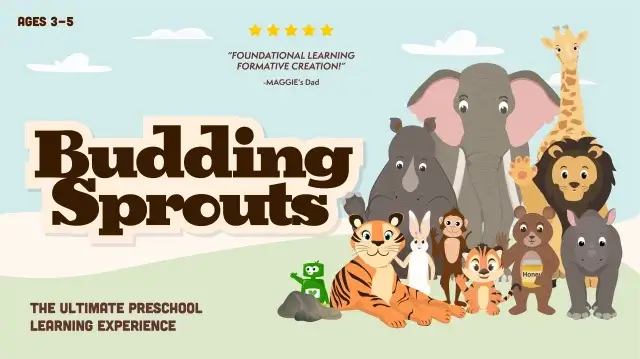
Miss Meera gathers Tiki Tiger, Ruby Rabbit, Maddy Monkey, Bobby Bear, Gina Giraffe, and Ronnie Rhino around an apple tree where busy ants are marching. Through a magical story about the Angel of Sound, children learn why the letter A has two sounds—and then go on a word hunt to find them everywhere!
What your child learns:
This video builds essential pre-reading skills by teaching both the long and short sounds of letter A through storytelling and interactive practice. Children also develop fine motor skills by tracing letters in the air and on paper.
- Recognizes uppercase A and lowercase a by sight
- Distinguishes between long "ay" sound (ape, angel, aim) and short "a" sound (apple, ant, arrow)
- Connects letter sounds to real objects and words
- Traces and writes both uppercase and lowercase A
- Builds phonemic awareness foundation for reading
They'll use these skills when:
- Pointing out the letter A on cereal boxes at breakfast
- Sounding out words in their favorite picture books
- Writing their name if it contains the letter A
- Playing alphabet games with friends or siblings
The Story (what keeps them watching)
The animal class discovers ants marching on a fallen apple and wonders how they communicate. Miss Meera shares a magical tale about the Angel of Sound who gave every creature its voice—and gave humans the sounds of letters! The class learns that letter A is extra special because it got TWO sounds. They march like ants making the short "a" sound, watch a clever ape eating acorns to learn the long "ay" sound, and practice writing A in the air and on paper. By the end, everyone's spotting A-words everywhere!
How We Teach It (the clever part)
- First 5 minutes: A captivating origin story about the Angel of Sound hooks children's attention and introduces WHY letters have sounds—making the concept meaningful, not arbitrary.
- Minutes 5-10: Interactive word hunts where children identify short "a" words (apple, ant, axe, arrow, action) and long "ay" words (ape, acorn, aim, ate, angel) with visual text reinforcement.
- Final 5 minutes: Step-by-step letter formation practice for both uppercase and lowercase A, with clear verbal instructions children can follow along with.
Teaching trick: The video uses physical movement to cement sounds—children march like ants saying "ae, ae, ae" and raise their arms joyfully saying "ay!" This kinesthetic connection helps sounds stick in memory.
After Watching: Quick Wins to Reinforce Learning
Mealtime activity: "Can you find the letter A on your cereal box?" Point to any A you see and ask if it makes the "ay" or "a" sound. Bonus points for A-foods like apples or avocado!
Car/travel activity: "Let's play A-spy! I spy something that starts with 'a' like apple." Take turns finding things outside that start with the short or long A sound.
Bedtime activity: "Let's draw a giant A in the air together—slant left, slant right, line in the middle!" Practice the motions Miss Meera taught while winding down.
Anytime activity: "Can you walk like the ants and say 'a-a-a-a'?" March around the room together making short A sounds, then stretch up tall saying "Ay!" for the long sound.
When Kids Get Stuck. And How to Help.
"My child mixes up the two A sounds." - Totally normal! The short sound is much more common, so practice that one first. Use the ant march ("a-a-a-apple") as a fun reminder whenever they need help.
"They can say the sounds but can't write the letter yet." - Writing comes after recognition—it's a separate skill! Keep practicing in the air or with finger paint. The muscle memory will come with time and zero pressure.
"My child loses interest before the writing practice." - Break it up! Watch the story portion one day, then come back to the writing section another time. Short, repeated sessions beat one long struggle every time.
What Your Child Will Learn
Prerequisites and Building Blocks
This foundational video requires no prior letter knowledge—it's designed as a perfect starting point for alphabet learning. Children should be able to listen to a short story and follow simple movement instructions. This video establishes the framework for all subsequent letter videos in the Budding Sprouts program, introducing the concept that letters have both names AND sounds. The dual-sound approach (long and short vowels) prepares children for phonics-based reading instruction.
Cognitive Development and Teaching Methodology
The 15-minute format respects preschoolers' attention spans while providing adequate repetition for retention. The narrative framework (Angel of Sound story) leverages children's natural love of stories to make abstract phonics concepts concrete and memorable. Multi-sensory learning is embedded throughout: visual (seeing letters and objects), auditory (hearing sounds repeated), and kinesthetic (marching like ants, drawing letters in air). This tri-modal approach ensures all learning styles are engaged.
Alignment with Educational Standards
This video addresses Common Core Foundational Skills RF.K.1 (print concepts) and RF.K.3 (phonics and word recognition). It supports kindergarten readiness indicators for letter-sound correspondence and phonemic awareness. The explicit instruction in letter formation aligns with handwriting standards expected in pre-K and kindergarten classrooms. Teachers expect incoming kindergarteners to recognize most letters; this video builds that essential foundation.
Extended Learning Opportunities
Pair this video with Kokotree's Letter A tracing worksheets for fine motor practice. The app's "Letter Hunt" game reinforces recognition skills learned here. Parents can extend learning with alphabet books focusing on A, or create an "A Collection" box where children gather small objects starting with A. Revisit this video before introducing Letter B to reinforce the concept that each letter has its own special sound.
Transcript Highlights
- "Letter A got two sounds from the Angel... a long sound and a short sound." — Introduces the key concept clearly
- "You will hear the short sound 'ae' if you listen to the steps of those marching ants on the apple." — Connects sound to memorable image
- "A slant to the left and a slant to the right. And one sleeping line to bridge them together!" — Simple, child-friendly letter formation instructions
- "Observe and identify objects that begin with 'aye' and 'ae' sound and share it with us!" — Encourages real-world application
Character Development and Story Arc
Miss Meera models excellent teaching behaviors—she validates Bobby Bear's observation about the ants, uses questions to spark curiosity, and celebrates every attempt. The animal students demonstrate learning behaviors parents want to see: Ruby Rabbit asks clarifying questions, Maddy Monkey shows enthusiasm through action, and the whole class practices together without judgment. This collaborative, supportive learning environment shows children that asking questions and trying new things is celebrated.
Phonics and Early Literacy Deep Dive
The letter A holds a unique position in early literacy instruction as both the first letter of the alphabet and one of the most complex vowels for young learners to master. This video wisely introduces both the long vowel sound (/eɪ/ as in "ape") and the short vowel sound (/æ/ as in "apple") from the start, rather than teaching them separately.
Research in phonemic awareness shows that children who understand letters represent sounds—not just symbols—become stronger readers. The Angel of Sound narrative brilliantly conveys this abstract concept in child-friendly terms. By personifying the origin of letter sounds, children grasp that letters are meaningful tools for communication, not arbitrary shapes to memorize.
The video's word selection is intentional: short A words (apple, ant, axe, arrow, action) use consistent, clear pronunciations, while long A words (ape, acorn, aim, ate, angel) demonstrate the "a says its name" pattern. This curated vocabulary avoids confusing exceptions and builds confidence.
The kinesthetic components—marching for short A, arms raised for long A—create "body anchors" that help children retrieve sounds from memory. This technique, supported by embodied cognition research, means children literally feel the difference between sounds. The letter formation instruction follows developmental handwriting principles: uppercase before lowercase, verbal cues during motor practice, and air-writing before paper. These scaffolded steps build the neural pathways needed for fluent handwriting later.