
What's Day & Night About?
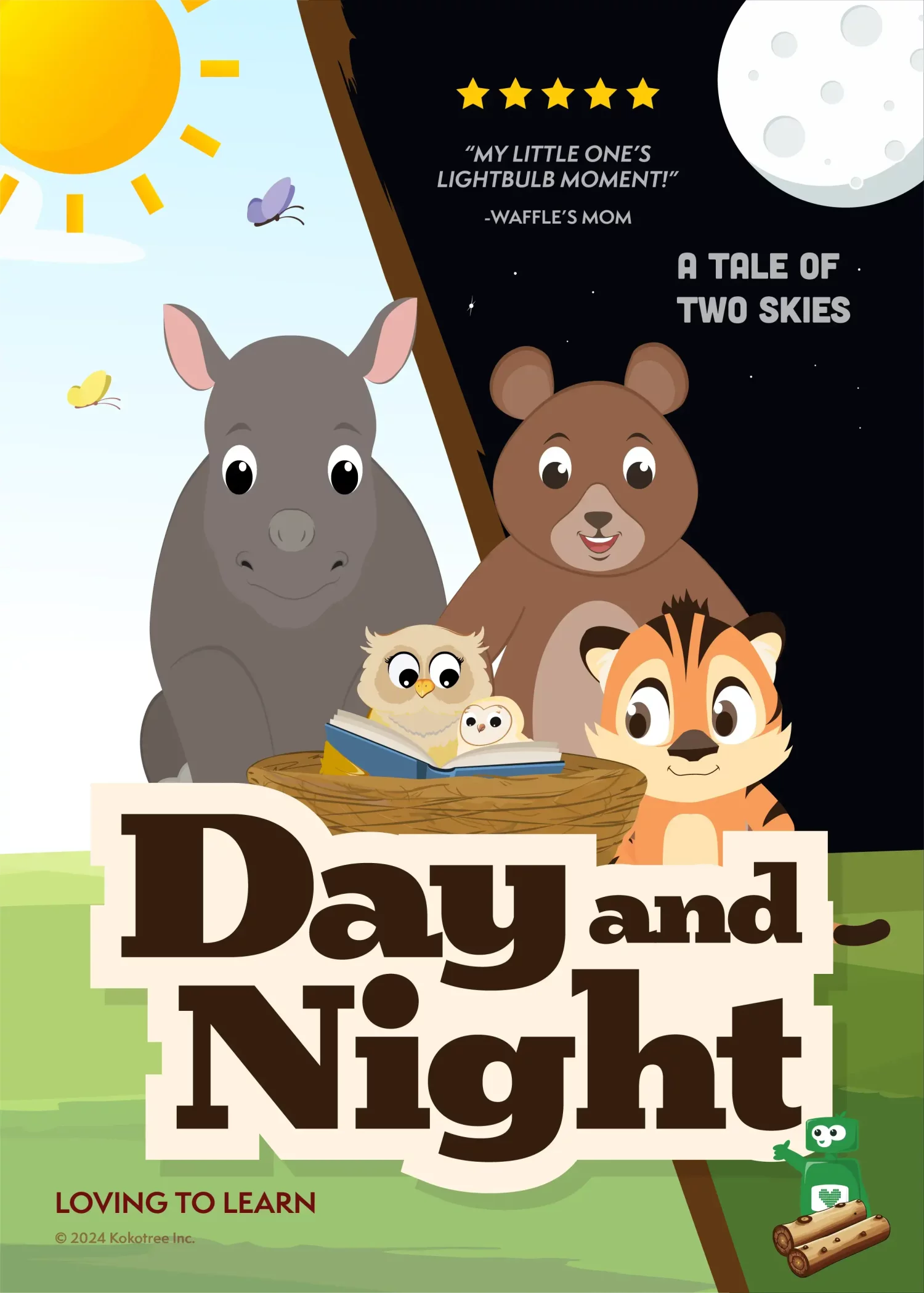
Your little one joins Miss Elizabeth and adorable animal friends to explore what makes daytime different from nighttime—and why sleep matters! They'll spot the signs of day and night in nature and learn the importance of healthy routines.
11 minutes
Ages 3-6
Skill: Understanding the day/night cycle and daily routines
Your kid watches animal friends discover nature's daily rhythms. You get 11 minutes to enjoy your coffee in peace.
The video opens with the Kokotree friends playing hide-and-seek in the jungle, but sleepy Eddie Elephant can barely keep his eyes open! Miss Elizabeth gathers everyone for a lesson about day and night, showing beautiful scenes of birds waking at dawn, butterflies and bees during the day, and fireflies lighting up the night sky.
What your child learns:
Through songs, stories, and stunning nature visuals, children discover how to identify whether it's day or night by observing the world around them. They also learn why consistent sleep routines help them feel their best.
- Identifies daytime indicators (sun, birds chirping, busy streets)
- Recognizes nighttime signs (moon, stars, quiet streets, fireflies)
- Understands how animals behave differently during day vs. night
- Learns the value of consistent bedtime routines
- Connects sleep to feeling healthy and energized
They'll use these skills when:
- Noticing birds singing in the morning and asking "Is that how we know it's daytime?"
- Spotting the moon through the car window and saying "Look, it's nighttime now!"
- Following their bedtime routine without resistance because they understand why rest matters
- Observing butterflies at the park and remembering "They sleep at night like me!"
The Story (what keeps them watching)
Poor Eddie Elephant is SO sleepy during hide-and-seek that Tiki Tiger finds him instantly—he fell asleep right in front of the counting tree! Turns out Eddie stayed up all night trying to count the stars (spoiler: there are too many!). Miss Elizabeth uses this as the perfect teachable moment, guiding the whole class through the wonders of day and night. They discover which animals are awake when, sing cheerful morning and bedtime songs, and learn why "early to bed, early to rise" isn't just a saying—it's the secret to feeling great!
How We Teach It (the clever part)
- First 3 minutes: The hide-and-seek game hooks kids immediately, then Eddie's sleepiness creates curiosity about WHY rest matters
- Minutes 3-8: Miss Elizabeth guides exploration of day vs. night through vivid nature examples—birds, butterflies, bees, fireflies, rainbows, and quiet streets
- Final 3 minutes: Two catchy songs reinforce morning greetings and bedtime calm, plus discussion of healthy nighttime routines
Teaching trick: The video uses contrast pairs (busy streets → quiet streets, butterflies awake → butterflies sleeping) so kids SEE the difference rather than just hear about it. This visual comparison makes abstract concepts concrete.
After Watching: Quick Wins to Reinforce Learning
- Mealtime activity: "What sounds do you hear right now? Are they daytime sounds or nighttime sounds?" (Practices using environmental clues to identify time of day)
- Car/travel activity: "Let's count how many daytime things we can spot—birds flying, people walking, the sun!" (Reinforces daytime indicators through observation)
- Bedtime activity: "What's YOUR nighttime routine? Let's name each step together." (Connects video lesson to personal habits and builds routine awareness)
- Anytime activity: "If you were a firefly, when would you wake up? What about a butterfly?" (Reinforces that different creatures have different schedules)
When Kids Get Stuck. And How to Help.
- "My child doesn't want to go to bed even after watching this" - Totally normal! Use the video's language: "Remember how tired Eddie was? Your body needs rest to play tomorrow." Consistency matters more than perfection.
- "She's confused about why it's dark in the morning sometimes" - Great observation! Explain that days are shorter in some seasons, but the pattern stays the same: sun = day, moon/stars = night.
- "He keeps asking why we can't see stars during the day" - This shows scientific curiosity! Simply explain the sun is SO bright it hides the stars, but they're always there waiting for nighttime.
What Your Child Will Learn
Prerequisites and Building Blocks
Children benefit most from this video if they can already identify the sun and moon as objects in the sky. This lesson builds on basic nature awareness and prepares children for deeper exploration of Earth science concepts like seasons and weather patterns. It connects beautifully to routines-focused content and animal behavior videos in the Kokotree library, creating a foundation for understanding natural cycles and cause-effect relationships in the world around them.
Cognitive Development and Teaching Methodology
This video leverages the concrete operational thinking emerging in preschoolers by using observable, tangible examples (birds flying, streets being busy or quiet) rather than abstract explanations. The contrast-based teaching—showing day THEN night versions of the same scene—supports comparative reasoning skills developing at this age. Songs engage auditory learners while the rich visuals support visual processors, and the invitation to recall personal routines activates kinesthetic memory.
Alignment with Educational Standards
This content aligns with NGSS K-ESS1-1 (patterns of day and night) and supports kindergarten readiness indicators for science observation skills. The routine discussion addresses self-regulation standards found in most early learning frameworks. Teachers expect entering kindergarteners to describe basic differences between day and night and understand that patterns repeat—both skills directly taught here. The vocabulary introduced (daytime, nighttime, routine, rhythm) builds academic language foundations.
Extended Learning Opportunities
Pair this video with a simple day/night sorting activity using picture cards of activities (eating breakfast vs. sleeping, playing outside vs. looking at stars). The Kokotree app's related animal videos extend learning about creature behaviors. Create a visual bedtime routine chart together, letting your child draw or place stickers for each step. Nature walks at different times offer real-world observation practice—morning bird sounds versus evening cricket chirps make the lesson tangible.
Transcript Highlights
- "We know it's the daytime when we can see the Sun and feel its light and heat."
- "When we can see the Moon or the stars in the sky—and don't feel the heat and the light of the Sun—we know it's nighttime."
- "The butterflies and bees are out during the day sipping nectar and buzzing around. But when nighttime comes, they go to sleep. And that's when the fireflies come out to light up the night!"
- "We need a rhythm for the night, preferably around the same time before we go to bed. And the rule is to be consistent."
Character Development and Story Arc
Eddie Elephant perfectly models what happens when we don't follow healthy routines—he's so tired he can't even play hide-and-seek! Rather than being scolded, Eddie receives gentle guidance from Miss Elizabeth, demonstrating that mistakes are learning opportunities. The other characters show curiosity by asking thoughtful questions ("What about holidays?") and making connections (Ruby's realization about delayed activities). This models active learning and shows children that wondering aloud is valuable.
Understanding Earth's Day-Night Cycle: A Science Deep Dive
The day-night cycle is one of the first large-scale natural patterns children can observe and predict, making it a cornerstone of early earth science education. This video introduces the concept through observable phenomena rather than planetary mechanics—appropriate for the preoperational and early concrete operational stages (ages 2-7) identified by developmental psychologists.
At this age, children learn best through direct sensory experience. The video capitalizes on this by connecting day and night to things children can SEE (sun vs. moon, bright vs. dark sky), HEAR (birds chirping vs. crickets), and FEEL (warmth vs. coolness). This multi-sensory approach creates stronger neural pathways than verbal explanation alone.
The inclusion of animal behavior patterns (diurnal butterflies vs. nocturnal fireflies) introduces basic ecology concepts while remaining concrete and observable. Children naturally find animals fascinating, so connecting the day-night cycle to creature behaviors increases engagement and retention.
The routine discussion bridges earth science to health science and self-regulation—a cross-curricular approach that helps children see connections between different knowledge areas. Research consistently shows that children with consistent sleep routines demonstrate better attention, memory, and emotional regulation. By framing healthy sleep habits within the context of natural cycles ("even the swings come to rest"), the video helps children see their bedtime as part of a bigger, natural pattern rather than an arbitrary rule imposed by grown-ups.
The Benjamin Franklin quote, while advanced, plants a seed connecting sleep to positive outcomes—a message children will encounter repeatedly as they grow, building familiarity with this wisdom tradition.