
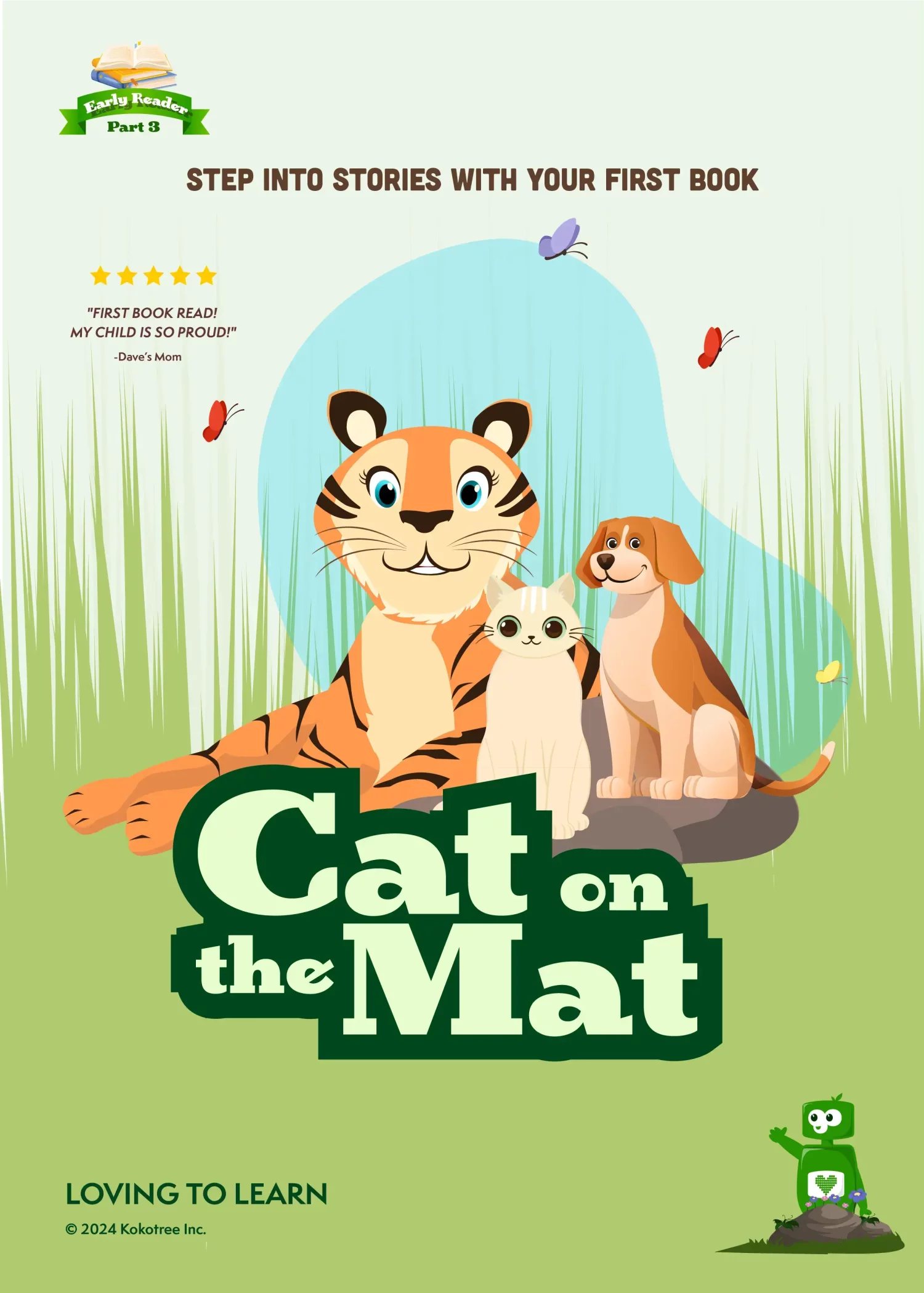
What's Early Reader: Cat On The Mat About?
Your child reads their very first book alongside Meera, decoding simple three-letter words and building complete sentences. By the end, they'll proudly say "I just read a whole book!"—and they really did.
3 minutes
Ages 3-6
Skill: Early reading and word decoding
Your kid watches Meera guide them through their first book. You get 3 minutes to finish that cup of coffee.
Meera, a friendly animal teacher, sits in a peaceful jungle setting with butterflies and fish nearby. She introduces a simple story about Tom the cat and Sam the dog, pausing after each sentence so your child can follow along and practice reading the words themselves.
What your child learns:
This video teaches foundational reading skills through repetition and simple phonics patterns. Children practice decoding CVC (consonant-vowel-consonant) words and connecting them into meaningful sentences.
- Decoding three-letter words (cat, mat, sat, dog, pet)
- Recognizing the short 'a' sound pattern
- Building simple sentences with familiar words
- Understanding that letters combine to make words with meaning
- Gaining confidence as an independent reader
They'll use these skills when:
- Spotting familiar words on cereal boxes and signs at the grocery store
- "Reading" their favorite picture books back to you at bedtime
- Sounding out their own name or a friend's name
- Pointing to words and asking "What does that say?"
The Story (what keeps them watching)
Meera welcomes young learners to Part 3 of the Early Reader Program in her cozy jungle classroom. Today's mission? Read an entire book! The story follows Tom, a pet cat who sits on a mat, and Sam, a pet dog who joins him. It's delightfully simple—and that's the point. Each sentence builds on the last, using repeated words so kids feel the thrill of recognition. By the final page, when Tom and Sam sit together on the mat, your child has officially read their first book. Meera celebrates their success and reminds them that reading gets easier with practice!
How We Teach It (the clever part)
- First 45 seconds: Meera creates a welcoming atmosphere and builds excitement about reading their first book, setting clear expectations for what they'll accomplish.
- Minutes 1-2: The actual book reading begins with strategic pauses after each sentence, giving children time to process, decode, and absorb each new line.
- Final 30 seconds: Meera celebrates the accomplishment, reinforcing that reading is fun and achievable with daily practice.
Teaching trick: The book uses word families (-at pattern: cat, mat, sat) so children experience the "aha moment" of recognizing patterns. Once they decode "cat," they can tackle "mat" and "sat" with growing confidence.
After Watching: Quick Wins to Reinforce Learning
- Mealtime activity: "Can you find something that rhymes with 'cat' at the table?" (Practice: identifying rhyming patterns—mat, hat, flat)
- Car/travel activity: "Let's play the -at game! I say 'cat,' you say another -at word!" (Practice: generating rhyming words and reinforcing the short 'a' sound)
- Bedtime activity: "Can you 'read' me the cat and mat story from memory?" (Practice: retelling builds comprehension and confidence)
- Anytime activity: Point to simple three-letter words in books and say, "Sound it out with me: c-a-t... cat!" (Practice: applying decoding skills to new words)
When Kids Get Stuck. And How to Help.
- "My child just memorizes instead of actually reading." - This is completely normal and actually a helpful step! Memorization builds confidence. Gently point to individual letters and sound them out together: "c-a-t makes cat!"
- "They get frustrated when words don't follow the pattern." - Stick with simple CVC words for now. Mastering patterns like -at, -an, and -op builds the foundation for tackling trickier words later.
- "Three minutes seems too short to learn anything." - Short bursts work best for this age! Rewatch the video daily for a week—repetition is how early reading skills stick.
What Your Child Will Learn
Prerequisites and Building Blocks
Before this video, children should recognize most alphabet letters and understand that letters represent sounds. This lesson builds on Parts 1 and 2 of the Early Reader Program, where foundational phonics concepts were introduced. "Cat on the Mat" represents a crucial milestone—applying individual letter sounds to decode complete words and sentences. It bridges the gap between letter recognition and actual reading, preparing children for more complex phonics patterns and longer texts.
Cognitive Development and Teaching Methodology
This video leverages the developmental sweet spot for phonemic awareness (ages 3-6) when children's brains are primed for pattern recognition. The teaching methodology uses scaffolded instruction—Meera models, then pauses for independent processing. Visual text paired with audio narration addresses both visual and auditory learners, while the encouragement to "follow along" engages kinesthetic learners who benefit from tracking words with their fingers.
Alignment with Educational Standards
This lesson aligns with Common Core Foundational Skills RF.K.2 (demonstrating understanding of spoken words and sounds) and RF.K.3 (knowing letter-sound correspondences). It addresses kindergarten readiness indicators for print concepts and phonics. Teachers expect entering kindergarteners to recognize that words are made of sounds—this video builds exactly that awareness through CVC word decoding and simple sentence construction.
Extended Learning Opportunities
Pair this video with printable word family worksheets featuring -at words (cat, bat, hat, mat, rat, sat). The Kokotree app offers interactive phonics games where children tap letters to build words. Extend learning with magnetic letters on the fridge—challenge your child to build "cat" and swap the first letter to make new words. Create a simple homemade book with your child starring their favorite stuffed animal.
Transcript Highlights
- "Today we're going to read your first book." — Sets a meaningful milestone that builds confidence
- "I'm gonna take you through... step-by-step... as you learn new sounds, decode words, and build sentences." — Explicitly names the skills being taught
- "Tom sat on the mat. Sam and Tom sat on the mat." — Demonstrates sentence building through repetition and expansion
- "Great job decoding words and building sentences. Reading is fun! And easy!" — Positive reinforcement that frames reading as achievable
Character Development and Story Arc
Meera models the role of an encouraging teacher, demonstrating patience and enthusiasm throughout the lesson. Her calm, step-by-step approach shows children that learning happens gradually. By celebrating at the end with "Outstanding! We read our first book together!" Meera models a growth mindset—emphasizing effort and practice over innate ability. This teaches children that reading is a skill anyone can develop with dedication.
The Science of Learning to Read: Phonics and Decoding Deep Dive
Learning to read is one of the most complex cognitive tasks young children undertake, requiring the brain to connect visual symbols (letters) with sounds (phonemes) and meaning (comprehension) simultaneously. This video targets the alphabetic principle—the understanding that letters and letter patterns represent the sounds of spoken language.
The CVC (consonant-vowel-consonant) word structure used in "Cat on the Mat" is pedagogically strategic. Words like "cat," "mat," "sat," and "dog" follow predictable patterns that allow children to apply phonics rules successfully. When children decode "cat" by blending /c/ + /a/ + /t/, they're engaging in synthetic phonics—the gold standard approach supported by decades of reading research.
Word families (like the -at family featured here) accelerate learning through analogy. Once a child masters "cat," their brain recognizes the -at pattern, making "mat" and "sat" easier to decode. This isn't memorization—it's pattern recognition, a fundamental cognitive skill.
The strategic pauses after each sentence serve multiple purposes: they allow phonological processing time, prevent cognitive overload, and create space for the child to subvocalize or read aloud. Research shows that beginning readers need 2-3 seconds per word for successful decoding.
Repetition of high-frequency words ("I," "am," "a," "on," "the") builds automatic recognition, freeing cognitive resources for decoding new words. By the video's end, children have encountered these sight words multiple times in meaningful context—exactly how vocabulary acquisition works in early literacy development.