
What's The Enormous Carrot About?
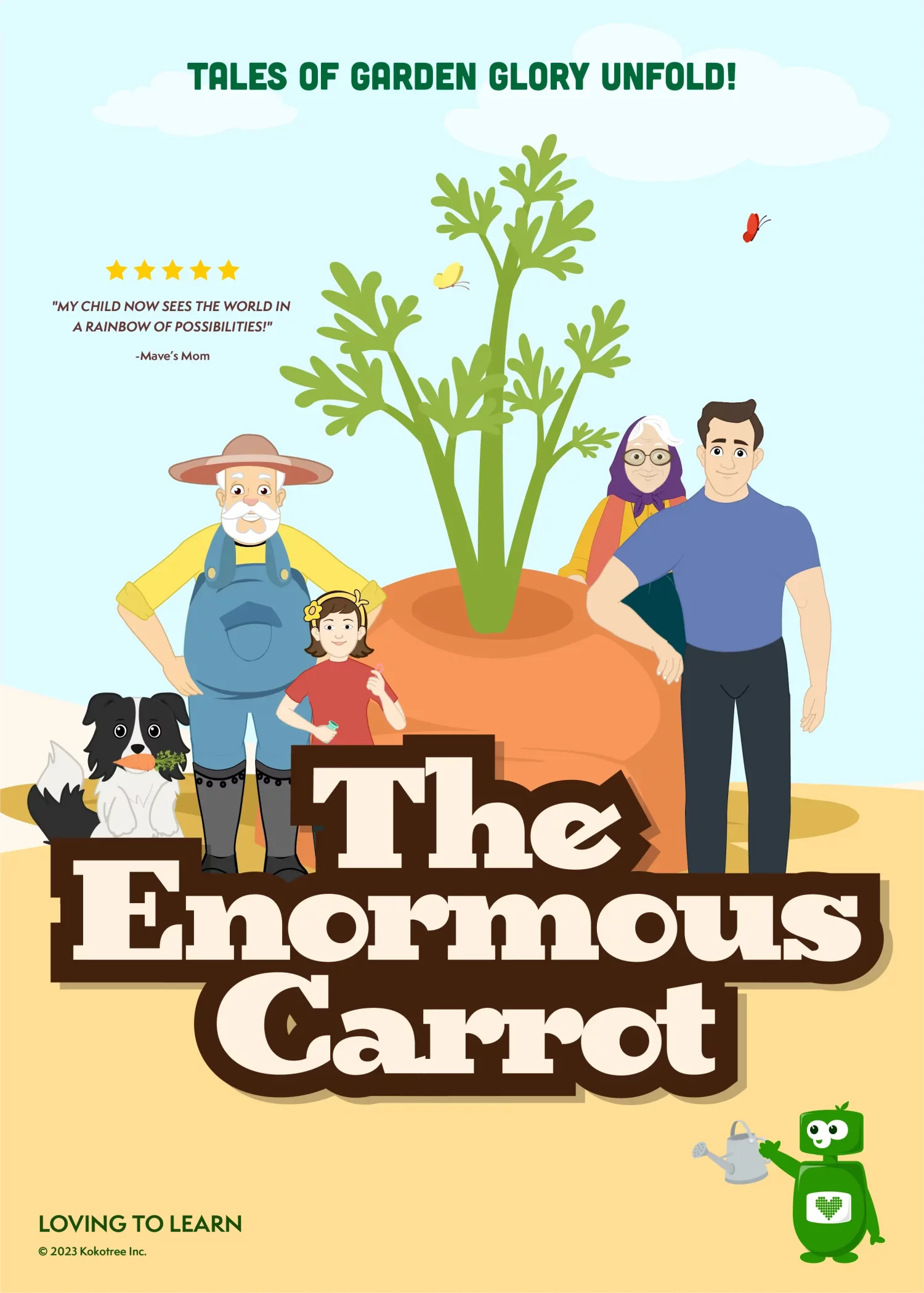
Your little one joins the Kokotree animal friends for an unforgettable story about a carrot so big it takes a whole team to pull it out! They'll learn that collaboration conquers challenges and discover the magic of how plants grow.
7 minutes
Ages 2-5
Skill: Teamwork & Plant Growth
Your kid watches friendly animals learn about working together. You get 7 minutes to finish that cup of coffee.
Ms. Meera gathers Eddie Elephant, Ruby Rabbit, Bobby Bear, and their friends around for story time. They watch an old man plant carrot seeds, care for them daily, and discover one morning that a carrot has grown absolutely enormous! One by one, helpers join the effort until everyone pulls together and—POP!—out comes the giant carrot.
What your child learns:
This story beautifully demonstrates that some tasks are too big for one person alone. Your child will see how asking for help isn't weakness—it's smart problem-solving.
- Understands that teamwork helps accomplish difficult tasks
- Learns the basic plant growth cycle: seed → water → care → harvest
- Recognizes that persistence pays off even when something seems impossible
- Sees how different helpers (big and small) all contribute value
- Discovers that sharing the reward is part of working together
They'll use these skills when:
- Helping a sibling or friend carry something heavy at home
- Working with classmates on a group project at preschool
- Understanding why the garden needs regular watering
- Asking for help instead of getting frustrated with a tough puzzle
The Story (what keeps them watching)
The Kokotree gang is busy tending their garden when Ms. Meera arrives with a story. An old man plants carrot seeds and cares for them so lovingly he even reads them bedtime stories! One morning, he discovers a carrot that's grown ENORMOUS. He pulls and pulls but it won't budge. His wife helps. Then his son. Then a little girl, a dog, and finally a rabbit. Together—SUCCESS! The carrot pops out and everyone celebrates with carrot soup, carrot bread, and carrot cake. Ruby Rabbit wishes she could've been that lucky story rabbit!
How We Teach It (the clever part)
- First 2 minutes: Sets the scene with the Kokotree class gardening together, naturally introducing concepts of plant care and teamwork before the main story begins.
- Minutes 2-5: The story unfolds with each failed attempt building anticipation—children see that one helper isn't enough, two isn't enough, creating a pattern they can predict and follow along with.
- Final 2 minutes: The payoff! Success through collaboration, followed by sharing the harvest. Ms. Meera connects the story back to the class's own garden work.
Teaching trick: Each time a new helper joins, the story pauses to show them trying together—this repetition helps toddlers anticipate what comes next and understand that more helpers = more pulling power.
After Watching: Quick Wins to Reinforce Learning
Mealtime activity: "Can you help me carry this heavy pot to the table?" Let your child be a helper and praise the teamwork. They'll connect it right back to pulling that enormous carrot!
Car/travel activity: "What vegetables grow underground like carrots?" See if they can guess potatoes, beets, or radishes. This extends their plant knowledge beyond the video.
Bedtime activity: "If you found an enormous carrot, who would you ask to help you pull it out?" Let them name family members or friends—they're practicing the concept of building a team.
Anytime activity: Try a mini tug-of-war with a towel or rope. Start alone, then add family members one by one. "See? More helpers make us stronger together!"
When Kids Get Stuck. And How to Help.
"My child doesn't like asking for help—they want to do everything alone." Totally normal at this age! Independence is healthy. Gently point out times when YOU ask for help: "I'm asking Daddy to help me move this couch. Some jobs need teamwork!"
"They don't understand why the carrot wouldn't come out." Use a hands-on demo! Press a toy into playdough and let them try pulling it out. It's tricky! Now both of you pull together—much easier.
"Is this story too simple for my 5-year-old?" The beauty is in the layers. Older kids can discuss strategy: "Who should they have called first? Why did adding the rabbit finally work?" It becomes a logic puzzle.
What Your Child Will Learn
Prerequisites and Building Blocks
This video works best for children who have basic vocabulary for common vegetables and understand simple cause-and-effect relationships. It builds beautifully on earlier Kokotree garden episodes where children learned about the color green and triangle shapes in the same field setting. The story format reinforces narrative comprehension skills while introducing cooperative problem-solving concepts that will support future social learning videos about sharing and helping others.
Cognitive Development and Teaching Methodology
The cumulative story structure (adding one helper at a time) leverages young children's love of repetition and pattern recognition. Each failed attempt creates productive cognitive tension that keeps 2-5 year olds engaged. The visual representation of "more helpers = more success" makes abstract cooperation concepts concrete. Auditory learners benefit from the rhythmic "pulled and pulled and pulled" repetition, while visual learners see the growing chain of helpers.
Alignment with Educational Standards
This video supports Head Start Early Learning Outcomes Framework goals for Cooperation (helping and working with others) and Scientific Reasoning (understanding cause and effect). It aligns with kindergarten readiness indicators for social-emotional development, specifically "works cooperatively with others" and "seeks help when needed." The plant growth sequence introduces life science concepts found in NGSS K-LS1 standards about what plants need to grow.
Extended Learning Opportunities
Pair this video with Kokotree's gardening activity sheets featuring carrot maze puzzles and "count the helpers" worksheets. The app's "Garden Grow" game lets children virtually water plants and watch them sprout. Extend learning by planting actual carrot seeds in a cup—they'll remember the old man's patience! Create a "teamwork chart" at home where children earn stickers for helping family members.
Transcript Highlights
- "If we collaborate and work together, we can do anything!" - Ms. Meera directly states the core lesson in child-friendly language.
- "He watered and cared for them daily. He even read stories to the plants!" - Models nurturing behavior and consistent care.
- "They pulled and pulled and pulled...but still the carrot would not move." - Repetition builds vocabulary and narrative anticipation.
- "Everyone was amazed to see such an enormous carrot. They celebrated and looked at the enormous carrot in amazement." - Models appropriate celebration of group achievement.
Character Development and Story Arc
Ms. Meera demonstrates excellent teaching behavior by connecting the story to the children's real gardening work, making learning relevant. The Kokotree class models collaborative behavior before the story even begins—Bobby and Gina water, Maddy and Ruby weed, Ronnie and Eddie compost. When Gina accidentally splashes Ronnie, the gentle resolution shows healthy peer interaction. Bobby Bear's running joke about pizza trees adds humor while Ms. Meera patiently redirects, modeling kind correction.
Social-Emotional Learning: Cooperation and Persistence
Cooperation is a foundational social skill that develops significantly between ages 2-5. This video addresses it through narrative modeling rather than direct instruction, which research shows is more effective for young children. The story demonstrates several key cooperation concepts developmentally appropriate for this age group.
First, it shows that asking for help is positive, not a sign of failure. The old man doesn't give up or get frustrated—he simply recognizes he needs assistance and seeks it out. This normalizes help-seeking behavior that many toddlers resist during their "I do it myself" phase.
Second, the story illustrates that everyone's contribution matters. The rabbit—the smallest helper—joins last, and only then does the carrot come out. This teaches children that even small helpers are valuable, encouraging younger siblings or smaller children to see themselves as capable contributors.
Third, the shared meal at the end demonstrates that cooperation leads to shared rewards. Everyone who helped gets to enjoy the carrot feast. This concrete outcome helps young children understand the abstract concept of mutual benefit.
The persistence theme runs parallel—the group fails five times before succeeding. For preschoolers who often abandon difficult tasks quickly, seeing characters try repeatedly without emotional meltdowns provides powerful modeling. The eventual success reinforces that persistence, combined with smart problem-solving (getting more help), leads to achievement.