
What's Rainbow Colors About?
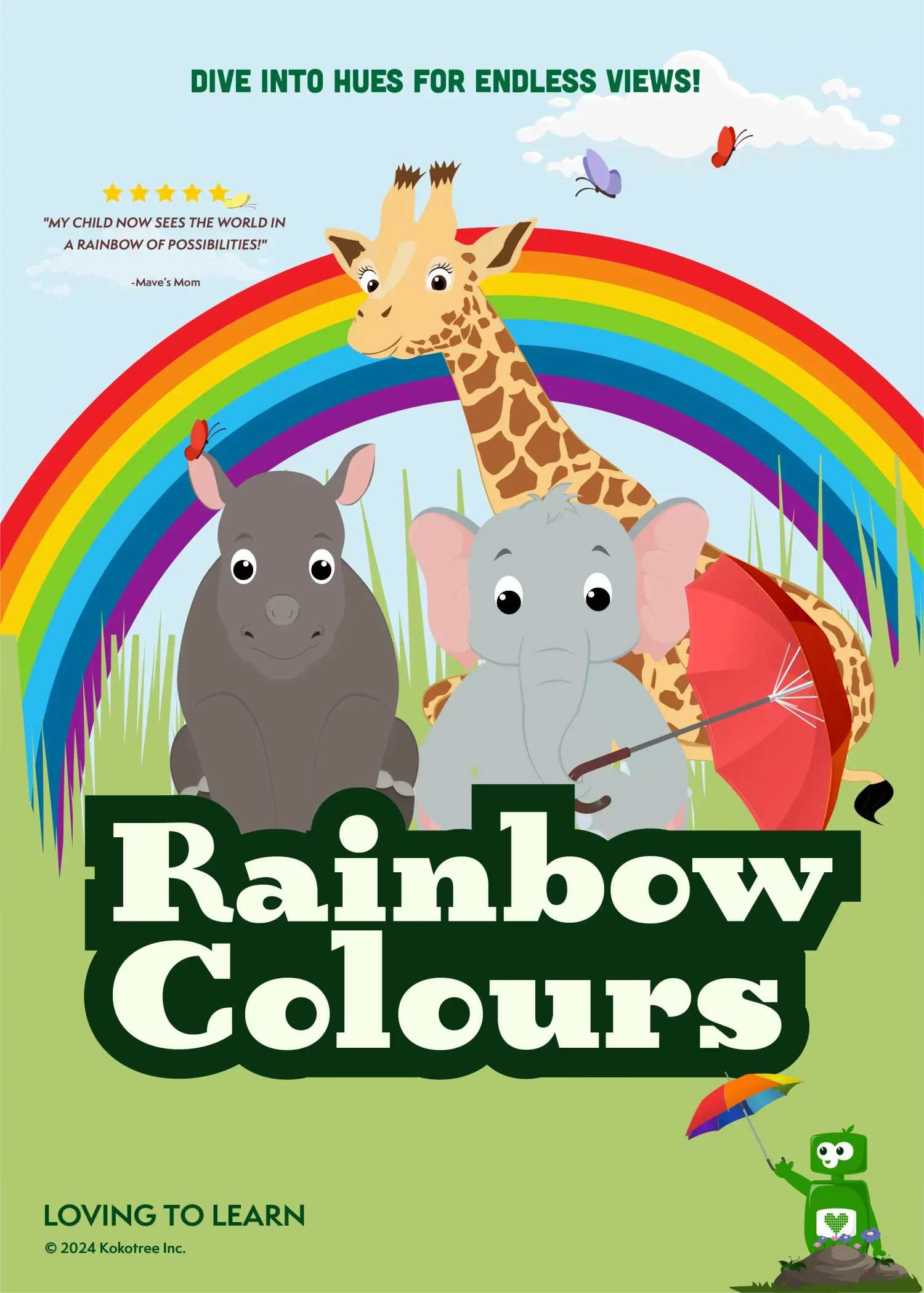
Your little one joins the Kokotree animal friends on a rainy day adventure that ends with a spectacular rainbow! They'll learn to identify, name, and remember all seven rainbow colors in the correct sequence.
7 minutes
Ages 2-5
Skill: Color recognition and sequencing
Your kid watches friendly animals discover rainbow colors together. You get 7 minutes to enjoy your coffee in peace.
The Kokotree class splashes through puddles with colorful umbrellas until the rain stops and a beautiful rainbow appears! Miss Elizabeth guides them through naming each color, counting to seven, and even creating their own rainbow with a prism.
What your child learns:
This video builds color vocabulary while introducing basic science concepts about light and rainbows. Children practice counting, sequencing, and connecting abstract colors to familiar objects they see every day.
- Names all seven rainbow colors (red, orange, yellow, green, blue, indigo, violet)
- Counts from 1-7 while pointing to each color
- Connects colors to real objects (fire truck = red, banana = yellow)
- Learns the ROY G. BIV memory trick for color order
- Understands that sunlight and rain create rainbows
They'll use these skills when:
- Sorting crayons or toys by color at home
- Spotting colors during car rides ("I see something red!")
- Describing their artwork or choosing clothes to wear
- Noticing rainbows in the sky, sprinklers, or bubbles
The Story (what keeps them watching)
It's a drizzly day in Kokotree Forest, and Eddie Elephant, Ruby Rabbit, Maddy Monkey, Bobby Bear, Ronnie Rhino, and Gina Giraffe are having a blast jumping in mud puddles! When the sun comes out, they spot their very first rainbow. Miss Elizabeth helps them name each color from top to bottom, but then—oh no—the rainbow starts to fade! Clever Ronnie saves the day with a prism from his backpack, and the class creates their own rainbow to study. They learn the secret code "ROY G. BIV" to remember the colors forever, and discover their umbrellas make a rainbow too!
How We Teach It (the clever part)
- First 2 minutes: Sets the scene with colorful umbrellas (each character holds a different rainbow color) and builds excitement when the rainbow appears
- Minutes 2-5: Names each color with real-world connections (orange like the fruit, yellow like a banana), counts to seven, and introduces basic rainbow science
- Final 2 minutes: Reinforces learning through repetition with the prism experiment, teaches the ROY G. BIV memory trick, and celebrates with the umbrella rainbow discovery
Teaching trick: Each color is paired with a familiar object (fire truck, banana, blueberries) so children anchor abstract color names to things they already know and can picture.
After Watching: Quick Wins to Reinforce Learning
- Mealtime activity: "Can you find something red on your plate? What about orange?" (Practices identifying colors in everyday food items like tomatoes, carrots, and peas)
- Car/travel activity: "Let's play ROY G. BIV! Can you spot something red outside? Now orange!" (Reinforces color sequence while building observation skills)
- Bedtime activity: "Let's name the rainbow colors together before sleep: red, orange, yellow..." (Repetition builds memory, and the calm recitation makes a soothing routine)
- Anytime activity: Line up crayons, blocks, or toys in rainbow order and say "ROY G. BIV" together. (Hands-on practice reinforces the sequence they learned)
When Kids Get Stuck. And How to Help.
- "My child mixes up blue and indigo" - Totally normal! Indigo is tricky even for adults. Focus on the main colors first (red, orange, yellow, green, blue, purple) and add indigo later as their color vocabulary grows.
- "They can't remember the order" - Keep practicing ROY G. BIV as a silly name! Turn it into a song or chant. Repetition over days and weeks is how this sticks—not perfection after one viewing.
- "My toddler just watches but doesn't repeat the colors" - That's actually learning! Young children absorb information before they produce it. Keep watching together and naming colors casually—one day they'll surprise you.
What Your Child Will Learn
Prerequisites and Building Blocks
This video works best for children who can already identify basic colors like red, blue, and yellow. It builds on foundational color recognition by introducing the full seven-color spectrum and adding sequencing skills. Rainbow Colors connects naturally to counting videos (1-7) and other color-focused content in the Kokotree library. Children who have watched basic shapes and colors content will find this an engaging next step that challenges them to remember color order while reinforcing familiar concepts.
Cognitive Development and Teaching Methodology
The video uses multi-sensory teaching strategies ideal for ages 2-5. Visual learners see each color highlighted individually; auditory learners hear colors named with real-world associations; kinesthetic concepts are modeled through the prism experiment. The ROY G. BIV mnemonic leverages the brain's natural pattern-recognition abilities, making abstract sequences memorable. Repetition appears three times (rainbow, prism, umbrellas) to cement learning without feeling redundant—each context adds novelty while reinforcing the same core content.
Alignment with Educational Standards
This video supports preschool learning standards for color recognition, counting 1-10, and sequencing skills. It addresses kindergarten readiness indicators requiring children to identify and name basic colors and understand simple patterns. The content aligns with early science standards introducing natural phenomena (light, weather). Teachers expect entering kindergartners to name primary and secondary colors confidently—this video extends that to the full spectrum while building vocabulary and observation skills valued in early childhood assessments.
Extended Learning Opportunities
Pair this video with rainbow coloring sheets where children practice the ROY G. BIV sequence independently. The Kokotree app's color-matching games reinforce identification skills. Parents can extend learning with simple prism play using a glass of water in sunlight, or by hunting for rainbows in soap bubbles, oil puddles, or garden sprinklers. Creating rainbow artwork with crayons, paint, or torn paper in the correct color order provides hands-on practice that bridges screen learning to tactile creativity.
Transcript Highlights
- On rainbow formation: "When the sunlight strikes with the raindrops, a rainbow is formed!" - Simple cause-and-effect explanation appropriate for young learners.
- Color-object connections: "I see yellow. Just like a banana!" and "I see red! Like a fire truck." - Anchors abstract color names to concrete, familiar objects.
- Memory strategy introduction: "Roy: red, orange, yellow. Then G for green. And Biv for blue, indigo, and violet!" - Breaks down the mnemonic into digestible chunks.
- Pattern recognition: "The sequence of colors is also the same as in the rainbow!" - Highlights the key learning that colors follow a predictable order.
Character Development and Story Arc
The Kokotree characters model curiosity and collaborative learning beautifully. Gina Giraffe expresses wonder at her first rainbow, showing it's okay to be new to something. Ronnie Rhino demonstrates resourcefulness by remembering his prism and sharing it with the group. Eddie Elephant asks thoughtful questions ("How does a rainbow form?"), modeling inquiry-based learning. The characters work together to name colors, taking turns and building on each other's observations—showing young viewers that learning is a team activity where everyone contributes.
The Science of Light and Color: A Deep Dive
Rainbows are one of nature's most captivating phenomena, and this video introduces children to foundational physics concepts in an age-appropriate way. When sunlight passes through raindrops (or a prism), it bends and separates into its component wavelengths—each wavelength corresponding to a different color we perceive. This process, called refraction, is why we always see rainbow colors in the same order: red light bends the least, violet the most.
For preschoolers, the key takeaway is simpler: sunlight contains hidden colors that we can reveal with water or special glass. This plants early seeds for understanding that the world has properties we can discover through observation and experimentation—core STEAM thinking.
The seven-color model (ROYGBIV) is a helpful teaching framework, though the visible spectrum is actually continuous. Isaac Newton originally chose seven colors to match musical notes, and the convention stuck. Indigo is the trickiest for young children because it falls between blue and violet—many educators focus on six colors initially and add indigo as children's color discrimination develops.
Color sequencing also builds mathematical thinking. Recognizing that patterns repeat and have predictable order is foundational for later math concepts like number sequences, skip counting, and algebraic thinking. When children chant "red, orange, yellow, green, blue, indigo, violet," they're practicing the same cognitive skill they'll use for "2, 4, 6, 8" or "Monday, Tuesday, Wednesday."
The prism experiment in this video models scientific inquiry: when the natural rainbow fades, the characters don't give up—they find another way to observe the phenomenon. This persistence and problem-solving approach teaches children that science is about asking questions and finding creative ways to answer them.