
What's Early Reader: Single Words About?
Your child takes their first exciting steps into reading by sounding out simple three-letter words with Meera, their cheerful animal teacher! They'll practice saying real words out loud and start connecting letters to sounds—the magic key that unlocks reading.
7.5 minutes
Ages 3-6
Skill: Phonics and word recognition
Your kid watches Meera teach simple words with funny animal visitors. You get 7 minutes to drink your coffee while it's actually hot.
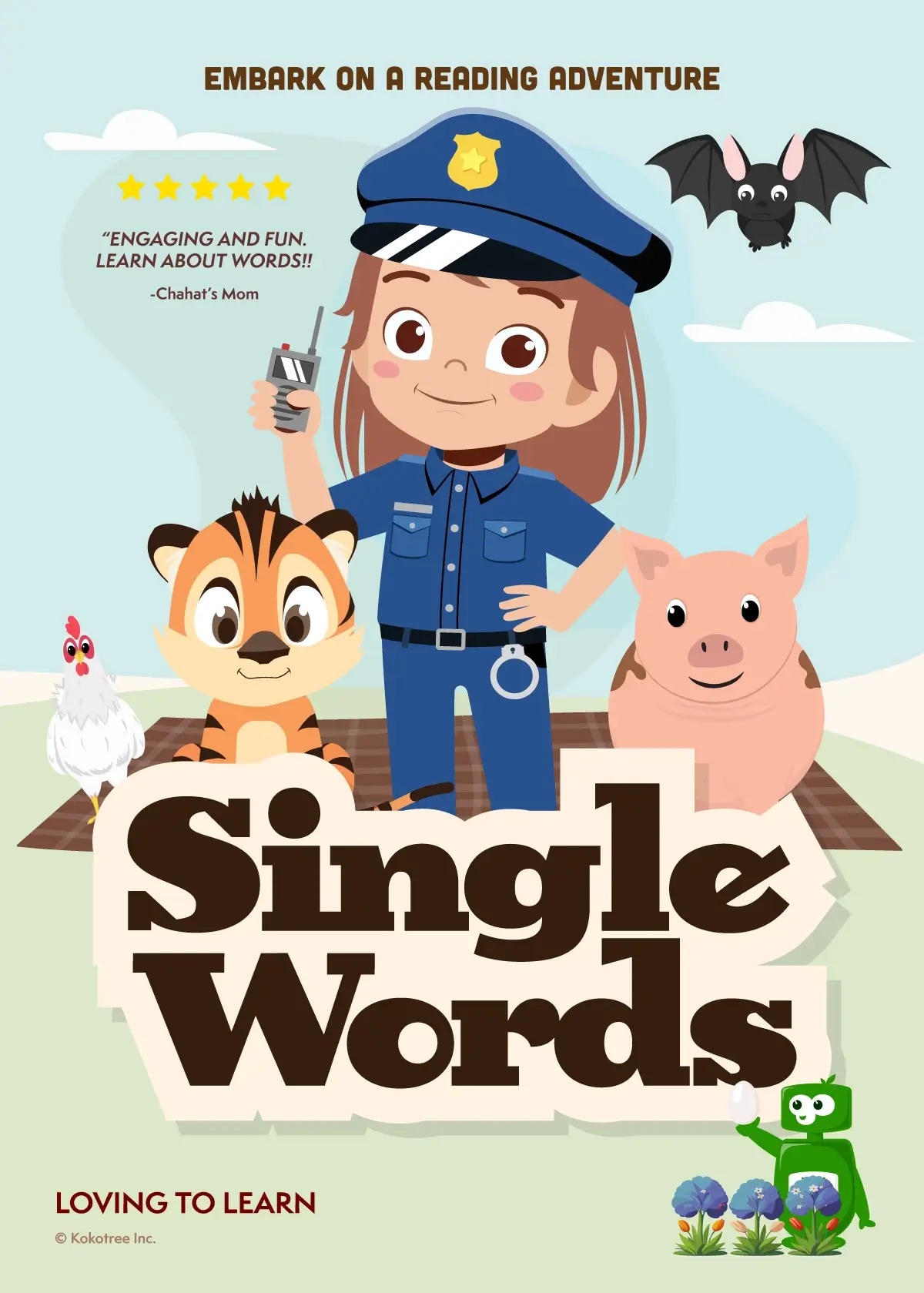
Meera, a friendly animal teacher, introduces three-letter words one at a time in a colorful jungle setting. Each word appears on screen while Meera says it clearly, then pauses so your child can repeat it back. Silly animal friends pop in during the lesson—a piggy oinks by when learning "pig," and chickens lay eggs right on cue!
What your child learns:
This video introduces CVC (consonant-vowel-consonant) words—the building blocks of early reading. Your child practices listening, repeating, and recognizing word patterns that will help them decode new words independently.
- Recognizes and says 20+ simple three-letter words
- Practices the repeat-after-me learning technique
- Identifies word families (cat/mat/bat, hot/pot/dog)
- Builds confidence speaking words out loud
- Connects spoken words to written letters on screen
They'll use these skills when:
- Spotting familiar words on cereal boxes and signs at the grocery store
- Sounding out words in their favorite picture books at bedtime
- Playing word games and pointing out letters during car rides
- Feeling proud when they "read" a word to a grandparent or friend
The Story (what keeps them watching)
Meera welcomes young learners to the jungle for their very first reading lesson! She introduces words in fun groups—"cat, mat, tap, bat"—with pauses so kids can say each word back. When Meera says "pig," a real Kokotree piggy waddles through, making everyone giggle. The adventure continues to a kitchen where a police officer (who's an animal!) and a dog make a silly joke about hot dogs. Back in the jungle, chickens lay eggs right when Meera teaches "egg." It's reading practice disguised as a comedy show!
How We Teach It (the clever part)
- First 2 minutes: Meera warmly introduces herself and explains the repeat-after-me format, making children feel safe and ready to participate actively.
- Minutes 2-6: Words are taught in rhyming groups (cat/mat/bat, sit/bin/lip/pig), helping children hear sound patterns. Surprise animal appearances reward attention and create memory anchors.
- Final 1.5 minutes: Meera celebrates progress with enthusiastic praise, reinforcing that practice leads to real reading skills.
Teaching trick: Words are grouped by ending sounds (word families), so children unconsciously learn that changing one letter creates a new word—the foundation of phonetic decoding!
After Watching: Quick Wins to Reinforce Learning
- Mealtime activity: "Can you find something on your plate that rhymes with 'cup'?" Point to items and help them sound out: "Does 'soup' rhyme? How about the words 'hot' and 'pot'?" (Practices word family recognition)
- Car/travel activity: "Let's play the word game! I say 'cat,' you say a word that sounds like it—mat, bat, hat!" Take turns adding rhyming words. (Builds phonemic awareness through play)
- Bedtime activity: "Meera taught us 'hug' today. Can you give me a hug and say the word?" Then try: "What rhymes with hug? Mug! Bug!" (Connects words to physical actions and emotions)
- Anytime activity: Grab three magnetic letters and make "cat" on the fridge. "Now watch—I change one letter and it says 'bat'! What if we try 'mat'?" (Demonstrates how reading works)
When Kids Get Stuck. And How to Help.
- "My child just watches but won't repeat the words out loud." - Totally normal! Many children prefer to listen first and process internally. Watch together and say the words yourself—they'll likely join in by the third viewing when they feel confident.
- "They mix up similar words like 'cat' and 'bat.'" - This actually shows they're hearing the rhyme pattern, which is great! Emphasize the first sound: "Cat starts with 'cuh,' bat starts with 'buh.' What sound does YOUR name start with?"
- "Is this too easy or too hard for my child?" - This video is designed as a gentle entry point. If your child breezes through, celebrate! If they struggle, rewatch it like a favorite song—repetition builds mastery, and the silly animals make repeat viewing fun.
What Your Child Will Learn
Prerequisites and Building Blocks
Children benefit most from this video if they can recognize some alphabet letters and understand that letters make sounds. This is an entry-level reading video in the Budding Sprouts program—no prior phonics instruction required. It establishes the foundational skill of connecting spoken words to written text, preparing children for blending sounds and reading sentences in future lessons. The repeat-after-me format requires only the ability to listen and attempt vocalization.
Cognitive Development and Teaching Methodology
The call-and-response teaching method leverages young children's natural imitation instincts while building phonological memory. Two-second pauses after each word respect developing processing speeds and encourage active participation rather than passive viewing. Grouping words by word families (rhyming patterns) activates pattern recognition—a key cognitive skill. Visual learners see words on screen, auditory learners hear clear pronunciation, and kinesthetic learners engage through speaking aloud.
Alignment with Educational Standards
This video addresses foundational literacy standards including phonemic awareness (hearing individual sounds), print concepts (recognizing that words are made of letters), and phonics (connecting sounds to written words). It aligns with kindergarten readiness indicators for recognizing high-frequency words and CVC word patterns. Teachers expect incoming students to attempt sounding out simple words—this video builds exactly that confidence and familiarity with basic word structures.
Extended Learning Opportunities
Pair this video with letter tracing worksheets focusing on the letters in featured words (c-a-t, d-o-g, p-i-g). The Kokotree app's letter recognition games reinforce individual letter sounds. Create simple flashcards with the 20 words from this video for daily practice. Read picture books featuring animals from the lesson (cats, dogs, pigs, hens) and pause to point out familiar words. Play "I Spy" with three-letter words in your environment.
Transcript Highlights
- "I'm going to show you some words with their letters and sounds. Just repeat after me." — Establishes clear, simple instructions for participatory learning.
- "Cat. Mat. Tap. Bat." — Demonstrates word family grouping, teaching rhyme patterns implicitly.
- "Great job! Let's try a few more words." — Models encouragement and growth mindset between learning segments.
- "Wow! You're learning so many new words. Soon you'll be able to read!" — Connects current practice to future reading success, building motivation.
Character Development and Story Arc
Meera models the ideal teacher: patient, enthusiastic, and celebratory of small wins. Her giggles at the visiting animals show that learning can be joyful and surprising. The cop and dog characters demonstrate friendly cooperation and humor, showing that even authority figures enjoy silliness. The animal visitors (pig, chickens) model curiosity by appearing at just the right moment, rewarding children's attention and creating positive associations with word learning.
Phonics and Early Literacy Deep Dive
This video introduces CVC (consonant-vowel-consonant) words—the simplest decodable word structure in English and the cornerstone of phonics instruction. CVC words like "cat," "dog," and "pig" follow predictable patterns that help children understand the alphabetic principle: letters represent sounds that combine to form words.
The word families presented (at-family: cat/mat/bat; ot-family: hot/pot/dog; ug-family: cup/tub/jug/hug) teach onset-rime awareness. Children learn that words sharing endings sound alike, making new words predictable. This pattern recognition dramatically accelerates reading acquisition—once a child knows "cat," they can decode "bat," "hat," "sat," and "rat" with minimal instruction.
The repeat-after-me methodology builds phonological memory, the brain's ability to hold and manipulate sound information. Research shows that children who practice saying words aloud develop stronger reading skills than those who only listen passively. The two-second pauses are calibrated to young children's processing speeds, giving them time to hear the word, formulate it mentally, and produce it verbally.
Importantly, this video presents words both auditorily and visually, strengthening the crucial connection between spoken and written language. Children begin understanding that those letter shapes on screen correspond to the sounds they're making—the fundamental insight that transforms a non-reader into a reader.