
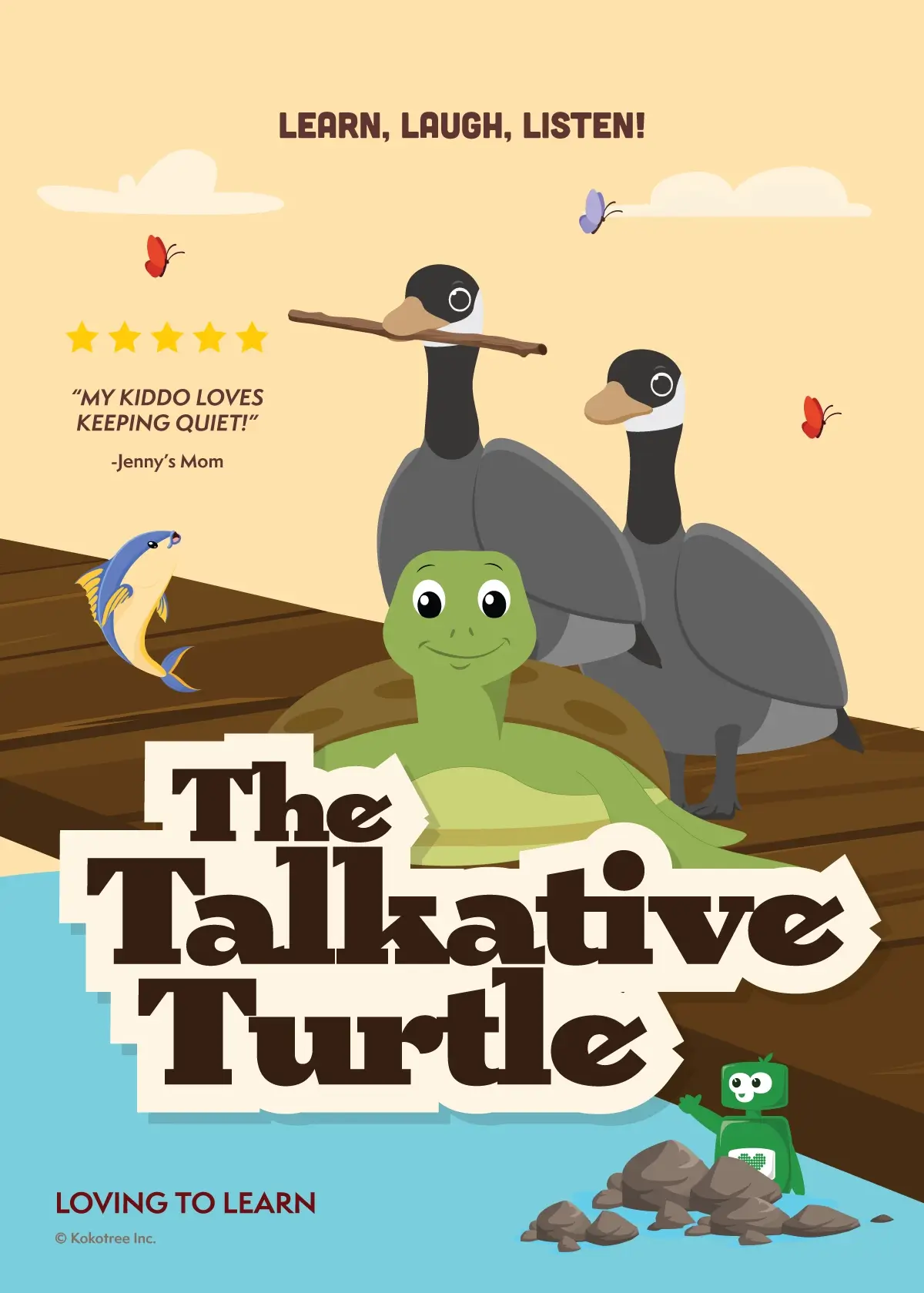
What's The Talkative Turtle About?
Your little one joins Miss Meera's class for a captivating story about friendship, listening skills, and knowing when to speak up! After watching, children understand why following friendly advice matters and can identify moments when it's time to listen versus time to talk.
11 minutes
Ages 3-6
Skill: Active Listening & Self-Control
Your kid watches a turtle learn to listen to his goose friends. You get 11 minutes to enjoy your coffee while it's still warm.
Miss Meera gathers her animal students—Tiki Tiger, Ruby Rabbit, Maddy Monkey, Bobby Bear, Ronnie Rhino, and Gina Giraffe—for story time. They breathe deeply to calm down, then listen to the tale of Tutu, a friendly turtle whose love of talking gets him into trouble during a flying adventure with his goose friends Greg and Gronk.
What your child learns:
This story teaches children the important social skill of knowing when to speak and when to stay quiet. Through Tutu's adventure, kids see real consequences of not following safety instructions while also learning that good friends give advice to help us, not to be bossy.
- Recognizing when it's important to listen carefully
- Understanding that following instructions keeps us safe
- Practicing self-control (keeping quiet when needed)
- Valuing friendly advice from those who care about us
- Learning that mistakes can lead to new opportunities
They'll use these skills when:
- Following safety rules at the playground or near water
- Listening to instructions during classroom activities
- Playing games that require taking turns and staying quiet
- Understanding why parents and teachers give certain rules
The Story (what keeps them watching)
Tutu the Turtle loves to chat with everyone at the lake—ants, fish, and especially his best friends, the goose brothers Greg and Gronk. When a drought forces everyone to leave, the geese devise a clever plan: Tutu can hold onto a stick with his mouth while they fly him to a new home. There's just one rule—don't open your mouth! But talkative Tutu spots curious villagers below and just can't help asking questions. He falls! Thankfully, kind villagers help him, and the friends discover an even bigger, more beautiful lake. Tutu learns that listening to good advice keeps us safe—and sometimes mistakes lead to wonderful new beginnings!
How We Teach It (the clever part)
- First 2 minutes: Miss Meera models calming techniques (breathing exercises) and sets expectations for listening during story time. Children learn to prepare their minds for focused attention.
- Minutes 2-9: The story unfolds with clear cause-and-effect sequences. Tutu's friends explain WHY he needs to stay quiet, and children see the direct consequence when he doesn't listen.
- Final 2 minutes: Miss Meera facilitates discussion with her students, reinforcing the lesson that there's "a time to talk and a time to listen." The happy ending shows that mistakes can be forgiven and lead to good outcomes.
Teaching trick: The story uses physical stakes (falling from the sky) to make the abstract concept of "listening to advice" concrete and memorable. Kids viscerally understand why Tutu needed to keep his mouth closed!
After Watching: Quick Wins to Reinforce Learning
- Mealtime activity: "Can you eat three bites without talking, just like Tutu needed to stay quiet?" (Practices self-control in a playful, low-stakes way)
- Car/travel activity: "Let's play the quiet game! I'll count to ten and we'll both stay silent. Ready?" (Builds the same muscle Tutu needed to develop)
- Bedtime activity: "Tell me about a time someone gave you good advice. Did you listen?" (Connects the story to their real experiences and reinforces the value of listening)
- Anytime activity: "If you were Tutu's friend, what would you tell him before the flight?" (Encourages perspective-taking and reinforces the lesson)
When Kids Get Stuck. And How to Help.
"My child interrupts constantly and never listens!" - This is completely normal for young children! Their brains are still developing impulse control. Use Tutu as a gentle reminder: "Remember what happened when Tutu talked at the wrong time?" Practice with short, fun quiet games.
"They seemed scared when Tutu fell." - The story intentionally shows Tutu is okay to model resilience. Emphasize that the villagers helped him and he found an even better home. Mistakes don't have to be scary—they can lead to good things!
"My child says they CAN'T stay quiet." - Tutu felt the same way! Start with tiny challenges (5 seconds of quiet) and celebrate success. Point out that Tutu DID stay quiet for the whole first part of the flight—your child can build this skill too.
What Your Child Will Learn
Prerequisites and Building Blocks
Children watching this video benefit from basic story comprehension skills and the ability to follow a narrative with multiple characters. This story builds on foundational social-emotional concepts like friendship and helping others. It serves as an excellent introduction to more complex self-regulation concepts, preparing children for videos about patience, turn-taking, and following multi-step instructions. The breathing exercise at the beginning connects to mindfulness practices that support emotional regulation.
Cognitive Development and Teaching Methodology
The narrative structure leverages children's natural love of animal characters and adventure stories to teach abstract social concepts. The cause-and-effect sequence (talking → falling) creates a concrete, memorable connection that preschoolers can grasp. Visual storytelling shows rather than tells, while Miss Meera's discussion with her class models metacognition—thinking about what we learned. Multiple learning styles are engaged: visual (the flying scenes), auditory (dialogue and narration), and kinesthetic (the breathing exercise).
Alignment with Educational Standards
This video supports kindergarten readiness in the social-emotional domain, specifically self-regulation and following directions—key indicators assessed in early childhood settings. It aligns with standards requiring children to "follow agreed-upon rules" and "demonstrate self-control." The story comprehension elements support language arts standards for understanding narrative structure, identifying characters, and retelling key events. Teachers expect entering kindergartners to listen attentively and follow two-step directions.
Extended Learning Opportunities
Pair this video with drawing activities where children illustrate their favorite part of Tutu's adventure. Create a simple "listening challenge" chart where children earn stickers for following instructions the first time. Practice the breathing exercise from the video before other learning activities. Explore related concepts through pretend play—children can act out the story with stuffed animals, practicing what Tutu should have done differently.
Transcript Highlights
- Teaching self-calming: "Okay. Breathe in and breathe out three times and relax." (Miss Meera models regulation techniques)
- Explaining consequences: "You fell the moment you opened your mouth. We told you that you couldn't take your mouth off of the stick." (Greg connects action to outcome)
- Summarizing the lesson: "There is a time to talk, and there is a time to listen. You need to be careful about when the appropriate time to do either is." (Miss Meera's explicit teaching moment)
- Modeling self-awareness: "See! I nodded instead of talking! I told you I could be quiet." / "But you're talking right now, Tutu." (Humorous moment showing the challenge of self-control)
Character Development and Story Arc
Tutu demonstrates a classic growth arc—he's lovable but flawed, making him relatable to young viewers who also struggle with impulse control. His enthusiasm for talking mirrors children's own excitement to share. Greg and Gronk model patience and problem-solving, offering solutions rather than criticism. Miss Meera's students show appropriate emotional engagement (Ronnie's concern for Tutu) while learning to regulate their own responses. The story validates that change is hard but possible.
Social-Emotional Learning: Self-Regulation and Impulse Control Deep Dive
Self-regulation—the ability to manage one's behavior, emotions, and impulses—is one of the most critical skills for early childhood success. Research consistently shows that children with stronger self-regulation perform better academically, have healthier relationships, and navigate challenges more effectively throughout life.
For children ages 3-6, the prefrontal cortex (responsible for impulse control) is still developing rapidly. This means that staying quiet when excited, following rules that conflict with desires, and delaying gratification are genuinely difficult—not defiance, but developmental reality. Stories like Tutu's provide external scaffolding for this internal process.
The video employs several evidence-based approaches:
Narrative distance: Children can observe Tutu's mistake without feeling personally criticized, making them more receptive to the lesson.
Natural consequences: Rather than arbitrary punishment, Tutu experiences a logical outcome (falling), helping children understand WHY the rule existed.
Repair and recovery: Critically, the story shows that mistakes don't define us. Tutu is forgiven, finds a new home, and maintains his friendships. This models resilience and reduces anxiety around imperfection.
Explicit instruction: Miss Meera doesn't assume children will extract the lesson independently. She clearly states the takeaway, supporting children who need direct teaching.
The breathing exercise at the story's start introduces a practical self-regulation tool children can use independently. Deep breathing activates the parasympathetic nervous system, helping children transition from excitement to focused attention—a skill they'll use throughout their educational journey.