
What's Pentagon & Orange About?
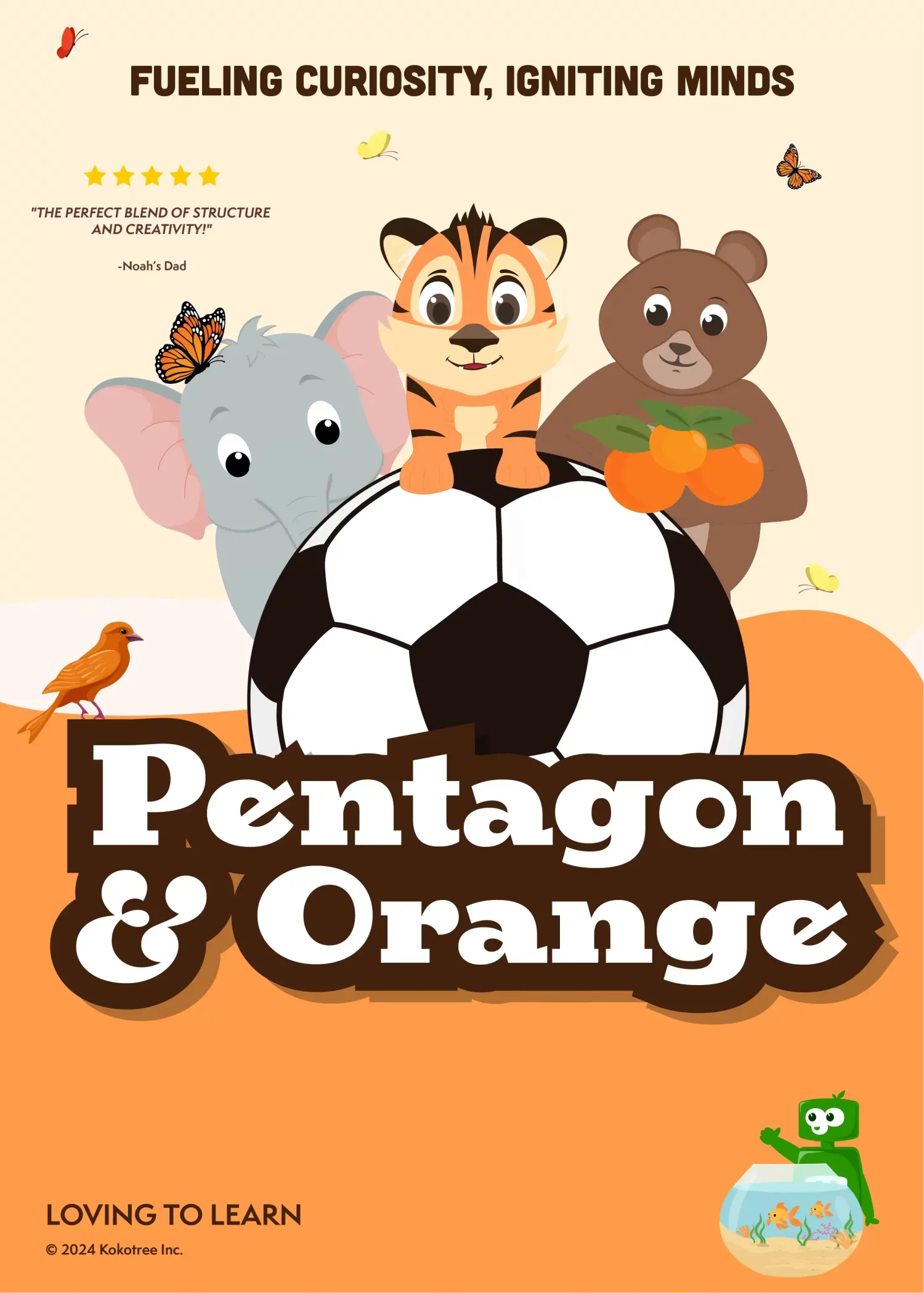
Your little learner joins the Kokotree Class on the playground to discover the sunny warmth of orange and count the five sides of a pentagon! They'll spot these shapes hiding in everyday objects—from soccer balls to treehouses.
6 minutes
Ages 3-5
Skill: Shape recognition and color identification
Your kid watches friendly animals hunt for shapes and colors. You get 6 minutes to finish that cup of coffee.
The Kokotree Class gathers for circle time after a soccer game. Ruby Rabbit shares an adorable poem about carrots, which sparks a colorful conversation about orange—from autumn leaves to butterflies to goldfish. Then Gina Giraffe spots a pentagon-shaped arrow in the forest, and the whole class goes on a shape hunt!
What your child learns:
This video teaches color mixing basics (red + yellow = orange) and introduces the pentagon as a five-sided shape. Children practice counting sides and identifying shapes in real-world objects.
- Identifies the color orange in nature and everyday objects
- Understands that mixing red and yellow creates orange
- Counts to five while tracing pentagon sides
- Recognizes pentagons in unexpected places (soccer balls, flowers, pencils)
- Connects abstract shapes to familiar items
They'll use these skills when:
- Sorting laundry by color or picking out orange foods at the grocery store
- Counting sides on road signs during car rides
- Playing with a soccer ball and noticing the black pentagon patches
- Drawing shapes and mixing paint colors during art time
The Story (what keeps them watching)
It all starts with Ruby Rabbit's sweet poem about carrots! This leads Miss Elizabeth and the class into a cozy conversation about the color orange—spotting it in butterflies, marigolds, canaries, and even rainbows. Then Gina Giraffe notices a mysterious orange arrow pointing to a treehouse. "How many sides does it have?" Miss Elizabeth asks. The class counts together: one, two, three, four, FIVE! It's a pentagon! Suddenly pentagons appear everywhere—on Tiki's pencil, the treehouse, a morning glory flower, and the soccer ball they were just playing with. Learning has never felt so much like a treasure hunt!
How We Teach It (the clever part)
- First 2 minutes: Ruby's carrot poem naturally introduces orange through a relatable, kid-friendly food. The class discusses orange objects they love, making the color personal and memorable.
- Minutes 2-4: Miss Elizabeth explains color mixing (red + yellow = orange) and guides children to spot orange in nature—butterflies, marigolds, canaries, goldfish, and rainbows. Visual examples reinforce each discovery.
- Final 2 minutes: The pentagon is introduced through the forest arrow. Children count sides together, then hunt for pentagons in familiar objects. The video ends with a challenge to keep exploring at home.
Teaching trick: By starting with the soccer ball (a toy kids know) and ending with it (showing the black pentagons), Miss Elizabeth creates a satisfying "aha!" moment—kids realize shapes were hiding in plain sight all along.
After Watching: Quick Wins to Reinforce Learning
Mealtime activity: "Can you find something orange on your plate?" Point to carrots, orange slices, cheese, or sweet potatoes. Ask what colors might mix to make that orange. (Practices color identification and color theory basics)
Car/travel activity: "Let's count the sides on that stop sign! Is it a pentagon?" Nope—it's eight sides! Keep hunting for five-sided shapes on your drive. (Practices counting sides and shape discrimination)
Bedtime activity: "What's the most orange thing you saw today?" A school bus? A pumpkin? A sunset? Talk about why orange feels warm and happy. (Reinforces color recognition and descriptive language)
Anytime activity: Grab a soccer ball or any ball with panels. "Can you find the pentagons?" Count the sides together with your finger. (Connects video learning to hands-on exploration)
When Kids Get Stuck. And How to Help.
"My child keeps calling pentagons 'triangles with extra sides.'" - That's actually great thinking! They're noticing the pointed shape. Gently count the sides together: "Triangles have three, but this one has five—that's a pentagon!" The comparison shows they're analyzing shapes.
"She can't find pentagons anywhere at home." - Pentagons are trickier to spot than circles or squares! Try the top of a pencil, certain flowers, or print a simple pentagon to take on a "shape hunt." Even noticing that pentagons are rare builds shape awareness.
"He mixes up orange with red or yellow." - These colors are neighbors on the color wheel, so confusion is normal! Try placing red, orange, and yellow objects in a row. Ask which is "in the middle"—that's orange, made from mixing the other two.
What Your Child Will Learn
Prerequisites and Building Blocks
Children benefit from prior exposure to basic shapes (circles, squares, triangles) and primary colors (red, yellow, blue) before watching. This video builds on counting skills (1-5) introduced in earlier Kokotree content. It bridges foundational shape recognition toward more complex polygons while reinforcing color mixing concepts. Pentagon & Orange fits mid-sequence in the shapes curriculum, after basic shapes but before hexagons and octagons.
Cognitive Development and Teaching Methodology
This video leverages concrete-to-abstract learning, starting with familiar objects (carrots, soccer balls) before introducing terminology. The call-and-response counting ("One...two...three...four...five") engages auditory learners, while highlighted shape outlines support visual processing. Kinesthetic connection happens when children are encouraged to count sides with their fingers. The discovery-based approach—letting characters spot shapes first—models curiosity and validates the "aha" moment.
Alignment with Educational Standards
This content aligns with Common Core Math Standard K.G.A.2 (correctly naming shapes regardless of orientation or size) and K.G.B.4 (analyzing and comparing shapes). Color identification and mixing supports pre-K visual arts standards. The counting-to-five reinforcement addresses K.CC.A.1 (counting to 100 by ones). These skills appear on kindergarten readiness assessments and support early geometry foundations teachers expect.
Extended Learning Opportunities
Pair this video with Kokotree's Shape Sorting game and Pentagon Tracing worksheet. Extend learning with a "Pentagon Hunt" around your home—check pencil tips, certain flowers, or building blocks. Follow up with the Hexagon video to continue polygon progression. For color mixing, try the Kokotree Art Lab where children virtually mix red and yellow. Outdoor nature walks reinforce orange identification in leaves, flowers, and insects.
Transcript Highlights
- "If you take some yellow and red and mix it together you will get an orange shade." (Direct instruction on color theory)
- "Can you count the number of sides on this arrow? One...two...three...four...five." (Guided counting practice)
- "The specific name for five is Penta. So this shape is called a pentagon." (Vocabulary building with etymology)
- "And look at the soccer ball. Can you identify the pentagons on the soccer ball?" (Real-world application)
Character Development and Story Arc
Ruby Rabbit models creative expression and confidence by sharing a personal poem, demonstrating that learning can be joyful and self-directed. Gina Giraffe exemplifies careful observation when she spots the pentagon arrow, showing children that noticing details leads to discoveries. The whole class participates in counting together, modeling collaborative learning. Miss Elizabeth guides without giving away answers, encouraging children to think before revealing solutions—a growth mindset approach that builds problem-solving confidence.
Shape Recognition and Color Theory: A Deep Dive
The pentagon represents an important milestone in geometric understanding. While children typically master circles, squares, and triangles by age 3-4, pentagons introduce the concept of irregular polygons and challenge children to count beyond four sides. This video strategically uses the pentagon's appearance in familiar objects—soccer balls, pencils, flowers—to demonstrate that geometry exists everywhere, not just in textbooks.
The five-sided shape requires more sophisticated visual discrimination than basic shapes. Children must count systematically rather than recognizing by gestalt (overall appearance). This builds executive function skills alongside geometry knowledge. The video's approach of highlighting each side during counting scaffolds this process perfectly for the 3-5 age range.
Color theory introduction through orange serves multiple developmental purposes. Understanding that orange results from mixing red and yellow introduces cause-and-effect thinking in a visual, memorable way. Orange's association with warmth, autumn, and positive emotions (as Miss Elizabeth describes) helps children build color vocabulary beyond simple naming—they begin understanding that colors carry meaning and feeling.
The video's progression from concrete examples (carrots, butterflies, goldfish) to abstract concepts (color mixing, shape names) follows Piaget's preoperational stage principles. Children at this age learn best when new information connects to their existing knowledge and sensory experiences. By grounding pentagon and orange in playground discoveries, the content becomes personally meaningful rather than rote memorization.
The call-to-action ending—"Keep exploring orange objects around you and don't forget to identify a few more pentagons!"—transforms passive viewing into active learning, extending the educational impact beyond screen time.