
What's Fun With Shapes About?
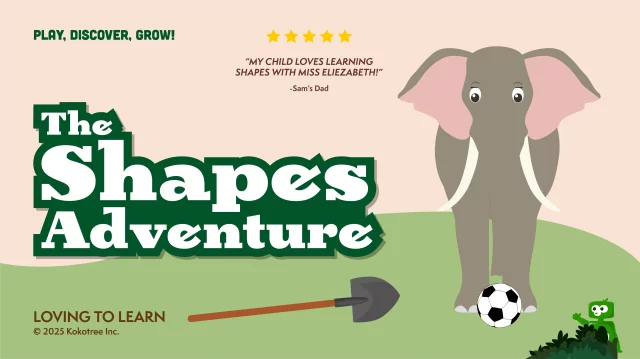
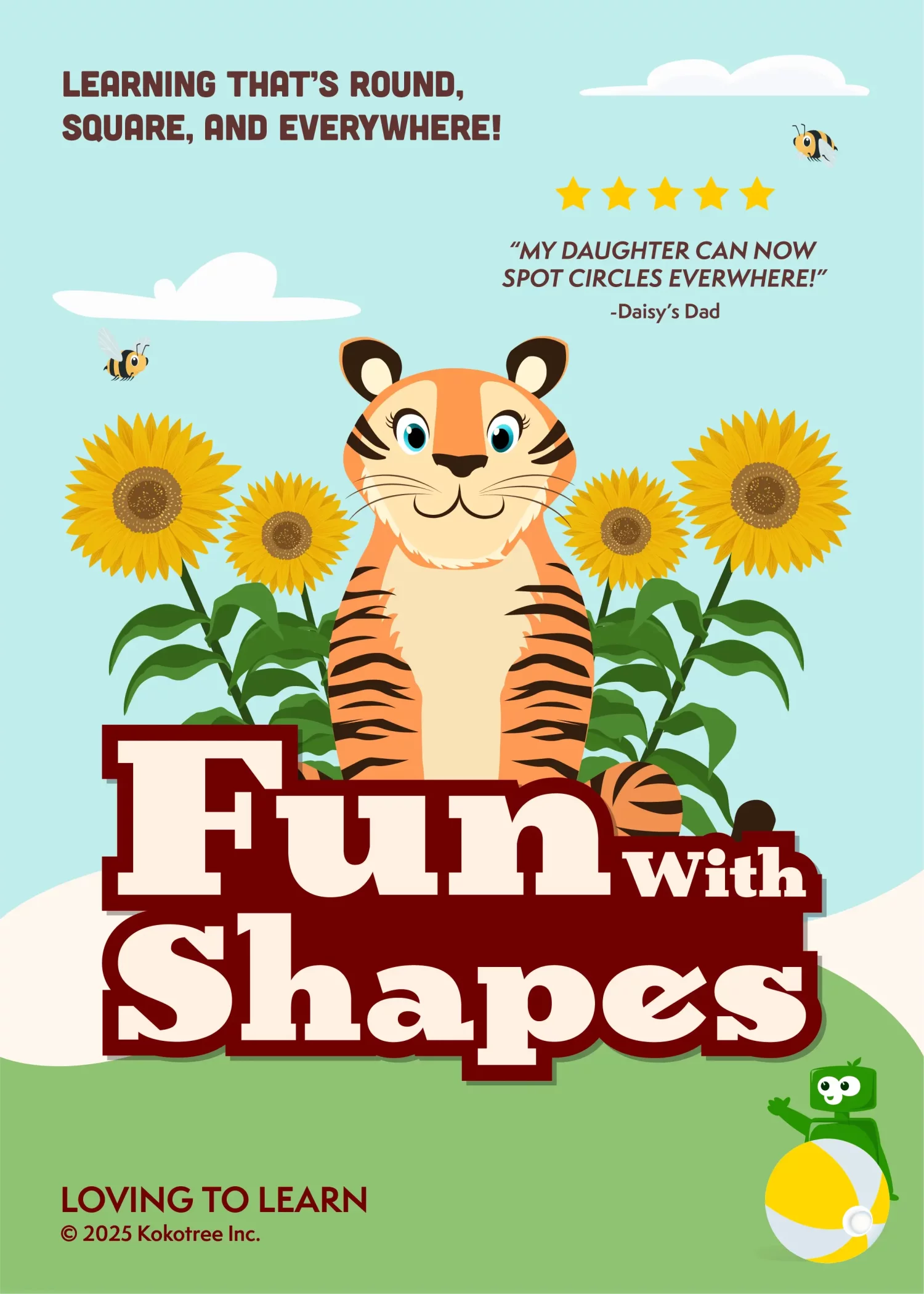
Your little one joins Meera the Tiger and friends on an outdoor adventure where shapes come alive! They'll spot circles in ponds and sunflowers, then build square sandwiches at a picnic—learning to identify shapes everywhere they look.
7 minutes
Ages 2-5
Skill: Shape recognition and identification
Your kid watches friendly animals discover shapes in nature and food. You get 7 minutes to enjoy your coffee while it's still warm.
Meera the Tiger leads a cheerful outdoor class where animal friends explore circles first—finding them in ponds, tree logs, sunflowers, and the bright sun. Then the crew heads to a picnic where they discover squares in lunch boxes, napkins, bread slices, and cheese while making sandwiches together.
What your child learns:
Your child will master two foundational shapes through real-world examples they can actually see and touch. They'll learn the defining characteristics of each shape and start noticing them everywhere.
- Identifies circles by their round, continuous shape with no corners
- Recognizes squares by counting four equal sides
- Spots shapes in nature (ponds, sunflowers, tree rings)
- Finds shapes in everyday objects (food, toys, household items)
- Understands that the same shape can be different sizes
They'll use these skills when:
- Setting the table and noticing plate shapes vs. napkin shapes
- Playing with blocks and sorting by shape
- Looking out the car window and spotting wheels, signs, and windows
- Helping in the kitchen and identifying food shapes
The Story (what keeps them watching)
Meera the Tiger welcomes everyone to an outdoor classroom adventure! First, the friends explore circles—Ruby shows off her hula hoop, and everyone discovers circles hiding in the pond, tree logs, sunflowers, and even the sun. Then Maddy Monkey plays guitar at a picnic (he calls his song "Maddy's Melody"—adorable!), and Miss Meera reveals that all their picnic mats are squares. The gang makes cheese sandwiches together, discovering squares in lunch boxes, napkins, bread, and cheese slices. Bobby Bear is thrilled about the sandwiches, and Maddy sneakily eats his bread before the lesson ends!
How We Teach It (the clever part)
First 3 minutes: Circles are introduced through catchy rhymes ("This is a circle, a shape that's round. It has no end or beginning found.") Then real-world examples appear—pond, log rings, sunflowers, sun, and Ruby's hula hoop.
Minutes 3-5: The scene shifts to a picnic where squares are introduced. Children observe picnic mats and identify the key feature: four equal sides. Eddie makes an "acute observation" about Tiki's square lunch box.
Final 2 minutes: Hands-on sandwich-making reinforces square recognition. Each item (napkin, bread, cheese) is identified as a square, with children explaining why—cementing the "four equal sides" rule.
Teaching trick: The video uses a "spot it in real life" approach—showing shapes in nature and food items kids already know. This transfers abstract geometry into concrete, touchable examples they'll remember at snack time.
After Watching: Quick Wins to Reinforce Learning
Mealtime shape hunt: "Can you find all the circles on your plate?" Point to cups, bowls, and round foods. Then ask about squares—crackers, sandwich bread, cheese slices. (Practices identifying shapes in familiar contexts)
Car window spotting: "I spy something round—wheels! Can you find more circles outside?" Move to squares with windows and signs. (Builds observation skills and reinforces shape vocabulary)
Bedtime book hunt: Before reading, ask "Can you find a circle on this book cover? What about a square?" Check the spine, pages, and illustrations. (Extends learning into calm, focused moments)
Kitchen helper time: Next time you're cooking, hand your child a slice of bread. "What shape is this? How do you know?" Let them count the sides. (Reinforces the "four equal sides" rule with hands-on practice)
When Kids Get Stuck. And How to Help.
"My child calls every shape a circle." Totally normal at this age! Circles are often learned first because they're everywhere. Gently trace the edges together: "Let's feel this shape. Does it have corners? Circles are smooth all around, but squares have pointy corners."
"She can't explain WHY something is a square." Understanding comes before explaining. Keep counting sides together out loud: "One, two, three, four—four sides that are all the same! That's what makes it a square." The language will click with repetition.
"He seems bored with basic shapes." Great sign—he might be ready for more! Try shape combinations: "Can you make a house using a square AND a triangle?" Or go on a hunt for circles and squares in the same object (like a clock with a square frame).
What Your Child Will Learn
Prerequisites and Building Blocks
This video is perfect for children just beginning their geometry journey—no prior shape knowledge required! It builds foundational visual discrimination skills that prepare children for more complex shapes like triangles and rectangles. "Fun With Shapes" connects naturally to counting concepts (counting four sides) and comparison skills (same length sides). Children who've explored basic sorting and categorizing will find shape identification a natural next step in their mathematical thinking development.
Cognitive Development and Teaching Methodology
The video leverages concrete-to-abstract learning progression ideal for ages 2-5. Children first see real objects (ponds, sandwiches), then connect them to shape vocabulary. The multi-sensory approach—visual examples, rhythmic songs, and the sandwich-making activity—addresses visual, auditory, and kinesthetic learners simultaneously. Repetition through rhyme ("This is a circle, a shape that's round") supports memory encoding, while peer modeling shows children discovering shapes together, normalizing the learning process.
Alignment with Educational Standards
This video addresses Common Core Kindergarten Geometry standards (K.G.A.2: correctly naming shapes regardless of size or orientation) and NAEYC guidelines for early mathematics. Shape recognition is a key kindergarten readiness indicator—teachers expect incoming students to identify basic shapes and describe their attributes. The emphasis on "four equal sides" for squares introduces precise mathematical language that builds toward first-grade geometry benchmarks involving shape properties and classifications.
Extended Learning Opportunities
Pair this video with Kokotree's shape sorting games and tracing activities in the app. Print simple shape worksheets for circle and square practice. Create a "shape walk" around your home, photographing circles and squares for a homemade book. Play "Shape Bingo" during meals. For extended screen-free learning, use playdough to form circles and squares, or sort household items (buttons, blocks, crackers) by shape. The sandwich-making activity from the video makes an excellent real-world follow-up!
Transcript Highlights
- Defining circles: "This is a circle, a shape that's round. It has no end or beginning found."
- Circle characteristics: "A circle has no beginning or end, just like your hula hoop. You can go 'round and 'round in circles."
- Introducing squares: "Can you observe and share what features make squares special?" "It has four sides." "All the sides are the same length." "Wonderful! That's right. Four equal sides make a square."
- Real-world application: "The slice of cheese had four equal sides. That means it's a square too!" "Ha ha ha. We can see squares everywhere."
Character Development and Story Arc
Meera the Tiger models excellent teaching behaviors—asking open-ended questions ("Can you observe and share what features make squares special?") and celebrating discoveries ("That is such an acute observation, Eddie!"). The student characters demonstrate curiosity and enthusiasm, with Ruby connecting circles to her hula hoop and Bobby excitedly counting sides. Maddy Monkey adds humor by eating his bread, showing that learning can be playful. Each character contributes observations, modeling collaborative learning and building confidence in sharing ideas.
Shape Recognition: The Mathematical Foundation
Shape recognition is far more than memorizing names—it's the foundation of spatial reasoning, a critical predictor of later mathematical success. When children identify circles and squares, they're developing visual discrimination skills that support letter recognition (distinguishing 'O' from 'Q'), number sense (recognizing '0' vs '8'), and eventually geometry and measurement.
The video's approach of teaching defining attributes ("four equal sides") rather than just shape names builds mathematical thinking. Children learn that a square is ALWAYS a shape with four equal sides—whether it's tiny like a cheese slice or large like a picnic mat. This attribute-based understanding transfers to more complex concepts later.
Circles introduce the concept of curves versus straight lines, while squares introduce corners (vertices) and the idea of equal measurement. Together, these two shapes create a foundation for comparing and contrasting—a key mathematical reasoning skill.
The real-world examples (ponds, sunflowers, lunch boxes, sandwiches) leverage what researchers call "mathematizing"—helping children see math in their everyday environment. This approach builds number sense naturally and creates countless opportunities for parents to reinforce learning during daily routines. When your child spots a circular plate or square window, they're practicing the same visual analysis skills that will later help them understand area, perimeter, and geometric proofs.