
What's Four Friends About?
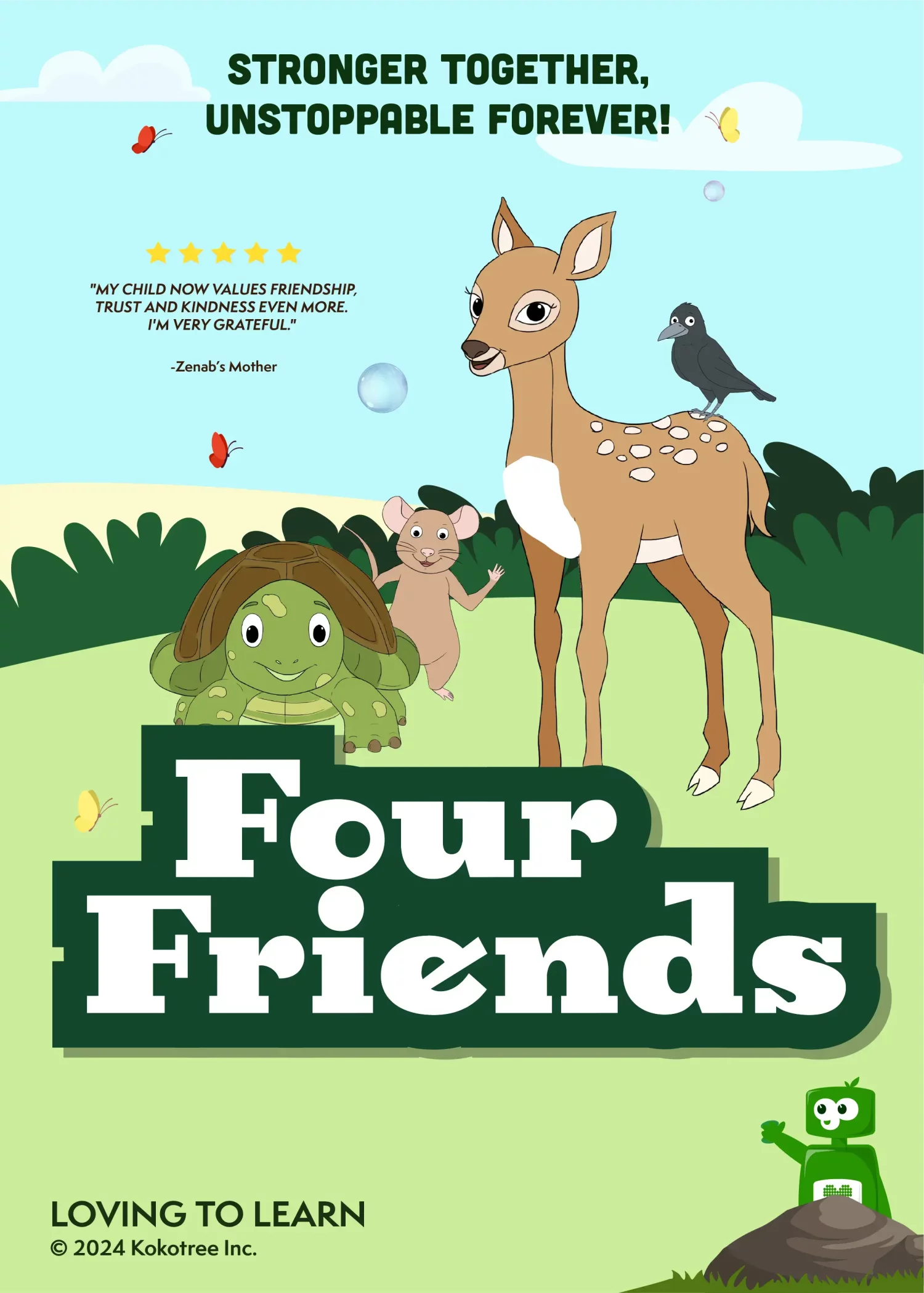
Watch as Miss Meera shares an exciting tale of a deer, crow, rat, and tortoise who prove that friendship means showing up for each other when it matters most. Your child will discover how working together and using each friend's unique strengths can solve any problem!
7 minutes
Ages 3-6
Skill: Social-Emotional Learning & Teamwork
Your kid watches animal friends rescue each other through clever teamwork. You get 7 minutes to enjoy your coffee while it's still warm.
The video opens with Maddy Monkey and Gina Giraffe working together to pick apples for their classmates—showing teamwork in action right away. Then Miss Meera gathers everyone for a story about four forest friends: a deer, crow, rat, and tortoise. When the deer gets trapped in a hunter's net, each friend uses their special ability to help—the crow flies to scout, the rat chews through ropes, and they all work together to outsmart danger.
What your child learns:
This story teaches children that everyone has something valuable to contribute, and that true friends help each other through difficult situations. Kids see problem-solving in action as each animal uses their unique strengths.
- Understanding that friends help each other in times of need
- Recognizing that everyone has different strengths to contribute
- Learning basic problem-solving through teamwork
- Practicing gratitude and saying "thank you"
- Building empathy by caring about others' safety
They'll use these skills when:
- Helping a friend who dropped their crayons or needs assistance
- Working together with siblings or classmates on a project
- Figuring out how to solve a problem by asking for help
- Expressing gratitude when someone does something kind for them
The Story (what keeps them watching)
Maddy Monkey and Gina Giraffe kick things off by working together to pick apples for their class—teamwork in action! This inspires Miss Meera to share a tale of four unusual forest friends: a deer, crow, rat, and tortoise who meet daily under an apple tree. When the deer gets caught in a hunter's net, panic sets in—but not for long! The crow scouts from above, the rat chews through the net with his sharp teeth, and when the tortoise later gets captured, the whole gang pulls off a brilliant rescue using their unique talents. The story ends with a catchy friendship song that'll have your little one humming about helping friends!
How We Teach It (the clever part)
- First 2 minutes: Teamwork is modeled immediately through Maddy and Gina's apple-picking cooperation, showing kids what helping looks like in everyday moments.
- Minutes 2-6: The story introduces a problem (trapped deer) and shows step-by-step how friends identify solutions using their individual strengths—crow flies, rat chews, deer runs fast.
- Final minute: A memorable friendship song reinforces the lesson, making the concepts stick through music and repetition.
Teaching trick: Each animal's rescue contribution matches their natural ability (crow flies to scout, rat's teeth cut rope, tortoise hides in water), helping kids understand that everyone has something special to offer—even if their strengths look different.
After Watching: Quick Wins to Reinforce Learning
- Mealtime activity: "Who helped make this meal? Let's say thank you!" (Practices gratitude and recognizing when others help us)
- Car/travel activity: "If you were stuck somewhere, which friend would you call? What could they do to help?" (Builds problem-solving thinking and understanding different strengths)
- Bedtime activity: "Tell me about a time a friend helped you today, or you helped a friend." (Reinforces recognizing helping behaviors in their own life)
- Anytime activity: "Let's be like the four friends! You hold one side, I'll hold the other, and we'll fold this blanket together." (Practices real teamwork with immediate results)
When Kids Get Stuck. And How to Help.
- "My child doesn't want to share or help others yet." - This is completely normal developmental behavior! Keep modeling helping and praise any small attempts. The video plants seeds—growth takes time.
- "They don't understand why the animals didn't just run away at the start." - Young children are still developing cause-and-effect thinking. Simply explain: "The deer's legs were stuck in the net, so he needed his friends' help to get free."
- "My child seems scared of the hunter part." - The hunter is shown minimally and the friends always win! Reassure them: "The friends are so clever—they always help each other stay safe."
What Your Child Will Learn
Prerequisites and Building Blocks
Children watching this video benefit from basic understanding of animal types and simple cause-and-effect relationships. This story builds on foundational social concepts like sharing and taking turns, extending them into more complex teamwork scenarios. It fits within the "Budding Sprouts" program's progression of social-emotional learning, bridging simple cooperation toward understanding how different contributions combine to solve bigger problems. No prior Kokotree videos are required, but familiarity with the classroom characters enhances engagement.
Cognitive Development and Teaching Methodology
At ages 3-6, children are developing theory of mind—understanding that others have different abilities and perspectives. This story leverages that development by showing four animals with distinct strengths contributing to shared goals. The narrative structure (problem → collaborative solution → celebration) matches how young minds process stories. Visual learners see the rescue unfold; auditory learners absorb Miss Meera's narration and the closing song; kinesthetic concepts are modeled through the physical actions of flying, chewing, and running.
Alignment with Educational Standards
This video supports Head Start Early Learning Outcomes in Social-Emotional Development, specifically SE-MR (Making and maintaining friendships) and SE-PR (Problem-solving with peers). It aligns with kindergarten readiness indicators for cooperation and communication. CASEL competencies addressed include relationship skills and responsible decision-making. Teachers expect entering kindergarteners to demonstrate basic collaborative play and helping behaviors—this video models exactly those interactions through relatable animal characters.
Extended Learning Opportunities
Pair this video with Kokotree's friendship-themed coloring pages featuring the four forest friends. The app's "Helping Hands" matching game reinforces identifying how different helpers contribute. Parents can extend learning by creating a "friendship chain" paper craft—each link representing a way to help others. Reading books about unlikely animal friendships or playing cooperative board games (where everyone wins together) deepens these concepts beyond screen time.
Transcript Highlights
- GINA GIRAFFE: "Teamwork makes the dream work!" — Introduces the core concept in memorable, child-friendly language.
- RAT: "I will go with the crow and cut the net with my sharp teeth!" — Models identifying personal strengths and offering specific help.
- RAT: "We are always there for one another. As long as we help each other, we'll always be safe!" — Summarizes the friendship lesson explicitly.
- MISS MEERA (singing): "True friends will be there for you and you'll know. That good friends are the best." — Reinforces learning through musical repetition.
Character Development and Story Arc
The four forest friends each demonstrate distinct problem-solving approaches that model growth mindset. The crow takes initiative by scouting—showing leadership. The rat offers his unique ability without hesitation—modeling confidence in personal strengths. The tortoise, despite being slower, never gives up and trusts his friends—demonstrating persistence and faith. The deer expresses genuine gratitude, modeling emotional intelligence. Together, they show children that being a good friend means both giving and receiving help.
Social-Emotional Development: The Science of Friendship in Early Childhood
Between ages 3-6, children transition from parallel play to truly cooperative interactions. This video arrives at a crucial developmental window when children are learning that friendships involve reciprocity—helping and being helped. Research in developmental psychology shows that children this age are beginning to understand that others have different capabilities, a concept called "differentiated helping." The story brilliantly illustrates this: the crow can fly (so he scouts), the rat has sharp teeth (so he cuts), the deer runs fast (so he distracts). This teaches children to recognize and value diverse contributions rather than expecting everyone to help in identical ways.
The rescue scenario also introduces age-appropriate problem-solving under pressure. Young children often freeze when problems arise, but watching characters calmly assess situations and delegate tasks based on abilities provides a mental model for collaborative problem-solving. The repeated pattern of "friend in trouble → friends help → everyone safe" builds emotional security around the concept that asking for help is both normal and effective.
The closing song serves a developmental purpose beyond entertainment. Musical encoding helps children retain social-emotional concepts more effectively than spoken instruction alone. The lyrics "tell your friends that you care" provide concrete language children can use in their own relationships, bridging the gap between understanding friendship abstractly and practicing it in daily interactions.