
What's Fun Time With E & F About?
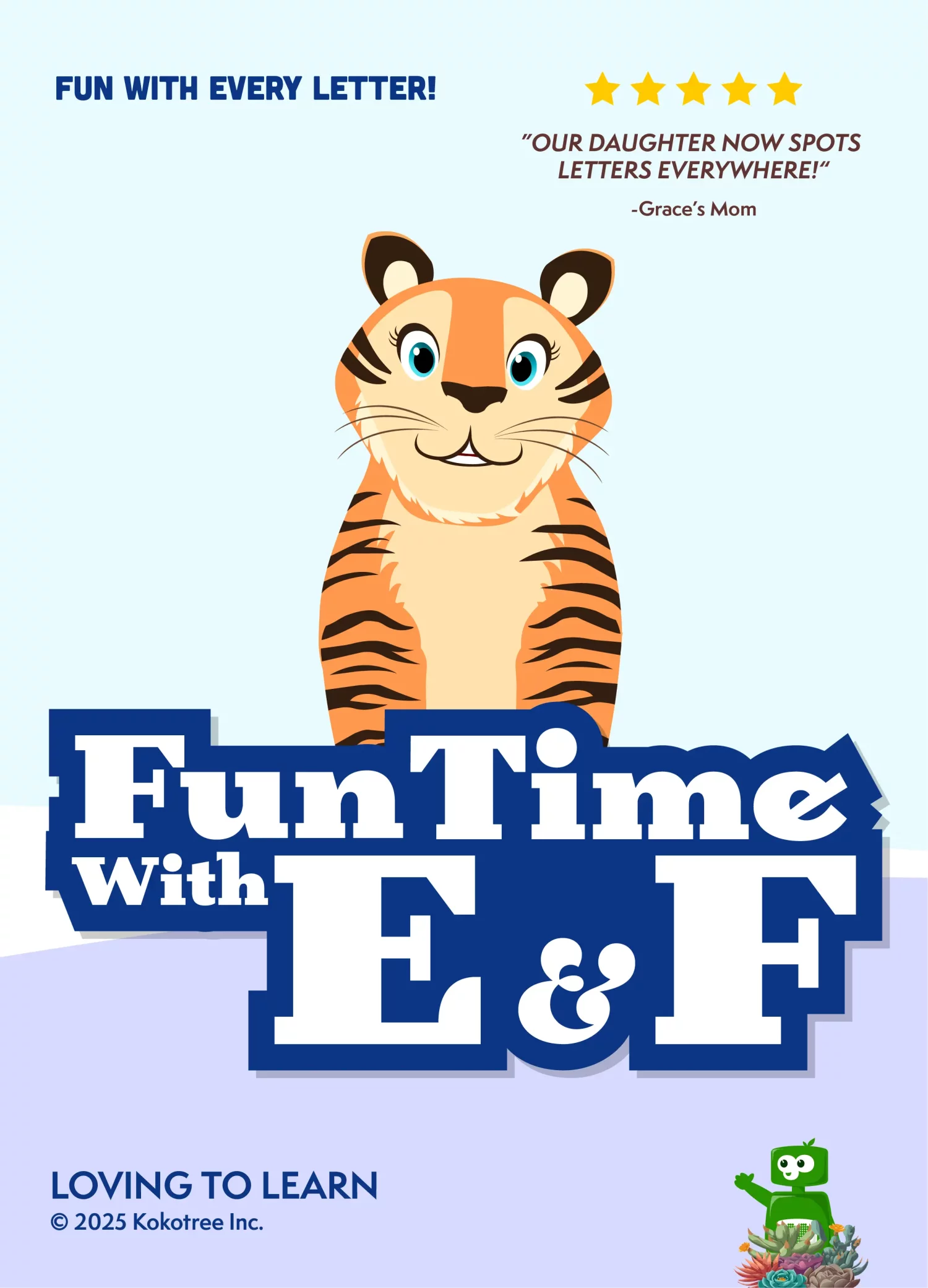
Your little one joins the Kokotree class for an adventure with two fantastic letters! They'll master the tricky letter E (it makes TWO sounds!) and discover the friendly 'fuh' of letter F through stories, songs, and surprise birthday presents.
8 minutes
Ages 3-5
Skill: Letter sounds and phonics foundations
Your kid watches animal friends explore letter sounds through stories. You get 8 minutes to finish that cup of coffee while it's still warm.
Miss Meera teaches the class about letter E using an imaginative story about Emily the Elephant who protects baby eaglets. Then the class surprises Miss Meera with birthday gifts—a flower, feather, frisbee, flag, fan, flute, and frog—all starting with the letter F!
What your child learns:
This video tackles one of phonics' trickiest concepts: letters that make multiple sounds. Your child will understand that E says both 'eh' (like empty) and 'ee' (like eagle), while F consistently says 'fuh.' They'll connect these sounds to real objects they can see and touch.
- Identifies the short 'eh' sound in words like elephant, egg, and echo
- Recognizes the long 'ee' sound in words like eagle, evening, and Emily
- Produces the 'fuh' sound and connects it to F words
- Matches beginning sounds to familiar objects
- Distinguishes between two sounds made by the same letter
They'll use these skills when:
- Sounding out words in picture books at bedtime
- Spotting letters on signs during car rides
- Playing 'I Spy' games with beginning sounds
- Writing their first words and spelling their name
The Story (what keeps them watching)
The adventure starts when Bobby, Maddy, and Gina play pretend with an empty bottle—perfect timing for Miss Meera to introduce letter E! She tells a heartwarming story about Emily the Elephant who discovers eleven eaglets in a fallen nest. Emily stays all night to protect them, feeds them worms, and watches the eleventh egg hatch into a beautiful white eaglet she names Emma. Then comes a birthday surprise! The class gives Miss Meera gifts that all start with F: a flower, feather, frisbee, flag, fan, flute, and one ribbiting frog. Learning sneaks right in with the fun!
How We Teach It (the clever part)
- First 3 minutes: Miss Meera introduces letter E through the empty bottle, teaching both the short 'eh' and long 'ee' sounds with clear examples like 'empty' and 'eagle.'
- Minutes 3-6: The Emily the Elephant story immerses children in E words naturally—elephant, evening, eggs, eaglets, echo, east—reinforcing both sounds through narrative.
- Final 2 minutes: The birthday surprise introduces letter F with tangible objects kids recognize, practicing 'fuh, fuh, flower' repetition for each gift.
Teaching trick: The video uses alliteration throughout Emily's story (eleven eggs, extremely large, echo) so children hear the E sound repeated naturally in context—not just in isolation.
After Watching: Quick Wins to Reinforce Learning
- Mealtime activity: "What 'eh' sounds can we find?" Point to eggs, bread, vegetables—anything with that short E sound. Count how many you discover together!
- Car/travel activity: "Let's find F things!" Spot flowers, fences, flags, or even french fries. Make the 'fuh' sound together each time.
- Bedtime activity: "Tell me about Emily the Elephant." Ask your child to retell the story—they'll naturally use E words and practice comprehension.
- Anytime activity: "E has two sounds—which one is this?" Say words like 'eat,' 'red,' 'tree,' 'bed' and have them identify short or long E.
When Kids Get Stuck. And How to Help.
- "My child mixes up the two E sounds." Totally normal! The short 'eh' and long 'ee' take time to distinguish. Use hand motions—a quick tap for short E, a stretched-out wave for long E.
- "They can say the sound but can't find it in words." Start with the beginning of words only. Ask 'Does ELEPHANT start with eh?' before moving to sounds in the middle of words.
- "The F sound comes out like a P or B." Show them how F uses air flowing through teeth and lips (not a 'pop' sound). Have them feel the air on their hand as they say 'fuh.'
What Your Child Will Learn
Prerequisites and Building Blocks
Children watching this video benefit from prior exposure to basic letter recognition—knowing that letters are symbols with sounds. This episode builds on earlier Kokotree alphabet content and prepares learners for blending sounds into words. Understanding that one letter can make multiple sounds (like E) is a crucial stepping stone toward decoding and early reading. This video bridges single-letter recognition toward phonemic awareness.
Cognitive Development and Teaching Methodology
At ages 3-5, children learn best through story and repetition. This video embeds phonics instruction within an engaging narrative (Emily the Elephant), activating episodic memory alongside phonological learning. Visual learners see the letters and objects; auditory learners hear repeated sounds; kinesthetic connections happen when children later touch real flowers, feathers, or fans. The call-and-response format invites active participation rather than passive viewing.
Alignment with Educational Standards
This content aligns with Common Core Foundational Skills RF.K.2 (demonstrating understanding of spoken words and sounds) and RF.K.3 (knowing letter-sound correspondences). Head Start Early Learning Outcomes Framework addresses this under Phonological Awareness. Kindergarten readiness assessments typically expect children to identify beginning sounds and recognize that letters represent sounds—exactly what this video teaches.
Extended Learning Opportunities
Pair this video with Kokotree's letter tracing activities for E and F. Print simple worksheets where children circle objects starting with each letter. Play the Kokotree phonics matching game. Extend learning by creating an 'E and F treasure box' at home—collect small objects (erasers, toy elephants, feathers, plastic flowers) for hands-on sound sorting practice.
Transcript Highlights
- "The Letter E has something special about it. It has not one but two sounds. One is the short sound 'eh'. Like the word empty."
- "But the letter E can also make a different sound: a long 'ee' sound." [Eagle flies overhead] "Just like the eagle that just flew over us!"
- "All the gifts you got begin with the letter F and the sound of the letter F is 'fuh'. Let's go—Fuh, fuh, fan. Fuh, fuh, feather."
- "You could hear the 'eh' 'eh' in egg. And the 'eh' 'eh' in elephant. The 'eh' 'eh' in extraordinary."
Character Development and Story Arc
Emily the Elephant models compassion and responsibility when she chooses to protect the eaglets instead of continuing her search for food. She demonstrates patience by waiting through the night and problem-solving by finding worms for the hungry babies. The Kokotree class characters show enthusiasm for learning and generosity through their birthday surprise. Miss Meera models curiosity by connecting everyday objects (an empty bottle) to learning opportunities.
Phonics Deep Dive: Understanding Vowel Sounds and Consonant Consistency
The letter E presents one of English phonics' most important concepts: vowels make multiple sounds. This video introduces the short vowel sound /ĕ/ (as in 'egg,' 'elephant,' 'empty') and the long vowel sound /ē/ (as in 'eagle,' 'evening,' 'Emily'). Understanding this duality is essential for decoding—children must learn to try both sounds when encountering unfamiliar words.
Research in phonological awareness shows that explicit instruction in vowel sounds significantly improves reading outcomes. The story format helps because children hear the sounds in meaningful context, not isolation. When Emily the Elephant searches 'east' and hears her footsteps 'echo,' children absorb multiple E-sound examples without drill-and-kill repetition.
Contrasting E with F reinforces an important distinction: consonants typically make one consistent sound, while vowels vary. The 'fuh' sound is reliable—flower, feather, flag, frog all begin identically. This consistency helps children build confidence before tackling trickier phonics patterns.
The video's use of alliteration (eleven eggs, extremely large, Emily eventually) creates phonemic density—children hear target sounds repeatedly within seconds. This technique, supported by literacy research, strengthens sound-symbol connections in working memory. By the video's end, children have heard the short E sound over twenty times in natural speech patterns, building automatic recognition that transfers to reading readiness.