
What's Sound Fun G And H About?
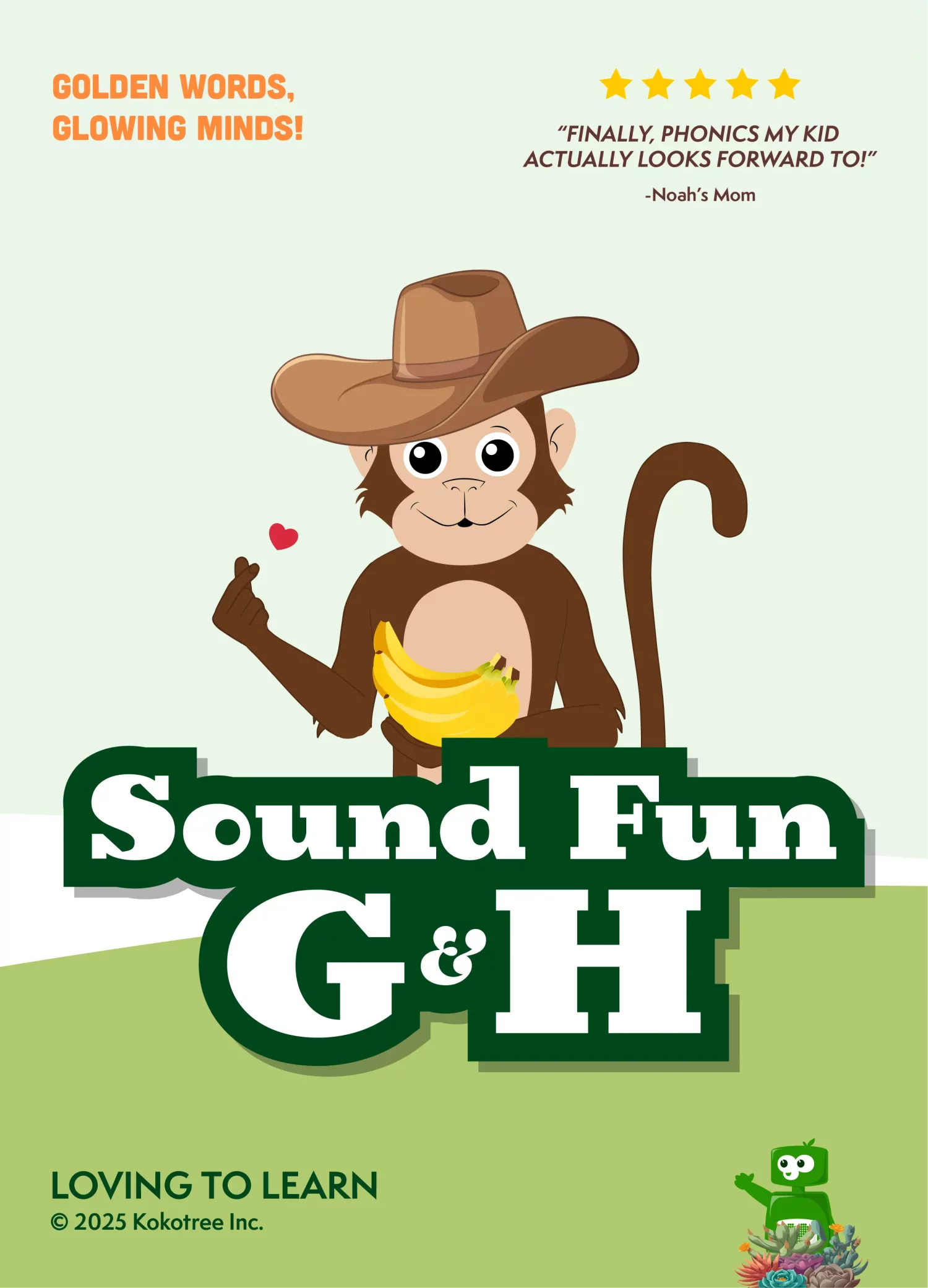
Your little one joins Miss Meera for two delightful stories packed with the sounds of letters G and H. By the end, they'll be confidently saying "guh... guh... golden" and "huh... huh... happy" while spotting these sounds in words all around them!
8 minutes
Ages 3-5
Skill: Letter sounds and phonics awareness
Your kid watches friendly animals discover letter sounds through stories. You get 8 minutes to finish that coffee in peace.
The Kokotree friends start by playing catch with a golden ball, which sparks Miss Meera to tell an enchanting story about gnomes caring for a magical glowing garden. Then Maddy the monkey shares how he got his new hat from Uncle Hubert. Both stories are cleverly packed with G and H words that kids naturally absorb.
What your child learns:
This video builds essential phonics foundations by connecting letter sounds to memorable stories. Children practice isolating the beginning sounds of words and learn to recognize these sounds in different contexts.
- Identifies the "guh" sound at the beginning of words like golden, glow, grass, and grand
- Recognizes the "huh" sound in words like hat, happy, heart, and hill
- Practices pronunciation by repeating sounds with the class
- Connects letter sounds to familiar objects and concepts
- Builds listening skills by identifying repeated sounds in stories
They'll use these skills when:
- Sounding out words while learning to read picture books
- Playing "I Spy" games with beginning letter sounds
- Writing their first words and connecting sounds to letters
- Following along with alphabet songs and rhymes
The Story (what keeps them watching)
Ronnie brings a golden ball to class, inspiring Miss Meera to tell a magical tale about gnomes who tend a beautiful garden lit by a glowing golden ball. When the ball grows dim, the determined gnomes work together to polish it back to brilliance—and every sentence sparkles with "guh" words! Then Maddy excitedly shares how he found a surprise hat on his hammock from Uncle Hubert, weaving in "huh" sounds throughout his happy morning adventure. Both stories make letter sounds feel like treasure hunts!
How We Teach It (the clever part)
- First 3 minutes: The golden ball story immerses children in G-sound words naturally—gnomes, garden, glowing, grass, grasshoppers, guava—before they even realize they're learning phonics.
- Minutes 3-5: Miss Meera explicitly teaches the "guh" sound, having children repeat words like golden, glow, grand, and green with the sound isolated at the beginning.
- Final 3 minutes: Maddy's hat story introduces the "huh" sound through words like hut, hammock, happy, and heart, with children actively identifying the repeated sound themselves.
Teaching trick: By embedding target sounds in engaging stories BEFORE explicitly teaching them, children's brains have already started recognizing patterns. When Miss Meera asks "Did you notice the repeated sound?" kids experience that satisfying "aha!" moment of discovery.
After Watching: Quick Wins to Reinforce Learning
- Mealtime activity: "Can you find something on your plate that starts with 'guh'?" (Grapes, green beans, granola—practice connecting the sound to real food items)
- Car/travel activity: "Let's play G and H I-Spy! I spy something that starts with 'guh'... grass!" (Turns observation time into phonics practice with trees, houses, hills)
- Bedtime activity: "What made you 'huh-huh-happy' today?" (Reinforces the H sound while building connection through conversation)
- Anytime activity: Go on a "G and H hunt" around your home—find a glass, a game, a hairbrush, or a hook! (Makes phonics tangible and exciting)
When Kids Get Stuck. And How to Help.
"My child mixes up G and H sounds" - Totally normal! These are both made in the back of the throat. Try having them feel their throat while saying each sound—G has a tiny vibration, H is just air. Practice with exaggerated sounds: "Guh-guh-guh" vs "Huh-huh-huh."
"They can hear the sounds but can't think of words" - That's actually great progress! Sound recognition comes before word generation. Keep playing "I Spy" where YOU give the words and they identify the starting sound. Production will follow.
"The stories seem too long for my child's attention" - Try watching one letter section at a time! The video naturally breaks into two mini-lessons. Mastering G first, then adding H later, can feel more manageable for younger learners.
What Your Child Will Learn
Prerequisites and Building Blocks
Children benefit most from this video if they have basic letter recognition and understand that words are made up of individual sounds. This episode builds on foundational alphabet awareness and prepares learners for blending sounds into words. It pairs well with other Sound Fun episodes covering different letter sounds, creating a comprehensive phonics foundation. The storytelling format assumes children can follow a simple narrative arc.
Cognitive Development and Teaching Methodology
This video employs narrative-based phonics instruction, which research shows significantly improves sound retention in preschoolers. By embedding target sounds in memorable stories before explicit instruction, the approach leverages implicit learning—children's brains naturally detect patterns. The call-and-response repetition ("Guh... guh... golden") activates auditory processing and motor memory simultaneously, addressing multiple learning modalities within a single engaging format.
Alignment with Educational Standards
This content aligns with Common Core Foundational Skills RF.K.2 (demonstrating understanding of spoken words and sounds) and RF.K.3 (knowing letter-sound correspondences). It supports kindergarten readiness benchmarks for phonemic awareness, specifically isolating initial sounds in words. Teachers expect incoming kindergarteners to recognize that words begin with specific sounds—this video builds exactly that skill through repeated, joyful practice.
Extended Learning Opportunities
Pair this video with letter G and H tracing worksheets to connect sounds to written symbols. The Kokotree app offers interactive games where children match objects to their beginning sounds. Extend learning with a "sound journal"—children draw pictures of G and H words they discover. Create simple alliterative sentences together: "Happy hippos hop on hills" reinforces sound patterns while building vocabulary.
Transcript Highlights
- "'Guh' is the sound of the Letter G. Let's recall a few 'guh' sound words from the story. I'll say the word and you repeat after me."
- "Guh... guh... golden. Guh... guh... glow. Guh... guh... grand. Guh... guh... green. Guh... guh... grass."
- "'Huh' is the sound of the Letter H. Let's practice that sound. Like, huh... huh... hairy. Huh... huh... horse. Huh... huh... happy."
- "There are so many other things around us which start with the Letter H. Keep observing and exploring."
Character Development and Story Arc
Miss Meera models enthusiastic teaching and genuine curiosity, showing children that learning is exciting. Ronnie demonstrates generosity by sharing his golden ball, sparking the lesson naturally. Maddy shows pride in sharing his story, modeling confident communication. Ruby and Bobby Bear actively participate by raising hands and offering answers, demonstrating that contributing to discussions is valued and celebrated.
Phonics Development: The Science of Letter Sounds G and H
The letters G and H represent fascinating phonetic territory for young learners. The hard G sound (/g/) is a voiced velar stop—produced when the back of the tongue touches the soft palate, briefly stopping airflow before releasing with vocal cord vibration. The H sound (/h/) is a voiceless glottal fricative—essentially shaped breath with no vocal cord involvement, making it one of the quietest consonants.
For preschoolers, these sounds present unique learning opportunities. The G sound connects to many high-frequency words children encounter early: go, get, good, and give. The H sound appears in foundational vocabulary like have, help, and here. Research in phonemic awareness shows that children who can isolate beginning sounds demonstrate stronger reading readiness.
The video's approach of embedding sounds in stories before explicit instruction aligns with constructivist learning theory—children build understanding through experience before formal teaching crystallizes knowledge. The repetition pattern ("Guh... guh... golden") isolates the target phoneme, helping children distinguish it from the rest of the word. This segmentation skill directly supports future decoding abilities.
Notably, both G and H can represent multiple sounds in English (soft G in "giraffe," silent H in "hour"), but this video wisely focuses on the most common, predictable sound-letter correspondences first—building confidence before introducing complexity.