
What's Math Fun Add And Subtract About?
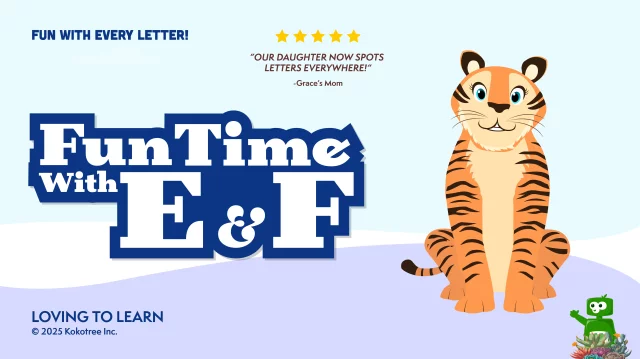
Dive into an exciting phonics adventure where your child discovers the magic of letters E and F through storytelling and sound exploration! They'll confidently identify letter sounds and connect them to real words they already know.
8 minutes
Ages 3-6
Skill: Letter sounds and phonics recognition
Your kid watches friendly animals explore letter sounds through stories. You get 8 minutes to enjoy your coffee in peace.
Miss Meera guides the Kokotree class through two letter lessons using everyday objects and an enchanting story about Emily the Elephant caring for baby eaglets. The class discovers birthday presents that all start with F, making the 'fuh' sound stick through repetition and fun.
What your child learns:
Your little one will discover that the letter E is special because it makes TWO sounds—the short 'eh' in elephant and the long 'ee' in eagle. They'll also master the letter F's consistent 'fuh' sound through memorable object associations.
- Recognizes the letter E and its two distinct sounds (short and long)
- Identifies the letter F and produces the 'fuh' sound correctly
- Connects letter sounds to familiar objects (eagle, egg, flower, frog)
- Develops phonemic awareness through alliteration and repetition
- Builds vocabulary with E and F words
They'll use these skills when:
- Sounding out words in picture books at bedtime
- Spotting letters on signs during car rides
- Playing alphabet games with toys and stuffed animals
- Telling stories and describing objects to friends and family
The Story (what keeps them watching)
The adventure begins when the Kokotree kids play imaginatively with an empty bottle—sparking Miss Meera's lesson on the letter E! She tells a heartwarming tale of Emily the Elephant who discovers a nest of eleven eaglets in the jungle. Emily stays all evening to protect them, feeds them worms, and watches the eleventh egg hatch into a beautiful white eaglet named Emma. Then comes a birthday surprise for Miss Meera, where every gift—flower, feather, frisbee, flag, fan, flute, and a friendly frog—starts with F!
How We Teach It (the clever part)
- First 3 minutes: The letter E is introduced through the word 'empty,' then both short and long E sounds are demonstrated with eagle and elephant examples
- Minutes 3-6: Emily the Elephant's story immerses children in E words naturally—evening, eggs, eaglets, echo, east—reinforcing both sounds through narrative
- Final 2 minutes: The birthday surprise introduces letter F with seven tangible objects, each repeated with the 'fuh' sound for maximum retention
Teaching trick: The video uses alliteration storytelling—packing Emily's adventure with E words so children hear the sounds dozens of times without feeling drilled. The birthday gift reveal makes F words feel like exciting discoveries rather than lessons.
After Watching: Quick Wins to Reinforce Learning
Mealtime activity: "Can you find something on your plate that starts with E or F?" Point to eggs, fruit, or fish sticks and practice the sounds together. Great for connecting letters to everyday foods!
Car/travel activity: "Let's play the E and F spotting game!" Look for exit signs, fire trucks, or flags. Each time they spot one, have them make the letter sound three times.
Bedtime activity: "What if an elephant visited your room tonight?" Ask your child to tell you a short story using E words they remember—evening, ears, eyes. Storytelling reinforces vocabulary!
Anytime activity: Gather five objects starting with F from around the house—a fork, a feather, something fuzzy. Line them up and let your child be the teacher, saying 'fuh, fuh, fork' just like Miss Meera!
When Kids Get Stuck. And How to Help.
"My child confuses the two E sounds" - This is completely normal! The short 'eh' and long 'ee' take time to distinguish. Practice with word pairs: 'egg' vs 'eagle,' 'empty' vs 'evening.' Exaggerate the sounds and make silly faces!
"They can make the sound but can't identify the letter" - Sound recognition often comes before visual recognition—that's actually great progress! Draw big E and F letters together, tracing them while making the sounds. The connection will click.
"The F sound comes out like 'puh' instead of 'fuh'" - Show your child how your top teeth touch your bottom lip for 'fuh.' Make it a game: 'fish face!' Practice in front of a mirror together so they can see the difference.
What Your Child Will Learn
Prerequisites and Building Blocks
Children watching this video benefit from basic alphabet awareness—knowing that letters exist and have names. This episode builds beautifully on earlier letter lessons (A-D) and introduces the important concept that some letters make multiple sounds. Understanding that E has both short and long sounds prepares children for reading success, as vowel sounds are foundational to decoding words. This fits into the phonics progression by establishing sound-letter correspondence before blending.
Cognitive Development and Teaching Methodology
The narrative approach leverages children's natural love of stories to embed learning in emotional memory. At ages 3-6, children learn best through concrete examples and repetition—Emily the Elephant provides both. The video addresses visual learners through on-screen characters and objects, auditory learners through repeated sound pronunciation, and kinesthetic connections by encouraging children to make sounds aloud. The surprise birthday segment taps into emotional engagement, making F words memorable.
Alignment with Educational Standards
This video aligns with Common Core Foundational Skills RF.K.3 (knowing letter-sound correspondences) and RF.K.2 (demonstrating phonemic awareness). It supports kindergarten readiness indicators for letter recognition and beginning phonics. The distinction between short and long vowel sounds addresses first-grade standards early, giving children a developmental advantage. Teachers expect incoming kindergarteners to recognize most letters and produce their sounds—this video directly builds those skills.
Extended Learning Opportunities
Pair this video with Kokotree's letter tracing activities for E and F to add fine motor practice. The app's phonics games reinforce sound recognition through interactive play. Print simple E and F coloring pages featuring elephants, eagles, flowers, and frogs. Create a letter hunt around your home, placing sticky notes on objects starting with these letters. Follow up with the next letter videos (G and H) to continue building the alphabet foundation.
Transcript Highlights
- "The Letter E has something special about it. It has not one but two sounds. One is the short sound 'eh'. Like the word empty."
- "But the letter E can also make a different sound: a long 'ee' sound." [Eagle flies overhead] "Just like the eagle that just flew over us!"
- "You could hear the 'eh' 'eh' in egg. And the 'eh' 'eh' in elephant. The 'eh' 'eh' in extraordinary. And even the 'eh' 'eh' in echo."
- "All the gifts you got begin with the letter F and the sound of the letter F is 'fuh'. Let's go... Fuh, fuh, fan. Fuh, fuh, feather."
Character Development and Story Arc
Emily the Elephant beautifully models caring behavior and responsibility when she discovers the abandoned eaglets. Rather than continuing her search for food, she chooses to stay and protect the babies—demonstrating patience as she waits through the night. Her excitement when the eleventh egg hatches shows genuine curiosity and joy in discovery. The Kokotree class characters model collaborative learning, taking turns answering Miss Meera's questions and building on each other's responses enthusiastically.
Phonics Deep Dive: Understanding Vowel Sounds and Consonant Consistency
The letter E presents one of English's most important phonics concepts: vowels can make multiple sounds. This video introduces children to the short vowel sound ('eh' as in elephant, egg, empty) and the long vowel sound ('ee' as in eagle, evening, Emily). Understanding this duality is crucial for reading development—children who grasp that letters can make different sounds in different words become more flexible, successful readers.
The teaching method here is particularly effective because it embeds both sounds within a continuous narrative. Children hear 'elephant' and 'evening' naturally within Emily's story, experiencing the sounds in meaningful context rather than isolation. Research shows that contextual phonics instruction—where sounds appear in real words and stories—produces stronger retention than drill-based approaches.
The letter F segment provides important contrast by demonstrating consonant consistency. Unlike vowels, the letter F reliably makes one sound ('fuh'). By presenting seven F-words in rapid succession (flower, feather, frisbee, flag, fan, flute, frog), the video creates a memorable pattern. The repetition technique—'fuh, fuh, flower'—isolates the initial sound while immediately connecting it to a complete word, building both phonemic awareness and vocabulary simultaneously.
This combination of vowel complexity and consonant reliability within one video helps children understand that letters behave differently, preparing them for the varied patterns they'll encounter in reading.