
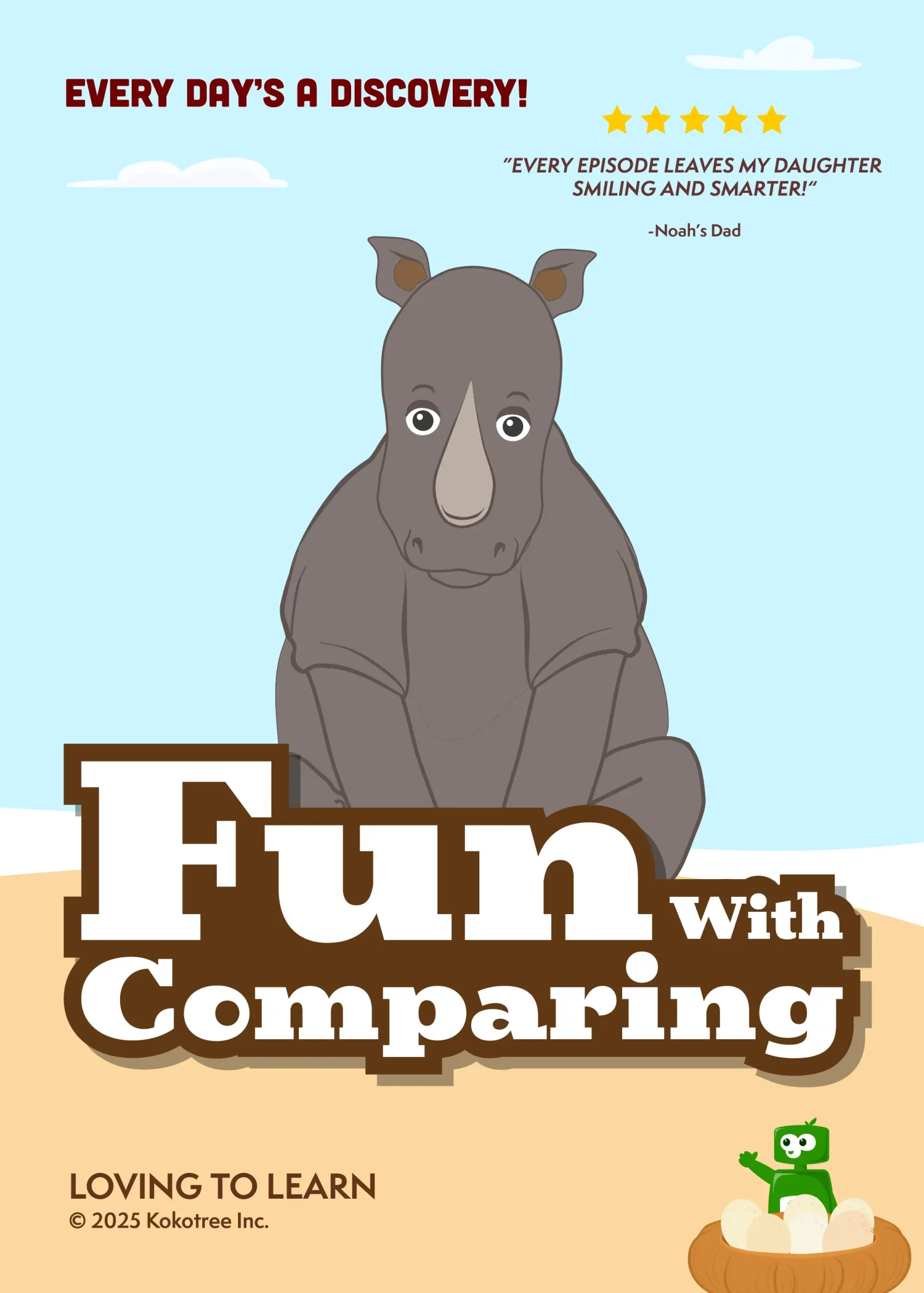
What's Fun with Comparing About?
Your little one joins Mr. Rocko's bracelet-making class and Elizabeth's jungle walk to master the art of comparing! They'll learn to identify "more vs. less" and "big vs. small" using real-world examples they can spot anywhere.
6 minutes
Ages 2-5
Skill: Comparing quantities and sizes
Your kid watches friendly animals compare beads, sand, and jungle creatures. You get 6 minutes to finish that cup of coffee.
Mr. Rocko leads a fun bracelet-making activity where the Kokotree kids count and compare who has more beads. Then Elizabeth takes everyone on a jungle adventure, pointing out big and small plants, rocks, trees, and even a baby deer with its mamma!
What your child learns:
This video introduces two foundational math concepts: comparing quantities (more vs. less) and comparing sizes (big vs. small). Children practice both counting-based comparison and visual estimation.
- Counting objects to determine which group has more or fewer
- Visually comparing quantities without counting
- Identifying big vs. small objects in nature
- Using comparison vocabulary in complete sentences
- Recognizing size relationships between parent and baby animals
They'll use these skills when:
- Dividing snacks with a sibling ("Who has more crackers?")
- Choosing which cup holds more juice at breakfast
- Picking out the biggest stick at the playground
- Sorting toys by size during cleanup time
The Story (what keeps them watching)
Mr. Rocko surprises his class with a bracelet-making activity! Ruby, Bobby, Maddy, Eddie, and Tiki string colorful beads and then compare their creations. Who has more beads? They count to find out! Then the adventure continues outside where Elizabeth leads a jungle exploration. The class discovers big and small plants, rocks, and trees—and even spots an adorable baby deer standing next to its bigger mamma. Every comparison becomes a mini celebration of discovery!
How We Teach It (the clever part)
- First 2 minutes: Mr. Rocko introduces comparing through bracelet-making—kids visually estimate which bracelet has more beads, then verify by counting
- Minutes 2-4: The class moves outdoors to compare sand mounds and tree leaves, learning that we can compare without counting
- Final 2 minutes: Elizabeth reinforces big vs. small using jungle examples—plants, rocks, trees, and animals—building vocabulary and confidence
Teaching trick: The video teaches two comparison methods: counting for precision AND visual estimation for quick judgments. This dual approach helps kids understand that "more" and "bigger" can be determined different ways depending on the situation.
After Watching: Quick Wins to Reinforce Learning
- Mealtime activity: "Which plate has more peas?" Point to two servings and let your child guess, then count together to check. Builds counting-to-compare skills.
- Car/travel activity: "Spot something big... now spot something small!" Take turns finding size opposites out the window. Reinforces big/small vocabulary.
- Bedtime activity: "Which stuffed animal is bigger?" Line up two toys and compare. Ask your child to find the smallest one in the pile.
- Anytime activity: "More or less?" Grab two handfuls of blocks or crayons and ask which hand holds more. Let them count to verify their guess.
When Kids Get Stuck. And How to Help.
- "My child always guesses wrong about which has more" - This is totally normal! The video shows that counting is the reliable way to check. Encourage guessing first, then counting together—being wrong is part of learning.
- "They mix up big and small" - Use hand gestures every time you say the words. Stretch arms wide for "big" and pinch fingers for "small." The physical connection helps the vocabulary stick.
- "Comparing seems too easy for my child" - Level up by asking "how many more?" or introducing "medium." The video's foundation makes these extensions natural next steps.
What Your Child Will Learn
Prerequisites and Building Blocks
Children benefit from basic counting skills (1-10) before watching, though the video reinforces counting naturally. This video builds on number recognition and prepares children for more advanced mathematical comparison like "greater than" and "less than." It connects to the Budding Sprouts program's progression from number identification to number application in real-world contexts.
Cognitive Development and Teaching Methodology
This video leverages concrete-to-abstract learning progression ideal for ages 2-5. Children first see physical objects (beads, sand, animals), hear comparison language, then practice categorizing independently. The dual-teacher approach addresses different learning styles—Mr. Rocko's hands-on craft activity engages kinesthetic learners while Elizabeth's observational jungle walk supports visual learners.
Alignment with Educational Standards
This content aligns with Common Core Math standard K.CC.C.6 (identify whether the number of objects in one group is greater than, less than, or equal to another group) and K.MD.A.2 (directly compare two objects with a measurable attribute). These are key kindergarten readiness indicators that teachers assess in early math screening.
Extended Learning Opportunities
Pair this video with Kokotree's counting activities and shape sorting games for reinforced practice. Create a "comparison journal" where children draw two objects and circle the bigger one. Use measuring cups during water play to explore "more" and "less" with liquids. The app's interactive quizzes offer immediate feedback on comparison skills.
Transcript Highlights
- "It's great that we can use counting to understand the concept of more or less. But we can also understand the concept of more or less without counting."
- "One, two, three, four, five, six, seven, eight, nine, ten, eleven. Eleven beads! Eleven is more than eight."
- "That mound is bigger and required more sand."
- "By looking at their bodies, you can tell that mamma deer is bigger than her baby."
Character Development and Story Arc
Mr. Rocko models patient teaching by guiding children through verification ("Well, let's check by counting") rather than simply providing answers. The students demonstrate collaborative learning—Ruby confidently answers, Maddy makes an initial guess then accepts correction gracefully. Elizabeth shows enthusiasm for discovery, modeling curiosity about the natural world that encourages children to observe their surroundings.
Mathematical Comparison Concepts Deep Dive
Comparing quantities and sizes represents foundational pre-algebraic thinking that children develop between ages 2-5. This video addresses two distinct but related skills: quantitative comparison (more/less/fewer) and magnitude comparison (big/small/bigger/smaller).
Quantitative comparison requires understanding cardinality—that the last number counted represents the total quantity. When Mr. Rocko counts Maddy's nine beads and Eddie's eleven beads, he's demonstrating one-to-one correspondence and the comparison principle. Research shows children typically master "more" before "less" because "more" connects to their natural desire for abundance.
The video brilliantly introduces estimation as a valid comparison strategy. When comparing sand mounds, exact counting isn't practical—visual estimation becomes the appropriate tool. This teaches mathematical flexibility and real-world problem-solving.
Size comparison (big/small) develops slightly earlier than quantity comparison because it relies on perceptual judgment rather than counting. Elizabeth's jungle examples progress from obvious differences (small plant vs. big plant) to relational comparison (baby deer is small compared to mamma deer). This relative thinking—understanding that "big" and "small" depend on context—represents sophisticated cognitive development.
The vocabulary introduced (more, less, big, small, bigger, smaller) forms the linguistic foundation for later mathematical symbols (>, <, =). Children who confidently use comparison words in preschool show stronger number sense in elementary school.