
What's Tales of Yellow & Red About?
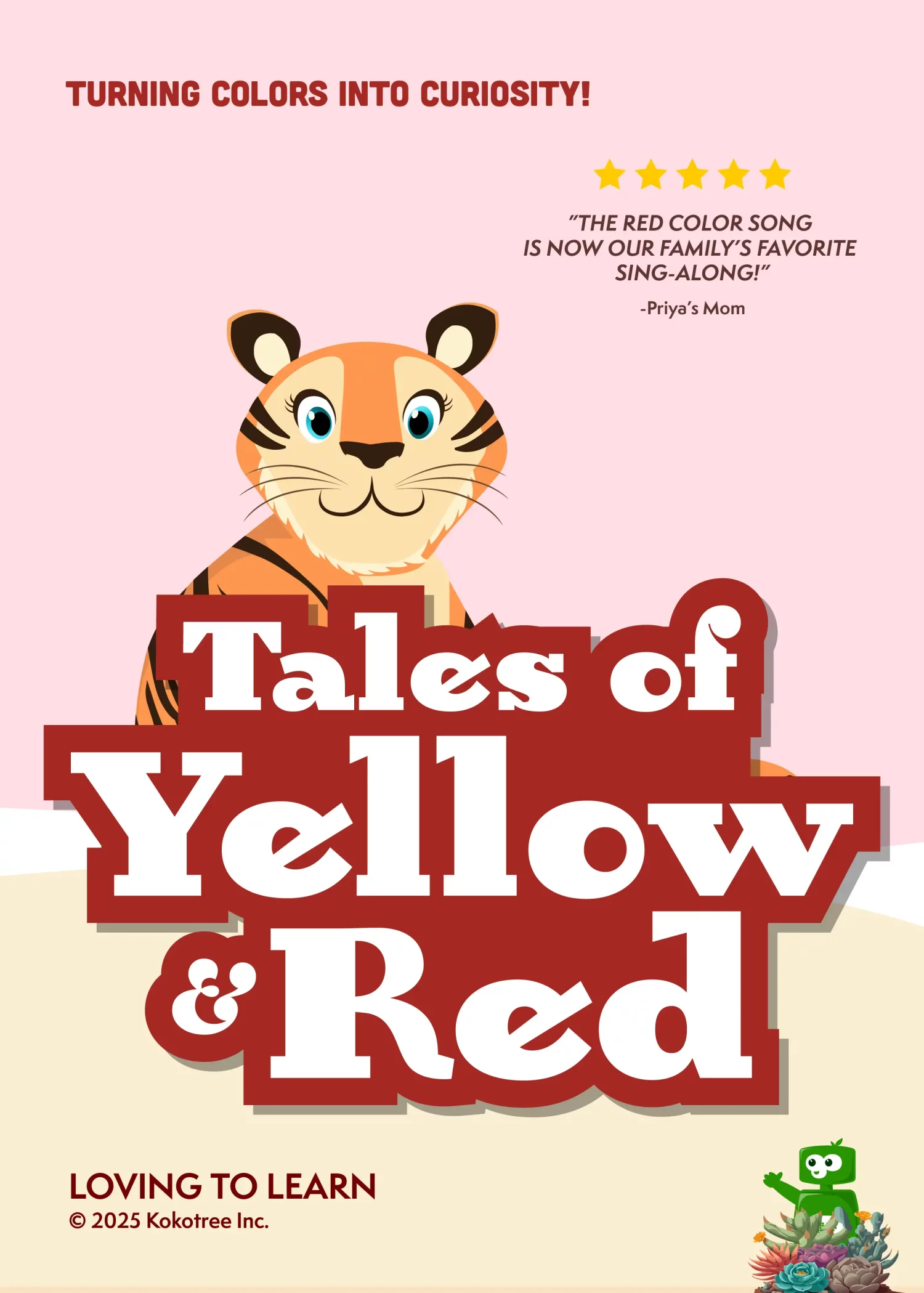
Your little one joins Meera the Tiger and friends on a vibrant color hunt through the jungle! They'll identify yellow and red objects in nature, food, and animals—then spot these colors everywhere in their own world.
6 minutes
Ages 1-6
Skill: Color Recognition (Yellow & Red)
Your kid watches friendly animals sing and explore colorful objects. You get 6 minutes to finish that cup of coffee.
Meera the Tiger leads the Kokotree crew on two mini color adventures. First, they discover yellow things—sunshine, sunflowers, bananas, and bumblebees. Then they head to a picnic where Eddie Elephant spots red tomatoes, leading everyone on a hunt for red mushrooms, roses, apples, and strawberries.
What your child learns:
This video builds foundational color recognition through repetition, catchy songs, and real-world examples. Your child will connect colors to familiar objects they see every day, making learning stick.
- Identifies yellow objects in nature (sun, sunflowers, dandelions)
- Recognizes yellow in food (bananas, lemonade, corn)
- Spots red items in everyday life (tomatoes, apples, strawberries)
- Connects colors to animals (yellow bumblebees, chicks, red beetles)
- Practices observation skills by finding colors in their environment
They'll use these skills when:
- Sorting laundry with you ("Can you find the yellow socks?")
- Grocery shopping and identifying fruits and vegetables by color
- Playing with blocks, crayons, or toys and naming colors correctly
- Pointing out things on walks ("Look, a red car! A yellow flower!")
The Story (what keeps them watching)
Meera the Tiger welcomes everyone to learn about yellow first. Gina the Giraffe notices her own yellow fur matches the sunshine, and Maddy Monkey shares her love of yellow bananas and lemonade. Everyone sings about yellow bumblebees, canaries, and corn!
Then it's picnic time! When Eddie Elephant spots red tomatoes in their sandwich, he gets curious about finding MORE red things. The whole gang explores together, singing about red mushrooms, roses, apples, strawberries, and even Meera's cozy red scarf. Gina shows off her sharp observation skills by spotting what everyone else missed!
How We Teach It (the clever part)
- First 3 minutes: Yellow is introduced through familiar objects (sun, sunflowers) and connected to Gina's own fur—making it personal and memorable
- Minutes 3-5: Red appears naturally during snack time, then expands through an exploration game that turns learning into adventure
- Final minute: Both colors are reinforced through observation challenges and celebration of what everyone found
Teaching trick: Each color gets its own catchy song with specific examples ("Yellow is the color of the bumblebee, and the canary on the tree"). The melody and rhymes help little brains remember which objects match which color.
After Watching: Quick Wins to Reinforce Learning
Mealtime activity: "Can you find something yellow on your plate?" Point to corn, cheese, or banana slices. Then ask about red—ketchup, tomatoes, or apple slices count! (Practices color identification with familiar foods)
Car/travel activity: Play "I Spy" with just yellow and red. "I spy something yellow... it's the sun!" Take turns and let your child lead. (Builds observation skills and reinforces color names)
Bedtime activity: During story time, pause on colorful pages and ask, "Where's something red? Where's something yellow?" (Extends learning to books without extra effort)
Anytime activity: Give your child two crayons—one yellow, one red—and ask them to draw a sun and an apple. Hang it on the fridge! (Connects colors to objects through creation)
When Kids Get Stuck. And How to Help.
"My child keeps mixing up yellow and orange." Totally normal! These colors are neighbors on the spectrum. Focus on "bright yellow like the sun" and compare side-by-side when possible. The song's examples (bananas, bumblebees) help because they're reliably yellow.
"She can point to red but won't say the word." Understanding comes before speaking—this is great progress! Keep naming colors yourself without pressure. One day she'll surprise you with "RED!" out of nowhere.
"He gets bored before the video ends." Six minutes is a lot for little ones! Watch in two sittings (yellow one day, red the next) or pause to hunt for colors in your room. Movement breaks help learning stick.
What Your Child Will Learn
Prerequisites and Building Blocks
This video works best for children who can focus on screen content for short periods and respond to simple questions. No prior color knowledge is required—this serves as an introduction or reinforcement. It builds on basic vocabulary (sun, banana, apple) and prepares children for more complex color concepts like mixing primary colors, identifying shades, and eventually understanding the color wheel. This pairs well with shape recognition videos, as children often learn shapes and colors simultaneously.
Cognitive Development and Teaching Methodology
The dual-color format leverages spaced repetition—children encounter each color multiple times through different examples. Songs activate auditory memory pathways while visual examples engage spatial recognition. The "exploration" framing taps into children's natural curiosity, making passive viewing feel like active discovery. Character modeling (Gina noticing her own yellow fur, Eddie getting excited about red) demonstrates metacognition—thinking about what you're seeing—which builds observation skills crucial for all future learning.
Alignment with Educational Standards
This video addresses Head Start Early Learning Outcomes Framework goals for Perceptual, Motor, and Physical Development (specifically visual discrimination). It aligns with Common Core Kindergarten standards for describing objects by color and supports NAEYC developmentally appropriate practices for ages 2-5. Color recognition is a key kindergarten readiness indicator assessed in most school readiness screenings. Teachers expect entering kindergarteners to identify at least 6 basic colors, with red and yellow being foundational.
Extended Learning Opportunities
Pair this video with Kokotree's color sorting games and shape-color matching activities in the app. Print simple coloring pages featuring suns, apples, and bananas for hands-on reinforcement. Create a "color walk" outside where children collect yellow leaves or spot red flowers. The Kokotree color mixing video extends this learning by showing what happens when yellow and red combine. Consider revisiting this video seasonally—autumn offers abundant red leaves, spring brings yellow daffodils.
Transcript Highlights
- Teaching through personal connection: "I love yellow because it reminds me of sunshine. And look at my fur! It has a lot of yellow, which makes me feel like sunshine too." —Gina connects color to identity and emotion
- Expanding vocabulary through examples: "Yellow is the color of the bumblebee. And the canary on the tree. Yellow is the color of lemonade. And the banana that Maddy ate." —Song format lists multiple examples for reinforcement
- Encouraging observation: "I can spot something red that no one has guessed yet. It's your nice red scarf, Miss Meera." —Gina models looking carefully and finding unexpected examples
- Celebrating discovery: "Good job, everyone! You could identify so many red things around." —Positive reinforcement encourages continued exploration
Character Development and Story Arc
Meera the Tiger models excellent teaching behavior—asking questions, praising specific observations, and guiding exploration without giving all the answers. Gina the Giraffe demonstrates self-awareness (noticing her own yellow fur) and sharp observation (spotting Meera's scarf). Eddie Elephant shows curiosity-driven learning by asking to explore for more red things. Maddy Monkey connects learning to personal experience (loving bananas). Together, they model collaborative discovery—each character contributes different observations, showing children that everyone notices different things.
The Science of Color Recognition in Early Childhood
Color recognition is one of the earliest cognitive categorization skills children develop, typically emerging between 18 months and 3 years. The brain processes color through specialized cells in the visual cortex, but naming colors requires connecting this visual processing to language centers—a complex neural pathway that takes time to develop.
Yellow and red are ideal starting colors for several reasons. They're high-saturation, high-contrast colors that young eyes detect easily. They appear frequently in nature and everyday objects, providing constant reinforcement. And they're visually distinct from each other, reducing confusion during early learning.
This video employs several evidence-based strategies. First, it uses exemplar-based learning—showing many different yellow and red objects helps children form a mental "category" rather than associating a color with just one item. A child who only sees yellow bananas might think "yellow" means "banana-shaped." By showing suns, bumblebees, corn, and chicks, the video helps children abstract the concept of "yellowness" itself.
Second, the musical format leverages the Mozart effect principle—not that music makes children smarter, but that melody and rhythm create stronger memory encoding. Children often remember song lyrics before conversational information because music activates multiple brain regions simultaneously.
Third, the exploration framing transforms passive viewing into active learning. When Eddie asks "Can we go and explore?" and the group hunts for red objects, children mentally participate in the search. This engagement increases attention and retention compared to simply being told "tomatoes are red."
For parents, understanding this science explains why children might know colors in some contexts but not others—the neural pathways are still forming. Consistent, low-pressure exposure across many examples builds robust color recognition that transfers to new situations.