
What's Prepositions Adventure About?
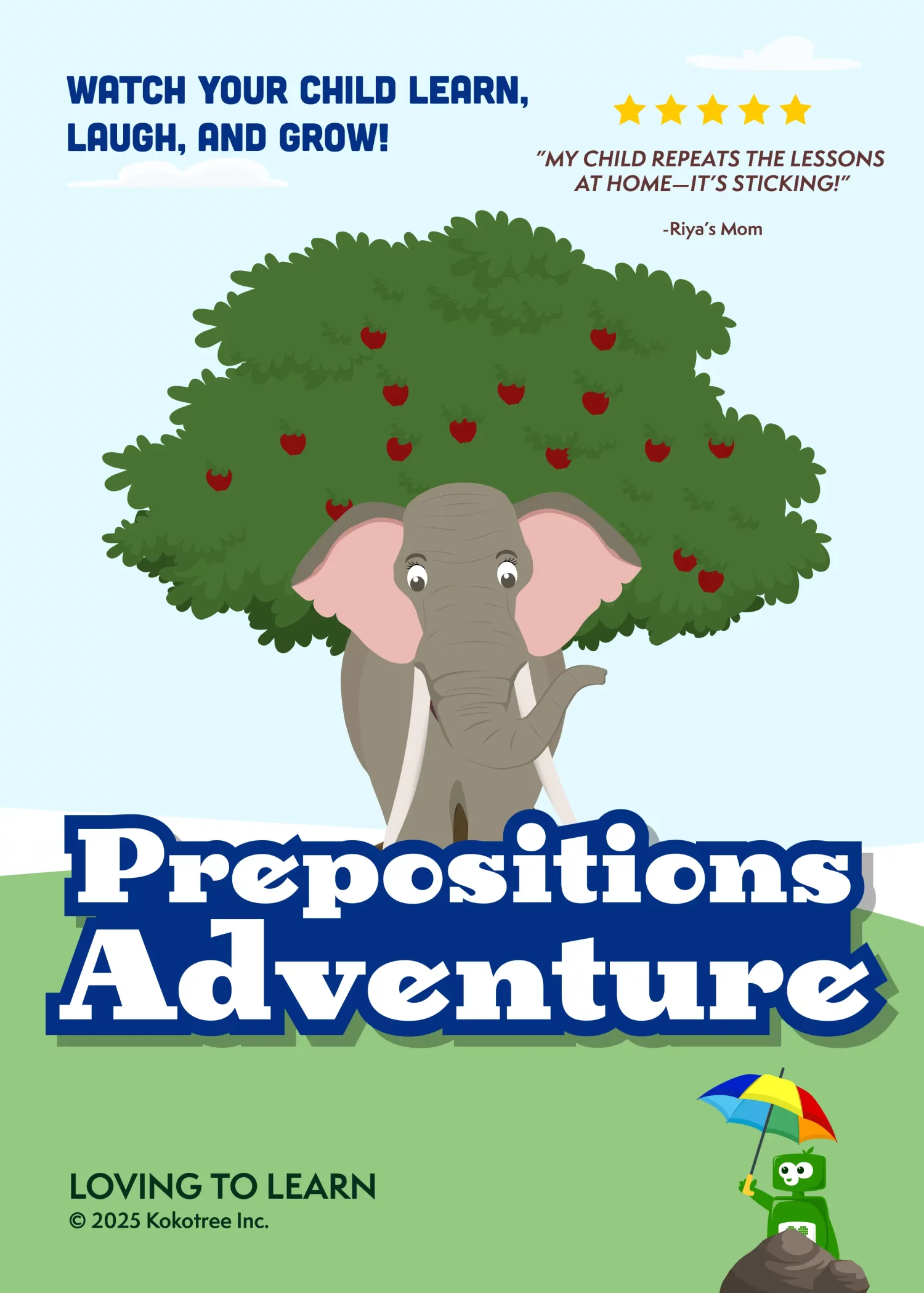
Your little one joins Miss Elizabeth and friendly animal friends to discover the magic of position words! Through playful games and everyday examples, they'll learn to describe exactly where things are in the world around them.
8.5 minutes
Ages 3-6
Skill: Understanding spatial relationships and position words
Your kid watches animal friends play games with position words. You get 8 minutes to enjoy your coffee while it's still warm.
Miss Elizabeth gathers the Kokotree class under an apple tree where curious birds are flying overhead. The children play "The Elevator" game—stretching up tall like Gina Giraffe and crouching down low like Ruby Rabbit. They draw pictures of things they see up and down, then share their discoveries with the class.
What your child learns:
This video builds essential spatial vocabulary that children need for following directions, describing their world, and preparing for reading comprehension. They'll connect abstract position words to concrete, visible examples they can point to and understand.
- Uses "over" and "under" to describe where objects are located
- Understands "up" and "down" as both positions and movements
- Connects position words to everyday objects (umbrella over head, shoes under bed)
- Follows multi-step directions using spatial language
- Observes surroundings and describes what they see using new vocabulary
They'll use these skills when:
- Following directions like "put your shoes under your bed" or "reach up for your toothbrush"
- Playing at the playground and describing where friends are climbing
- Reading books and understanding phrases like "the cat jumped over the fence"
- Helping around the house by finding objects in specific locations
The Story (what keeps them watching)
The Kokotree class is playing under an apple tree when curious birds start flying overhead! Miss Elizabeth turns this into a learning moment—the birds are OVER the tree, and the friends are UNDER it. Bobby Bear shares about his umbrella, Maddy Monkey finds shoes under the bed, and everyone gets excited about position words. Then comes the really fun part: "The Elevator" game! The kids stretch UP tall like Gina Giraffe and crouch DOWN low like Ruby Rabbit. Finally, everyone draws pictures of things they see up and down—kites soaring, birthday balloons on ceilings, and friends on see-saws!
How We Teach It (the clever part)
- First 3 minutes: Miss Elizabeth introduces "over" and "under" using the birds and apple tree as a natural, visual example. On-screen labels reinforce the words while children see them in action.
- Minutes 3-6: The class plays "The Elevator" game to learn "up" and "down" through whole-body movement. Miss Elizabeth tells a story about her morning routine, naturally weaving in position words.
- Final 2.5 minutes: Children apply their learning by drawing objects they see up and down, then share with the class—reinforcing through creative expression and peer learning.
Teaching trick: Miss Elizabeth connects abstract position words to body movements (stretching tall, crouching low), which helps young children physically feel the meaning of "up" and "down" before using the words abstractly.
After Watching: Quick Wins to Reinforce Learning
- Mealtime activity: "What's over your plate? What's under your cup?" Point to the ceiling light over the table, the floor under your feet. Let your child spot three things that are over or under something else.
- Car/travel activity: "I spy something OVER the road!" Take turns finding things over, under, up, and down—clouds up in the sky, wheels under the car, bridges over water.
- Bedtime activity: "Let's do the sleepy elevator!" Stretch arms UP high, then bring them DOWN to rest. Ask: "What's over your bed? What's under your pillow?" Perfect wind-down that reinforces learning.
- Anytime activity: Play "Position Word Simon Says"—"Simon says reach UP! Simon says look UNDER the table!" Add silly challenges like "Put your hand OVER your head" for giggly practice.
When Kids Get Stuck. And How to Help.
- "My child mixes up over and under all the time." Totally normal! These are abstract concepts. Try using a favorite stuffed animal: put it OVER their head, then UNDER a blanket. The physical demonstration clicks faster than verbal explanations.
- "She understands during the video but forgets right after." Repetition is key at this age. Casually use these words throughout your day: "Hand me the book UNDER the pillow" or "Look at that bird flying OVER us!" Natural exposure beats drilling.
- "Is this too easy? He already knows up and down." Great foundation! Challenge him to use the words in sentences or find multiple examples. "What else is UP in this room?" builds observation skills and expands vocabulary use.
What Your Child Will Learn
Prerequisites and Building Blocks
Children watching this video should have basic vocabulary for common objects (tree, bird, umbrella, chair) and understand simple directions. This video builds on early spatial awareness developed through physical play and prepares children for more complex prepositions like "beside," "between," and "behind." It connects naturally to the Kokotree curriculum's focus on observation skills and descriptive language, setting the foundation for reading comprehension where position words appear frequently in stories.
Cognitive Development and Teaching Methodology
This video leverages embodied cognition—the principle that physical movement enhances abstract concept learning. The "Elevator" game activates kinesthetic learning pathways, helping children internalize position concepts through their bodies before applying them verbally. Visual learners benefit from on-screen labels ("OVER" and "UNDER"), while auditory learners absorb the repeated verbal modeling. The progression from observation to game to creative drawing follows Bloom's taxonomy from recognition through application.
Alignment with Educational Standards
This video addresses Common Core Kindergarten Language Standard L.K.1e (using frequently occurring prepositions) and supports spatial reasoning benchmarks in early mathematics standards. Position words are kindergarten readiness indicators assessed in most school readiness screenings. Teachers expect incoming students to follow two-step directions using basic prepositions—exactly what this video practices through Miss Elizabeth's morning routine story and the drawing activity.
Extended Learning Opportunities
Pair this video with Kokotree's printable "Position Word Scavenger Hunt" worksheet where children draw objects in specific positions. The app's interactive "Where Is It?" game reinforces these concepts through touch-based play. Extend learning with building block activities: "Can you build a tower and put the red block OVER the blue one?" Picture books with clear positional language make excellent read-aloud companions after watching.
Transcript Highlights
- "The birds are flying right above the tree, hence they are flying over the tree... And all of us are here on the ground, right below the tree, hence we are playing under the tree."
- "Did you observe that the word 'over' tells you about the position and can also tell you the movement of an object?"
- "When I say 'up,' we'll have Maddy put his hands high above his head, stretching tall like Gina Giraffe. And when I say 'down,' he will bend his knees and crouch low to the ground, small like Ruby Rabbit."
- "All of you think and draw one object that you see up and one object you see down in your surrounding."
Character Development and Story Arc
The animal characters model active learning behaviors throughout. Bobby Bear connects new concepts to personal experience (his umbrella), demonstrating how learners relate new information to prior knowledge. Tiki Tiger's observation "My head is up and my feet are down" shows body awareness developing alongside vocabulary. The collaborative sharing circle models respectful peer learning—each character celebrates others' contributions, reinforcing that learning happens in community.
Spatial Language Development: The Foundation for Mathematical and Literacy Success
Prepositions represent one of the most challenging word categories for young children because they describe invisible relationships rather than concrete objects. Unlike nouns ("apple") or verbs ("run"), prepositions require children to mentally map relationships between objects in space—a sophisticated cognitive skill that develops between ages 2-6.
Research in developmental linguistics shows children typically acquire "in" and "on" first, followed by "under" and "over," with "up" and "down" developing alongside as children gain vertical spatial awareness. This video strategically pairs these concepts because they share a vertical axis, reducing cognitive load while building a coherent mental framework.
Spatial language directly predicts later mathematical achievement. Children who fluently use position words demonstrate stronger geometry understanding, better mental rotation abilities, and enhanced problem-solving skills. When Ronnie says "My toy car rolled under the chair," he's practicing the same spatial reasoning he'll need for understanding number lines, graphs, and geometric transformations.
For literacy, prepositions appear in nearly every sentence children will read. Comprehending "The cat jumped over the fence" requires instant understanding of spatial relationships. Children who struggle with prepositions often show reading comprehension difficulties because they cannot visualize described scenes. This video builds the mental imagery skills essential for reading success by connecting words to visible, memorable examples—birds over trees, shoes under beds, kites up in the sky.