
What's The Shapes Adventure About?
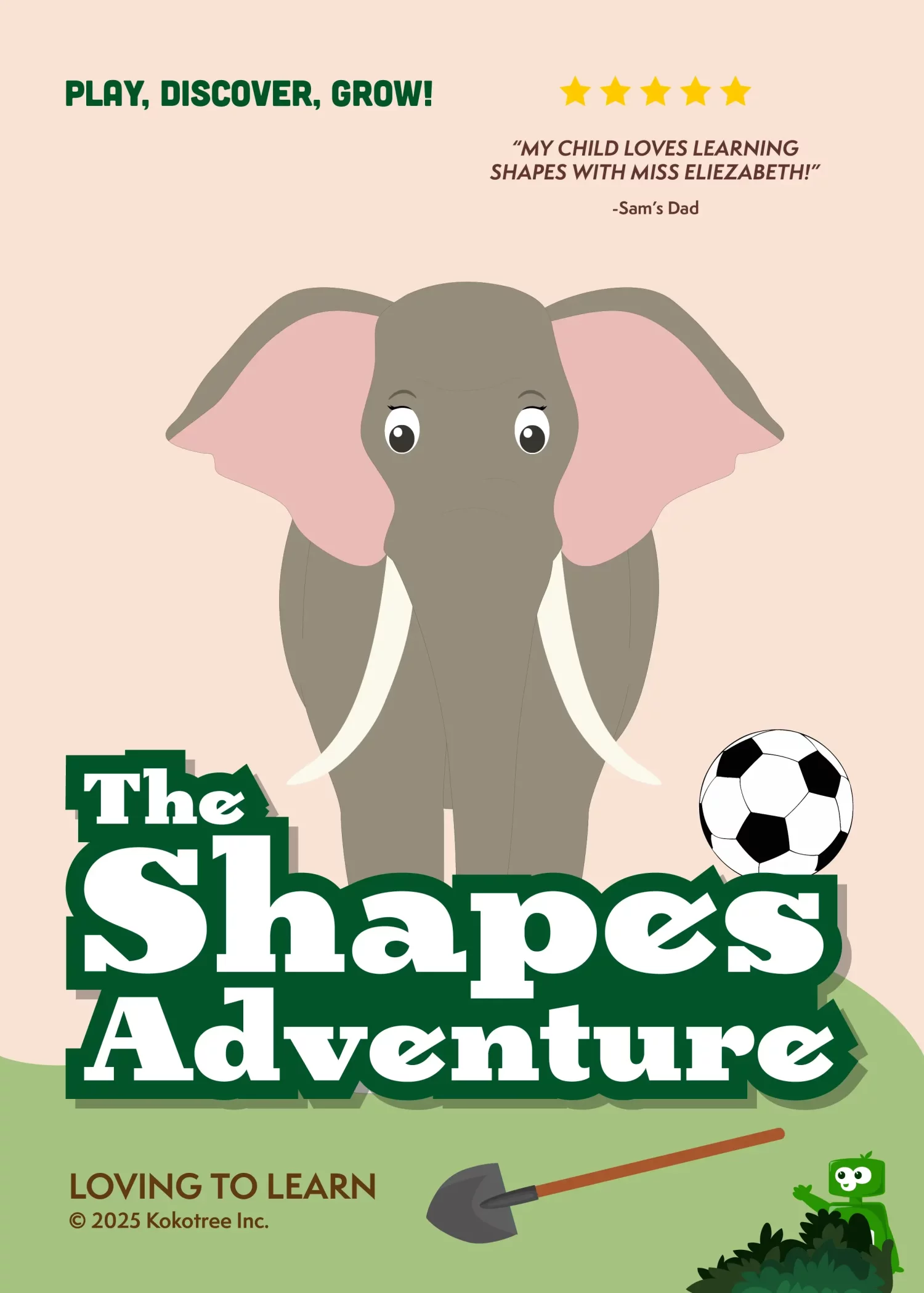
Your little one joins Miss Elizabeth and their animal friends on a garden adventure where shapes come alive! They'll count sides, spot triangles in tools, and discover pentagons hiding in flowers and soccer balls.
5 minutes
Ages 3-6
Skill: Recognizing and counting sides of shapes
Your kid watches friendly animals hunt for shapes on a farm. You get 5 minutes to finish that cup of coffee.
Miss Elizabeth takes the Kokotree class to her farm where they discover a triangle-shaped garden plot. The animal friends find triangles everywhere—in rakes, shovels, and even in their own hands! Then the adventure continues as they spot an orange arrow in the forest and learn it's actually a pentagon with five sides.
What your child learns:
This video builds foundational geometry skills by teaching children to identify shapes by their defining characteristics—not just by how they look, but by counting their sides. Kids practice active observation and discover that shapes are everywhere in the real world.
- Identifies triangles by counting three sides
- Recognizes pentagons by counting five sides
- Spots shapes in real-world objects (tools, flowers, balls)
- Creates shapes using their own hands
- Connects shape names to their Greek roots ("penta" means five)
They'll use these skills when:
- Pointing out the triangle shape of a pizza slice or sandwich cut corner
- Noticing the pentagon sections on a soccer ball at the park
- Sorting toys or blocks by number of sides
- Describing what they see in picture books ("That house has a triangle roof!")
The Story (what keeps them watching)
Miss Elizabeth invites the Kokotree class to help plant seeds in her triangle-shaped garden! Ruby the rabbit spots the shape first, and Maddy Monkey counts the three sides. The fun really kicks in when everyone makes triangles with their hands—thumbs together for the bottom, fingertips touching at the top. Gina Giraffe notices the rake is triangle-shaped, and Bobby Bear's shovel is too! Later, the class discovers a mysterious orange arrow in the forest. Is it a rectangle with a pointy side? Nope—it's a pentagon with five whole sides! Soon they're spotting pentagons everywhere: pencils, treehouses, morning glory flowers, and even the black patches on a soccer ball.
How We Teach It (the clever part)
- First 2 minutes: Miss Elizabeth introduces the triangle through the garden plot shape. Kids count three sides together and learn about "sleeping lines" and "slanting lines" in friendly, visual terms.
- Minutes 2-3: Learning becomes physical! Children follow along making triangles with their hands, then spot triangles in garden tools like rakes and shovels.
- Final 2 minutes: The pentagon is introduced through discovery—an arrow in the forest. Kids count to five, learn that "penta" means five, then hunt for pentagons in pencils, treehouses, flowers, and soccer balls.
Teaching trick: The video uses the "sleeping line" and "slanting line" language to help young children understand how lines work together to form shapes—much easier than "horizontal" and "diagonal" for little learners!
After Watching: Quick Wins to Reinforce Learning
Mealtime activity: "Can you find any triangles on your plate?" Cut sandwiches diagonally, point out pizza slices, or notice the triangle shape of tortilla chips. Count the three sides together!
Car/travel activity: "Let's hunt for pentagons! Look for stop signs... wait, how many sides does a stop sign have?" This sparks counting practice and introduces the octagon as a bonus shape discovery.
Bedtime activity: "Make a hand triangle like Maddy Monkey!" Practice the thumbs-together, fingertips-touching move from the video. Shine a flashlight through it to project a triangle shadow on the ceiling.
Anytime activity: "How many sides does that have?" Point to objects around the house—picture frames, windows, books—and count sides together. When you find something with five sides, celebrate: "That's a pentagon!"
When Kids Get Stuck. And How to Help.
"My child keeps calling every shape a triangle." - Totally normal! Young children often overgeneralize new words. Gently redirect by counting sides together: "Let's count! One, two, three, four... this one has four sides, so it's a square. Triangles have just three!"
"She can't remember what a pentagon is called." - The word is tricky! Reinforce the "penta = five" connection by counting fingers on one hand: "Penta means five, just like your five fingers!" The name will stick with repetition.
"He gets frustrated trying to make the hand triangle." - Fine motor skills are still developing at this age. Try making the triangle together, hand-over-hand, or use pipe cleaners or straws to build a triangle he can hold and trace instead.
What Your Child Will Learn
Prerequisites and Building Blocks
Children watching this video should be comfortable with basic counting to five and familiar with the concept that objects have names. This lesson builds on earlier shape recognition (circles, squares) and introduces the idea that shapes are defined by their number of sides—a key geometric principle. It prepares children for more complex polygon identification and lays groundwork for understanding that mathematical properties (like side count) determine classification.
Cognitive Development and Teaching Methodology
This video leverages concrete-to-abstract learning progression, starting with physical objects children can see (garden plot, rake, shovel) before introducing the defining property (three sides). The kinesthetic hand-triangle activity engages motor memory, while the real-world object hunt reinforces transfer learning. Multiple examples prevent children from associating shapes with only one representation—a common early geometry misconception.
Alignment with Educational Standards
This content aligns with Common Core Math Standard K.G.A.2 (correctly name shapes regardless of orientation or size) and K.G.B.4 (analyze and compare shapes). The pentagon introduction exceeds typical preschool standards, providing enrichment for kindergarten readiness. NAEYC guidelines emphasize learning through play and real-world connections—both central to this video's approach.
Extended Learning Opportunities
Pair this video with shape sorting activities using household items. Create a "shape hunt" checklist for walks outside. Use playdough to form triangles and pentagons, counting sides as you build. The Kokotree app offers interactive shape-tracing games and matching activities that reinforce these concepts. Consider following up with videos on other polygons to build a complete shape vocabulary.
Transcript Highlights
- "A triangle has one sleeping line and two slanting lines. One on each side. Doesn't it look like the roof on Maddy's house?"
- "First, put your thumbs together to form a sleeping line. Now, join the tips of your fingers—like this—to make a triangle."
- "Can you count the number of sides on this arrow? One...two...three...four...five. Yes! The specific name for five is Penta. So this shape is called a pentagon."
- "And look at the soccer ball. Can you identify the pentagons on the soccer ball? Is it the black sections of the ball? It is!"
Character Development and Story Arc
Miss Elizabeth models patient, inquiry-based teaching—asking questions rather than simply telling answers. Gina Giraffe demonstrates that making a "wrong" guess ("a rectangle with a pointed side") is part of learning, and Miss Elizabeth validates her thinking before guiding her to the correct answer. Maddy Monkey shows enthusiasm and active participation, while the whole class counts together, modeling collaborative learning and the joy of discovery.
Geometry Foundations: Understanding Polygons Through Side-Counting
This video introduces a fundamental geometric principle: shapes are classified by their properties, specifically the number of sides. This moves children beyond simple shape recognition ("that looks like a triangle") toward mathematical reasoning ("it has three sides, so it's a triangle").
The triangle is the simplest polygon—the minimum number of sides needed to enclose a space. By starting here, children grasp the foundational concept before encountering more complex shapes. The pentagon introduction is particularly valuable because it's less common in everyday labeling, pushing children to apply their new counting strategy rather than relying on memorized shape names.
The "sleeping line" and "slanting line" terminology bridges the gap between informal and formal geometric language. Young children understand the concept of a line "lying down" or "leaning," making these terms developmentally appropriate while still mathematically accurate.
Real-world applications (rakes, shovels, soccer balls, flowers) demonstrate that geometry isn't abstract—it's everywhere. This builds spatial reasoning skills children will use when learning to write letters, read maps, and eventually study formal geometry. The soccer ball example is particularly rich: the ball's surface is actually a truncated icosahedron, with 12 pentagons and 20 hexagons, though the video appropriately focuses only on identifying the pentagons.
The kinesthetic hand-triangle activity engages procedural memory, helping children internalize the shape through physical experience—a technique supported by embodied cognition research showing that movement enhances learning and retention.