
What's Let's Count Forward And Backward About?
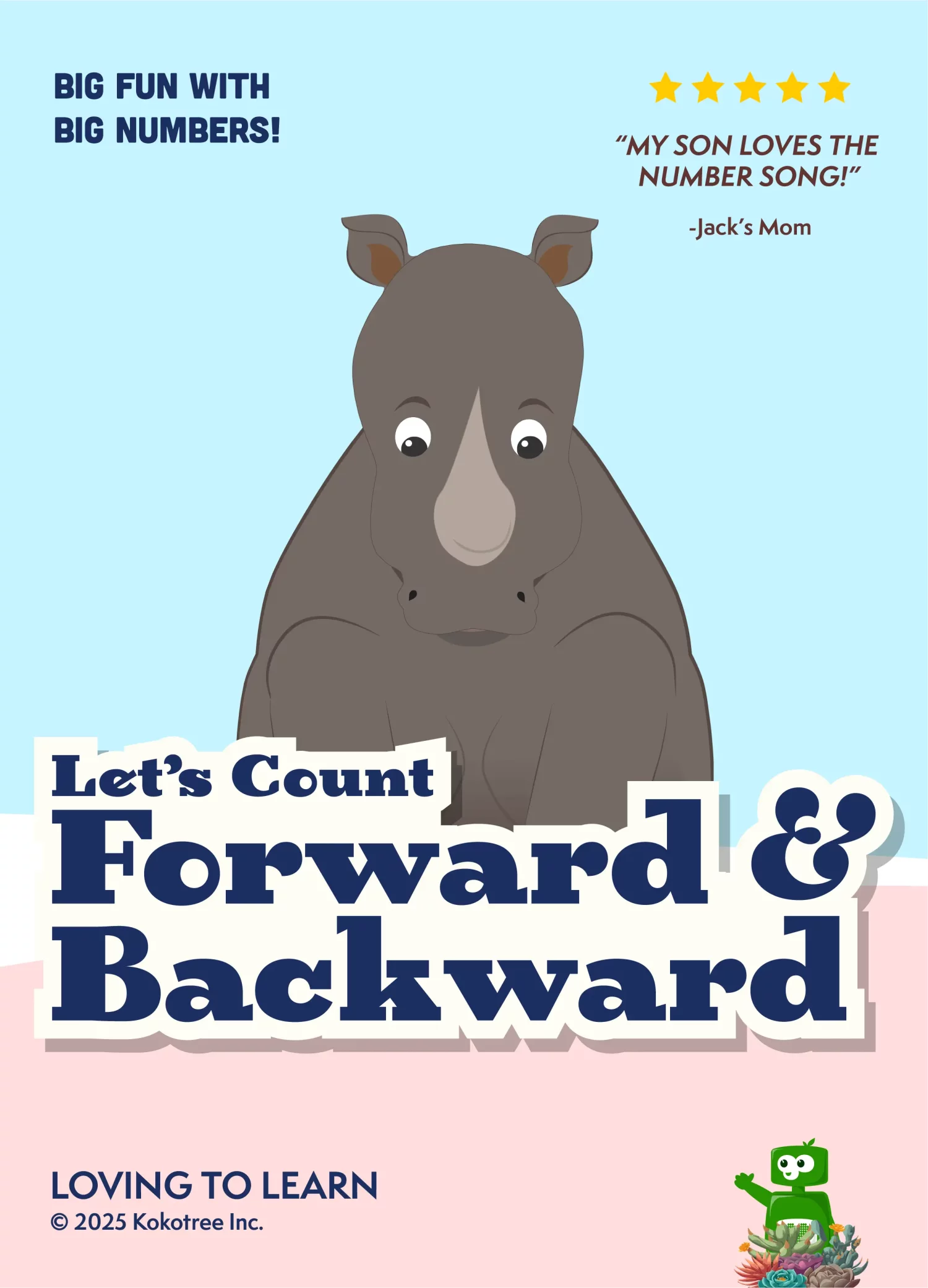
Your child joins friendly Rocko the Rhino to master counting 1-10 in both directions through interactive practice and a fun apple-picking story. They'll finish ready to count anything—forward or backward!
8 minutes
Ages 2-5
Skill: Number sequence and counting fluency
Your kid watches Rocko teach counting with apples and fingers. You get 8 minutes to enjoy your coffee in peace.
First, Rocko the Rhino guides your child through counting 1-10 multiple times, encouraging them to repeat along. Then the scene shifts to a cozy nighttime setting where the Kokotree class picks apples from a tree, counting backward from 10 to 1 as each apple disappears. Finally, kids practice backward counting using their own fingers.
What your child learns:
This video builds confident number recognition and sequencing in both directions. Children practice saying numbers aloud, connecting quantities to number words, and understanding that counting backward is just counting in reverse order.
- Counts forward from 1 to 10 with confidence
- Counts backward from 10 to 1 fluently
- Connects number words to quantities (apples, fingers)
- Understands number sequence and order
- Practices verbal repetition for memory retention
They'll use these skills when:
- Counting snacks at the table ("How many crackers do you have?")
- Playing hide-and-seek and counting down from 10
- Climbing stairs and counting each step up or down
- Waiting for something exciting ("5, 4, 3, 2, 1... go!")
The Story (what keeps them watching)
Rocko the Rhino welcomes kids warmly and dives right into counting practice—no fluff, just friendly repetition that builds confidence. Then the magic happens: it's nighttime at the apple tree, and the whole Kokotree class is hungry! Bobby Bear loves apples so much he catches one in his mouth (kids will giggle). Mr. Rocko turns snack time into learning time—as each apple comes down, everyone counts backward together. When the apples run out, clever Rocko shows kids they can count backward anytime using their own ten fingers. Problem solved!
How We Teach It (the clever part)
- First 2 minutes: Rocko introduces forward counting 1-10 with clear, slow pacing. Kids hear the sequence three times with encouragement to repeat aloud.
- Minutes 2-6: The scene shifts to the apple tree story. Backward counting is introduced naturally as apples are picked—each number connects to a disappearing apple, making abstract counting concrete.
- Final 2 minutes: Kids practice backward counting with their fingers, reinforcing that they can count anywhere, anytime, with tools they always have.
Teaching trick: Rocko uses "vanishing objects" to teach backward counting—as each apple disappears, kids SEE the quantity shrinking. This visual-to-verbal connection helps children understand that backward counting means "one less" each time.
After Watching: Quick Wins to Reinforce Learning
- Snack countdown: Before your child eats their snack, count the pieces together. "You have 7 grapes. Now eat one—how many left?" (Practices connecting subtraction to backward counting)
- Stair climbing: Count steps going up, then count backward going down. "10, 9, 8..." (Reinforces both directions in a physical, memorable way)
- Bedtime countdown: Start a "blast off to bed" routine: count backward from 10 together, then it's time for sleep! (Makes backward counting a fun daily ritual)
- Finger practice: Hold up fingers and take turns counting forward and backward. Ask "Can you count your fingers backward?" (Zero-prep practice they can do anywhere)
When Kids Get Stuck. And How to Help.
- "My child always gets stuck at 7 or 8." Totally normal! The middle numbers are trickiest because they're less memorable than 1, 2, 3 or 10. Practice just 5-8 repeatedly until it clicks, then add the rest back.
- "Backward counting seems really hard for them." Backward counting is genuinely harder—it requires holding the sequence in memory AND reversing it. Start with just 5-1, celebrate that win, then gradually add more numbers.
- "They can count but don't understand what the numbers mean." Use physical objects like Rocko does! Count toys into a basket, then count them back out. Touching each item while saying the number builds that crucial quantity connection.
What Your Child Will Learn
Prerequisites and Building Blocks
Children watching this video benefit from basic exposure to number words, though no formal counting skills are required. This video serves as both an introduction for beginners and reinforcement for children who've started counting. It builds on number recognition concepts and prepares children for skip counting, basic addition, and subtraction. The forward-then-backward structure establishes bidirectional number sense—understanding that the number line moves in both directions—which is foundational for all future mathematical operations.
Cognitive Development and Teaching Methodology
The video employs spaced repetition, a proven memory technique where content is repeated at intervals to strengthen neural pathways. Rocko's three rounds of forward counting with increasing participation (listen, follow, repeat) follows the "I do, we do, you do" teaching model. The shift from abstract counting to concrete objects (apples, fingers) addresses multiple learning styles: auditory learners hear the sequence, visual learners see quantities change, and kinesthetic learners can participate using their own fingers.
Alignment with Educational Standards
This video directly addresses Common Core Math Standard K.CC.A.1 (count to 100 by ones) and K.CC.A.2 (count forward from a given number). Backward counting supports K.CC.B.4 (understand the relationship between numbers and quantities). These skills appear on virtually every kindergarten readiness assessment. Teachers expect incoming kindergarteners to count to at least 10 and demonstrate emerging understanding of "one more" and "one less"—exactly what this video reinforces.
Extended Learning Opportunities
Pair this video with Kokotree's number tracing activities to connect verbal counting with written numerals. The "Count the Objects" interactive games in the app reinforce one-to-one correspondence. Parents can extend learning with simple counting books, dice games, or by creating a "counting jar" where children add or remove objects daily. For children ready for more challenge, introduce counting to 20 or practice counting by 2s using pairs of socks or shoes.
Transcript Highlights
- Building confidence: "Now, you might know some of these already, and that's great. Just follow along." (Validates prior knowledge while encouraging participation)
- Active engagement: "This time, repeat after me. One. Two. Three." (Shifts from passive watching to active practice)
- Contextual learning: "Each time we take an apple down, we'll count which number it was." (Connects abstract counting to concrete action)
- Transferable skills: "You can count down from ten by using your hands... put your fingers down one by one as you count." (Shows counting works anywhere with any objects)
Character Development and Story Arc
Rocko the Rhino models the ideal teacher: warm, patient, and enthusiastic about the subject. His casual "How ya doin? Come on in" creates immediate comfort. Bobby Bear's silly apple-catching demonstrates that learning can be playful. Ruby's request for "just one more lesson" models curiosity and love of learning. The collaborative apple-counting scene shows the Kokotree class working together, with each character taking turns—demonstrating that everyone participates and everyone succeeds.
Number Sense and Mathematical Foundations Deep Dive
Counting forward and backward represents far more than memorizing a sequence—it's the foundation of number sense, which predicts mathematical success more reliably than any other early skill. When children count forward, they're learning the stable order principle: numbers always come in the same sequence. When they count backward, they're building reversibility—understanding that mathematical operations can be undone.
This video strategically teaches backward counting through subtraction context (removing apples), helping children intuitively grasp that backward counting and "taking away" are connected. This early exposure to the inverse relationship between addition and subtraction gives children a significant advantage when formal arithmetic begins.
The use of fingers as counting tools is developmentally intentional. Research shows that finger counting strengthens the brain's numerical processing areas. Children who use their fingers while learning to count develop stronger number sense than those who don't. By ending with finger counting, Rocko gives children a portable, always-available tool for practice.
The video's pacing respects working memory limitations in young children. Rather than rushing through numbers, Rocko groups them (1-2-3, pause, 4-5-6, pause) which aligns with how young brains chunk information. This grouping also subtly prepares children for place value concepts they'll encounter later, where numbers are grouped by tens and ones.
Bidirectional counting fluency—moving confidently both forward and backward on the number line—is a key indicator of kindergarten readiness and correlates strongly with later success in addition, subtraction, and even algebra. Children who only count forward often struggle with subtraction because they haven't internalized that numbers exist in both directions from any starting point.