
What's Slanting Lines About?
Your little one joins Miss Elizabeth and friends on an adventure to discover slanting lines—the diagonal shapes hiding everywhere in nature! After watching, they'll spot slanting lines on rooftops, mountains, and even in the veins of leaves.
7.5 minutes
Ages 3-5
Skill: Recognizing and drawing diagonal lines
Your kid watches animal friends slide down hills spotting diagonal lines. You get 7 minutes to finish that cup of coffee.
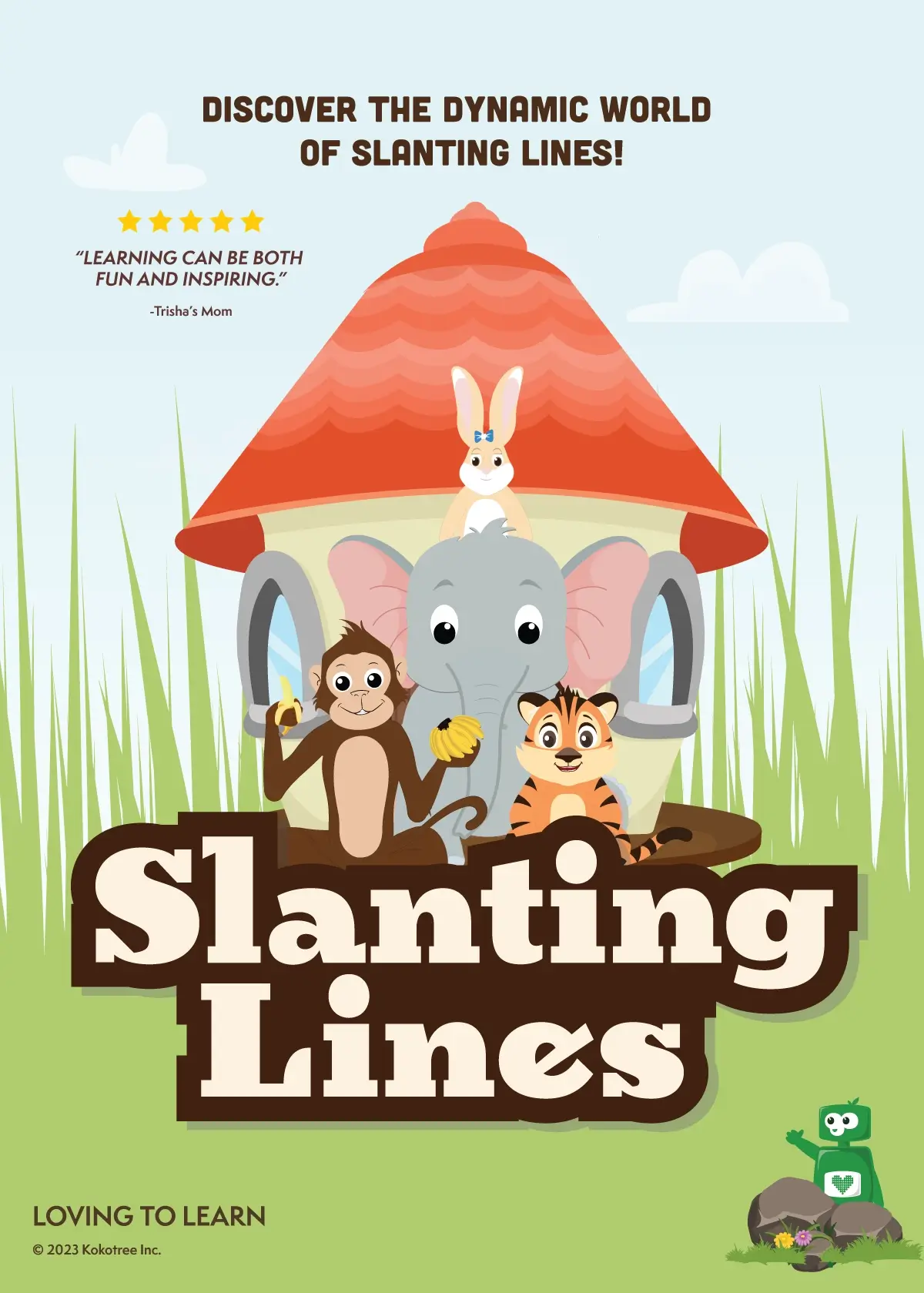
The Kokotree Class slides down a grassy hill (Maddy Monkey hilariously uses banana peels as skis!), then Miss Elizabeth shows them how the hill's slopes are actually slanting lines. The group explores the jungle finding diagonal lines in leaf veins, sailboat patterns, rooftops, and mountain peaks.
What your child learns:
This video teaches children to identify and draw slanting lines—an essential pre-writing skill that builds the foundation for letters like A, K, M, N, V, W, X, Y, and Z. They'll discover that slanting lines can go left or right, and practice tracing both directions.
- Identifying right-slanting and left-slanting lines in everyday objects
- Drawing slanting lines starting from a dot and moving diagonally
- Distinguishing slanting lines from standing (vertical) and sleeping (horizontal) lines
- Observing geometric patterns in nature and structures
- Following step-by-step drawing instructions
They'll use these skills when:
- Writing letters like A, M, N, V, W, X, Y, Z, and K
- Drawing houses, mountains, trees, and stars
- Noticing patterns on buildings, fences, and playground equipment
- Completing connect-the-dots activities and mazes
The Story (what keeps them watching)
The adventure begins with the Kokotree Class having a blast sliding down a grassy hill—Maddy Monkey steals the show by using banana peels as skis and crashing into a leaf pile! Miss Elizabeth uses this fun moment to introduce slanting lines, showing how the hill's slopes are perfect examples. The group then explores the jungle, discovering diagonal lines in leaf veins by a wild berry tree, zigzag patterns on sailboat sails by the river (with a cameo from two friendly crabs!), and finally spots slanting lines on Maddy's hut roof and a distant mountain. The video ends with a sweet gratitude verse thanking nature for teaching opportunities.
How We Teach It (the clever part)
- First 2 minutes: The hill-sliding fun naturally introduces the concept—kids see that slopes ARE slanting lines before any formal teaching begins.
- Minutes 2-5: Miss Elizabeth demonstrates drawing both right-slanting and left-slanting lines step-by-step, with the class practicing in sand. Clear instructions: "Draw a dot, trace from top, come down slanting."
- Final 2.5 minutes: Real-world application as kids spot slanting lines on Maddy's hut, mountains, and sun rays—reinforcing that these lines are everywhere!
Teaching trick: Elizabeth connects new learning to previous lessons (standing and sleeping lines), helping kids build a complete mental framework for understanding all line types.
After Watching: Quick Wins to Reinforce Learning
Mealtime activity: "Can you find slanting lines on your plate?" Point to pizza slice edges, sandwich halves cut diagonally, or carrot sticks arranged in a V shape. (Practices real-world line identification)
Car/travel activity: "Let's spot slanting lines outside!" Look for rooftops, mountains, road signs, or the letter A on storefronts. Count how many you find! (Builds observation skills)
Bedtime activity: "Draw a mountain with your finger on my back!" Take turns drawing slanting lines on each other's backs or palms. (Reinforces motor memory for line direction)
Anytime activity: "Make a tent with your hands!" Touch fingertips together to create slanting lines, then separate hands to show right-slanting and left-slanting. (Kinesthetic learning without supplies)
When Kids Get Stuck. And How to Help.
"My child draws slanting lines that look more like curves." Totally normal! Diagonal lines are tricky because they require coordinating two directions at once. Try having them trace along the edge of a book held at an angle first.
"They can't tell the difference between right-slanting and left-slanting." This distinction takes time to develop. Focus on just recognizing ANY slanting line first. The directional awareness will click around age 4-5 with practice.
"My child gets frustrated when their lines don't look perfect." Remind them that even Maddy Monkey crashed into leaves while learning! Celebrate the attempt, not perfection. Thick crayons or drawing in sand makes it easier than pencils.
What Your Child Will Learn
Prerequisites and Building Blocks
Children benefit most from this video after learning about standing lines (vertical) and sleeping lines (horizontal), as Miss Elizabeth references these concepts directly. This video is part of the "Budding Sprouts" pre-writing progression, building toward letter formation. Kids should be comfortable holding drawing tools and making intentional marks. The video explicitly connects to previous line lessons through a flashback feature, reinforcing the learning sequence.
Cognitive Development and Teaching Methodology
This video leverages embodied cognition—children physically experience slanting lines by watching characters slide down slopes before abstract instruction begins. The multi-sensory approach (visual demonstration, verbal step-by-step instructions, kinesthetic tracing in sand) addresses diverse learning styles. Repetition with variation (drawing in grass, then sand, then spotting on structures) builds neural pathways. The 3-5 age range is ideal for this spatial reasoning development.
Alignment with Educational Standards
This lesson aligns with kindergarten readiness standards for pre-writing skills and geometric awareness. It addresses Common Core Math Standard K.G.A.1 (describing positions) and handwriting readiness benchmarks requiring diagonal stroke mastery before letter formation. Teachers expect incoming kindergarteners to draw basic lines in multiple directions—this video directly prepares children for letters containing diagonal strokes (A, K, M, N, V, W, X, Y, Z).
Extended Learning Opportunities
Pair this video with printable slanting line tracing worksheets featuring zigzag patterns and simple mountain drawings. The Kokotree app offers interactive tracing games for diagonal line practice. Extend learning with outdoor chalk activities drawing giant slanting lines, or create "line hunts" around your home. Building with blocks or sticks to create slanting structures reinforces three-dimensional understanding of this concept.
Transcript Highlights
- "A slanting line looks like a slope and can go both up and down. It can lean in any direction, both left and right. That's what makes it so special."
- "First, draw a dot here on the right. Then trace a line from the right top and come down slanting toward the left. This gives you a right slanting line."
- "Draw a dot here on the left. Now trace a line from the left top and come down slanting toward the right. This gives you a left slanting line."
- "Lines give us the possibility to create anything. We simply need to visualize!"
Character Development and Story Arc
Maddy Monkey's creative problem-solving (banana peel skis!) models inventive thinking and resilience—he crashes but pops up cheerfully declaring success. The ensemble cast demonstrates collaborative learning as they discover slanting lines together, with different characters contributing observations (Gina asks clarifying questions, Tiki makes connections to previous knowledge, Ronnie identifies roof lines). Miss Elizabeth models patient, encouraging teaching, celebrating each discovery with genuine enthusiasm.
Understanding Slanting Lines: The Pre-Writing Foundation
Slanting lines represent a significant developmental milestone in early childhood fine motor development. Unlike vertical and horizontal lines, which follow single-axis movements, diagonal lines require simultaneous coordination of both horizontal and vertical muscle movements—a complex neuromotor task for young children.
From a geometric perspective, slanting lines introduce children to the concept of angles without formal terminology. When Miss Elizabeth shows right-slanting versus left-slanting lines, she's building foundational spatial reasoning that will later support understanding of acute and obtuse angles, symmetry, and geometric transformations.
The pre-writing significance cannot be overstated. Research in early literacy development shows that diagonal stroke mastery is one of the last pre-writing skills children develop, typically between ages 4-5. This is why letters containing diagonal strokes (A, K, M, N, V, W, X, Y, Z) are often taught later in handwriting curricula. Children who struggle with these letters frequently have underlying difficulty with diagonal line production.
The video's approach of finding slanting lines in nature before drawing them follows the concrete-to-abstract learning progression recommended by early childhood experts. By connecting diagonal lines to meaningful real-world objects (hills, mountains, rooftops, leaf veins), children develop conceptual understanding alongside motor skills. The distinction between right-slanting and left-slanting lines also builds directional awareness crucial for letter formation and preventing reversals in early writing.