
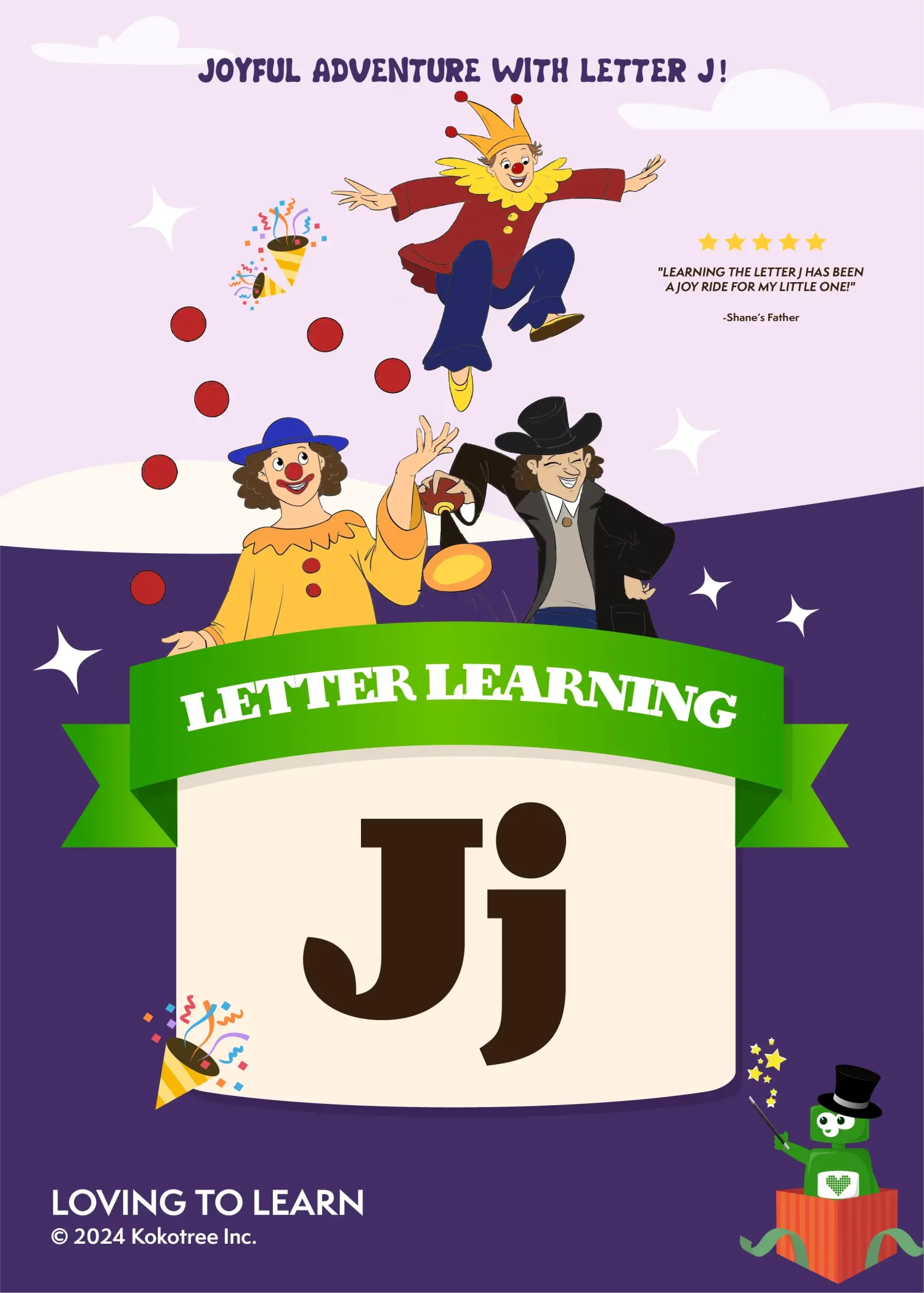
What's Letter J About?
Your little learner joins Miss Meera and the Kokotree crew to master the letter J through an engaging story about three silly jokers on a jungle adventure! They'll practice the "juh" sound, trace uppercase and lowercase J, and discover J-words hiding in everyday life.
9 minutes
Ages 3-5
Skill: Letter recognition and phonics
Your kid watches friendly animals learn the letter J through storytelling. You get 9 minutes to enjoy your coffee while it's still warm.
The Kokotree Class gathers around a jigsaw puzzle when Miss Meera arrives with an exciting lesson. She tells the tale of three jokers—Jumbo, Jumper, and Junior—who travel through the jungle making animals laugh. The class then practices the "juh" sound together and learns to write both uppercase J and lowercase j.
What your child learns:
This video builds essential pre-reading skills by connecting the letter J to its sound through repetition, storytelling, and hands-on letter formation. Children see the letter in action through dozens of J-words woven naturally into an entertaining narrative.
- Recognizes the letter J in uppercase and lowercase forms
- Produces the "juh" phonetic sound consistently
- Writes uppercase J (straight line down with a hook)
- Writes lowercase j (dot and hook)
- Identifies J-words in everyday contexts
They'll use these skills when:
- Spotting the letter J on street signs, food packages, and book covers
- Sounding out words that start with J while reading together
- Writing their name if it contains the letter J
- Playing alphabet games and singing ABC songs with friends
The Story (what keeps them watching)
The Kokotree Class is busy with a jigsaw puzzle when Miss Meera bounces in with her signature enthusiasm. Tiki Tiger shares exciting news about visiting the circus, which inspires Miss Meera's lesson about three jokers named Jumbo, Jumper, and Junior. These silly characters pile into a jeep and journey deep into the jungle to make animals laugh—even grumpy jackals! After the story, the class practices their "juh" sounds together, and Maddy Monkey steals the show by forming the letter J with his body and tail. Bobby Bear adds an apple as the dot for lowercase j!
How We Teach It (the clever part)
- First 3 minutes: Miss Meera connects to the jigsaw puzzle activity, introducing J-words naturally (jigsaw, jolly, jumping, joker) before the main lesson begins
- Minutes 3-7: The Three Jokers story immerses children in J-words through narrative—jeep, jungle, juggling, jackrabbits, jaybirds, jackals, jaguars—making phonics memorable through adventure
- Final 2 minutes: Direct instruction kicks in as the class practices the "juh" sound together, writes both letter forms, and Maddy's physical demonstration cements the letter shape visually
Teaching trick: The video layers J-words throughout casual conversation before formal instruction begins. By the time children practice the "juh" sound, they've already heard it 30+ times without realizing they were learning!
After Watching: Quick Wins to Reinforce Learning
Mealtime activity: "Can you find something on the table that starts with J?" Look for jam, juice, or jelly together. If nothing's there, ask what J-foods they could add to the shopping list!
Car/travel activity: "Let's be J-detectives! Can you spot a jeep or find the letter J on any signs?" This turns boring errands into a phonics treasure hunt.
Bedtime activity: "What made you feel jolly today?" Practice the "juh" sound while reflecting on happy moments. Bonus points for jumping into jammies!
Anytime activity: Try Maddy Monkey's trick! Stand straight and curve one arm down like a hook to form a J. Add a ball or small toy above your head for lowercase j's dot.
When Kids Get Stuck. And How to Help.
"My child confuses J with other letters like I or L" - Totally normal! Focus on the hook at the bottom of J. Draw a fishing hook and explain that J has a "hook to catch fish" while I and L don't. Physical letter formation helps too.
"They can say 'juh' but don't recognize J in words" - Sound recognition often develops before visual recognition. Keep pointing out J in their environment—on juice boxes, in their jacket—and connect it to the sound each time.
"Writing the lowercase j dot placement is tricky" - Many kids put the dot in the wrong spot! Use the Bobby Bear trick: write the hook first, then add the "apple on top." Making it a two-step process with a fun image helps the sequence stick.
What Your Child Will Learn
Prerequisites and Building Blocks
Children benefit most from this video if they understand that letters represent sounds and have some exposure to the alphabet sequence. This lesson builds on foundational phonemic awareness—the ability to hear distinct sounds in words. Letter J typically follows mastery of simpler letter forms and sounds. The video assumes children can attend to a short story and participate in call-and-response activities, making it ideal after exposure to earlier alphabet videos in the series.
Cognitive Development and Teaching Methodology
The narrative-based approach leverages preschoolers' natural affinity for storytelling, embedding phonics instruction within an engaging plot. This methodology activates episodic memory, helping children retain letter-sound associations longer than rote drilling. Visual learners benefit from on-screen letter formation, auditory learners from repeated "juh" sound practice, and kinesthetic learners from Maddy's physical letter demonstration—a multimodal approach that reaches diverse learning styles effectively.
Alignment with Educational Standards
This video addresses Common Core Foundational Skills RF.K.1d (recognize and name uppercase and lowercase letters) and RF.K.3a (demonstrate basic knowledge of letter-sound correspondences). It supports kindergarten readiness indicators requiring children to identify most letters and their sounds. The letter formation instruction aligns with handwriting standards expecting children to print many uppercase and lowercase letters, preparing them for formal writing instruction.
Extended Learning Opportunities
Pair this video with letter J tracing worksheets focusing on proper stroke order. The Kokotree app's letter matching games reinforce recognition skills, while the phonics sound sorting activities help children categorize J-words. Extend learning with a "J Journal"—a simple page where children draw or paste pictures of J-items they find. Jigsaw puzzles (like the one in the video!) build fine motor skills while reinforcing the vocabulary connection.
Transcript Highlights
- "Pay attention to the special sound, okay?" - Miss Meera primes active listening before the story begins
- "Juh...juh...jolly" - The class practices phoneme isolation through rhythmic repetition
- "It's just a dot and a hook. Just like this." - Simple, memorable description of lowercase j formation
- "You can have fun at home and look for more J words around your house" - Direct invitation for home extension activities
Character Development and Story Arc
Maddy Monkey demonstrates creative problem-solving by finding an innovative way to form letters with his body, modeling the growth mindset principle that there are multiple ways to approach learning. Bobby Bear shows persistence when his juggling attempt fails—he laughs it off rather than getting discouraged. The Three Jokers within the story model bravery, facing scary jungle animals with their talents. Miss Meera consistently praises effort and creativity, reinforcing that trying new approaches is valued.
Phonics and Letter Recognition Deep Dive
The letter J presents unique phonological characteristics that make it both accessible and challenging for young learners. The /dʒ/ sound (voiced palato-alveolar affricate) requires children to combine two articulatory movements—the tongue touches the roof of the mouth, then releases with friction. This video's approach of emphasizing "juh" helps children isolate this distinctive sound.
Research in emergent literacy shows that letter-sound correspondence develops most effectively when children encounter letters in meaningful contexts rather than isolation. By embedding 30+ J-words within an engaging narrative, this video creates what literacy experts call "print-rich exposure"—children absorb letter patterns naturally while focused on story comprehension.
The visual distinction between uppercase J and lowercase j introduces children to the concept that letters can look different while representing the same sound. Uppercase J's simple form (vertical line with bottom curve) provides an accessible entry point, while lowercase j's dot-above-hook structure builds awareness of diacritical marks that will matter for letters like i and punctuation later.
The progression from auditory recognition (hearing "juh" in the story) to visual recognition (seeing J on the board) to kinesthetic production (writing J themselves) follows the multisensory Orton-Gillingham approach proven effective for phonics instruction. Maddy's body-letter demonstration adds proprioceptive learning—children who form letters with their whole bodies develop stronger neural pathways for letter recognition than those who only see or write them.