
What's Letter K About?
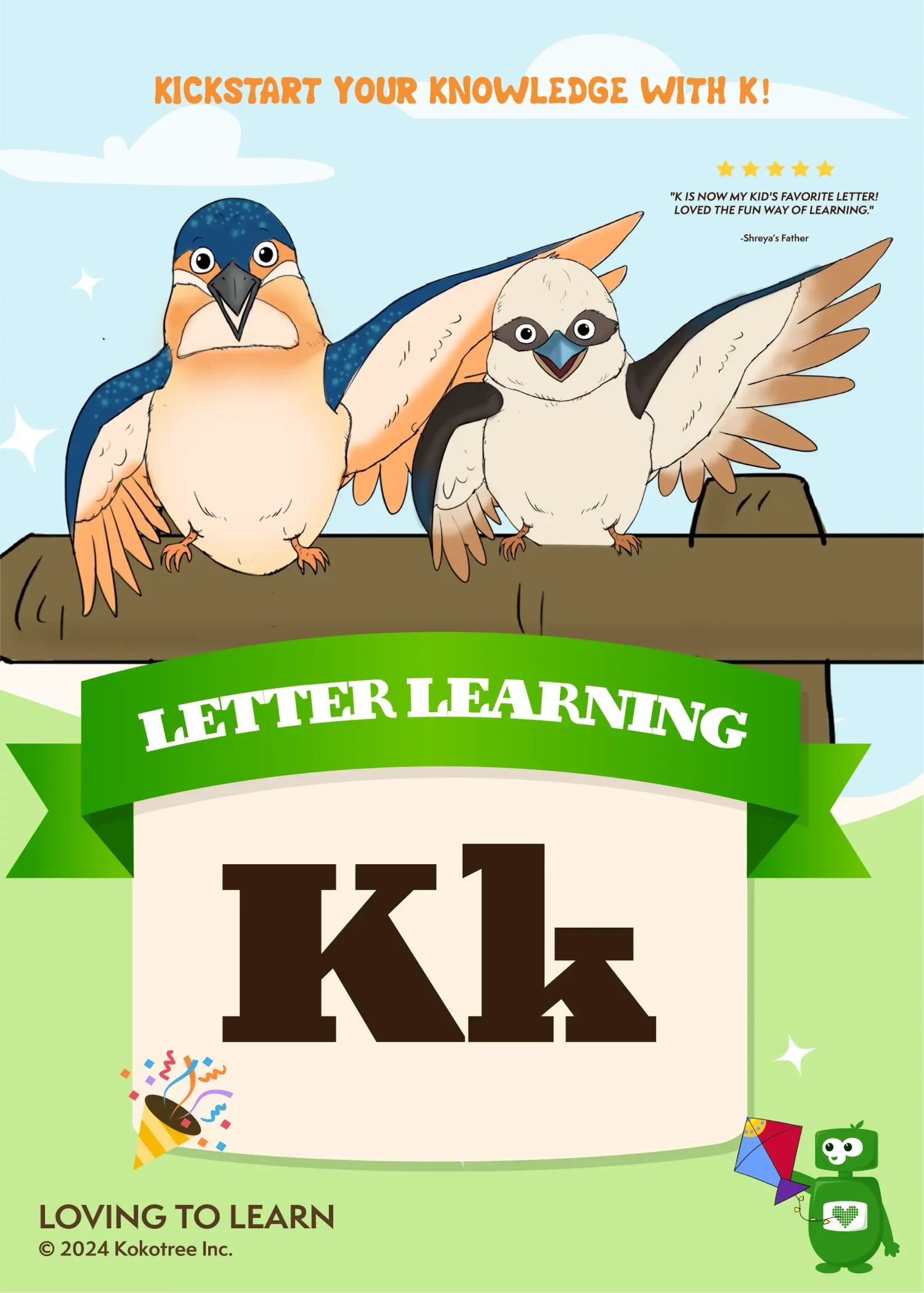
Your little one joins the Kokotree animal friends on an adventure that starts with a stuck kite and ends with mastering the letter K! They'll learn the "kuh" sound, practice writing both uppercase and lowercase K, and discover fun K words from around the world.
8 minutes
Ages 3-5
Skill: Letter recognition and phonics
Your kid watches animal friends learn letter K through storytelling. You get 8 minutes to enjoy your coffee in peace.
The Kokotree Class works together to rescue a kite stuck in a tree, then gathers around Miss Meera for an engaging story about a kind boy named King who helps an injured kingfisher bird. The adventure weaves in K words naturally while Miss Meera demonstrates exactly how to write the letter.
What your child learns:
This video builds essential pre-reading skills by connecting the letter K to its sound and real words. Children see the letter formed step-by-step and hear the "kuh" sound repeated in meaningful context.
- Recognizes the letter K in both uppercase and lowercase forms
- Produces the "kuh" sound consistently
- Connects the K sound to vocabulary words (kite, king, key, kangaroo)
- Follows stroke-by-stroke letter formation instructions
- Identifies K words in everyday conversation
They'll use these skills when:
- Spotting the letter K on cereal boxes, signs, and book covers
- Sounding out new words that start with "kuh"
- Writing their name if it contains the letter K
- Playing alphabet games and singing ABC songs
The Story (what keeps them watching)
The Kokotree Class—including Tiki Tiger, Bobby Bear, Ruby Rabbit, Maddy Monkey, and friends—team up to rescue Gina Giraffe's kite from a tree. Once they succeed, Miss Meera gathers everyone for a heartwarming story about King, a kind boy from Kenya who nurses an injured kingfisher back to health while a loyal kookaburra waits nearby. The tale is packed with K words that children absorb naturally. After the story, the class brainstorms more K words together, and Miss Meera shows exactly how to write the letter. The episode ends with everyone flying the rescued kite high into the sky!
How We Teach It (the clever part)
- First 2 minutes: The teamwork scene hooks kids emotionally while naturally introducing the word "kite"—setting up the K lesson ahead
- Minutes 2-5: Miss Meera's story embeds 10+ K words in context (king, kingfisher, kookaburra, Kenya, kiwi, kindness), so children hear the "kuh" sound repeatedly without drill-style repetition
- Final 3 minutes: Interactive recall, student-generated K words (key, kangaroo, karate, Kokotree), and step-by-step letter writing instruction cement the learning
Teaching trick: Miss Meera uses body movement to teach letter shape—asking children to imagine holding a king's staff and walking regally. This kinesthetic approach helps kids "feel" the letter K before they write it.
After Watching: Quick Wins to Reinforce Learning
- Mealtime activity: "Can you find something on the table that starts with K?" (Ketchup, knife, kiwi fruit—practices sound recognition in real objects)
- Car/travel activity: "Let's play K-spy! Who can spot a K on a sign first?" (Builds letter recognition while keeping little ones engaged)
- Bedtime activity: "Trace a big K on my back with your finger, then I'll guess what letter it is!" (Reinforces letter formation through touch)
- Anytime activity: "What sound does a kangaroo's name start with? Kuh-kuh-kangaroo! What else starts with kuh?" (Extends vocabulary through playful repetition)
When Kids Get Stuck. And How to Help.
- "My child confuses K with other letters" - Totally normal! The diagonal lines in K are tricky. Try making K with pretzel sticks or pipe cleaners so they can feel the shape with their hands.
- "They can say the sound but can't write the letter yet" - Sound recognition actually comes first developmentally—celebrate that win! Letter writing will follow with practice. Try tracing K in sand or shaving cream to build muscle memory.
- "My child only remembers 'kite' and forgets the other K words" - One word is a great start! Add one new K word per day. Point out keys, kitchens, and kicking to build their K vocabulary naturally over time.
What Your Child Will Learn
Prerequisites and Building Blocks
Children benefit most from this video after exposure to earlier alphabet letters, particularly those with similar sounds or shapes. Familiarity with straight lines and diagonal strokes (from letters like A, V, or X) helps with K formation. This lesson builds on phonemic awareness foundations—the ability to hear distinct sounds in words. Letter K naturally follows lessons on letters with simpler formations and prepares children for more complex consonant blends.
Cognitive Development and Teaching Methodology
The narrative-based approach leverages how preschool brains naturally learn—through story and emotional connection. Embedding K words within an engaging tale activates episodic memory, making vocabulary stick better than rote memorization. The video addresses multiple learning styles: visual learners see the letter formed, auditory learners hear the repeated "kuh" sound, and kinesthetic learners are invited to mimic the king's walking pose. This multimodal approach aligns with how 3-5 year olds process new information.
Alignment with Educational Standards
This video supports Common Core Foundational Skills for Reading (RF.K.1d, RF.K.3a)—recognizing and naming uppercase and lowercase letters and associating letters with sounds. It addresses kindergarten readiness benchmarks requiring children to identify at least 20 letters and their sounds. The letter formation instruction aligns with handwriting standards emphasizing proper stroke sequence, preparing children for the fine motor expectations of kindergarten writing curricula.
Extended Learning Opportunities
Pair this video with letter K tracing worksheets available in the Kokotree app's printable resources. The "Letter Hunt" game reinforces K recognition through interactive play. Extend learning with a nature walk to find K items (sticks shaped like K, looking for birds). Create a "K Collection Box" where children gather small objects starting with K. The app's phonics matching games provide additional practice connecting the K sound to images.
Transcript Highlights
- "The sound of the Letter K is 'kuh'!" - Clear, direct phonics instruction
- "Kuh...kuh...king. Kuh...kuh...kid. Kuh...kuh...kingfisher." - Modeling sound segmentation technique
- "Start from the top and make a line down to the baseline. Next go back to the top and slant left to the midline and then slant right to the baseline." - Explicit stroke-by-stroke formation guidance
- "Imagine a staff is in your hand and you're walking like a king." - Kinesthetic memory anchor for letter shape
Character Development and Story Arc
The opening scene beautifully models collaborative problem-solving as the animal friends work together to retrieve the stuck kite. Gina Giraffe shows persistence, and the group celebrates collective success rather than individual achievement. During the lesson, Maddy Monkey demonstrates creative thinking by fashioning a crown and staff from natural materials. The characters model active participation by volunteering K words (Ruby suggests "key," Tiki offers "Kokotree"), showing children that contributing ideas is valued and celebrated.
Phonics and Letter Formation Deep Dive
The letter K presents unique phonics considerations for early learners. It shares its primary sound (/k/) with the letter C, which children will eventually need to distinguish through spelling patterns. This video wisely focuses on establishing strong K-sound association first, using high-frequency words where K is the clear choice (kite, key, king).
The formation of K requires three distinct strokes and involves diagonal lines meeting at a midpoint—a more complex motor planning task than letters with only straight or curved lines. Miss Meera's instruction breaks this down systematically: vertical line first (establishing the "backbone"), then the two diagonal strokes that branch from the middle. This stroke sequence prevents the common error of drawing K as two separate shapes that don't connect properly.
The video's vocabulary selection is pedagogically strategic. Words like "kingfisher" and "kookaburra" introduce children to less common vocabulary while maintaining the K-sound focus. Geographic and nature-based words (Kenya, kiwi tree, kangaroo) expand world knowledge alongside phonics skills. The story context gives these words meaning—children remember "kookaburra" because it was the loyal friend waiting in the tree, not just a random vocabulary item.
The kinesthetic approach of "walking like a king with a staff" taps into embodied cognition research showing that physical movement strengthens memory formation. When children later see the letter K, they may recall the feeling of that regal walk, triggering letter recognition through body memory rather than visual memory alone.