
What's Letter O About?
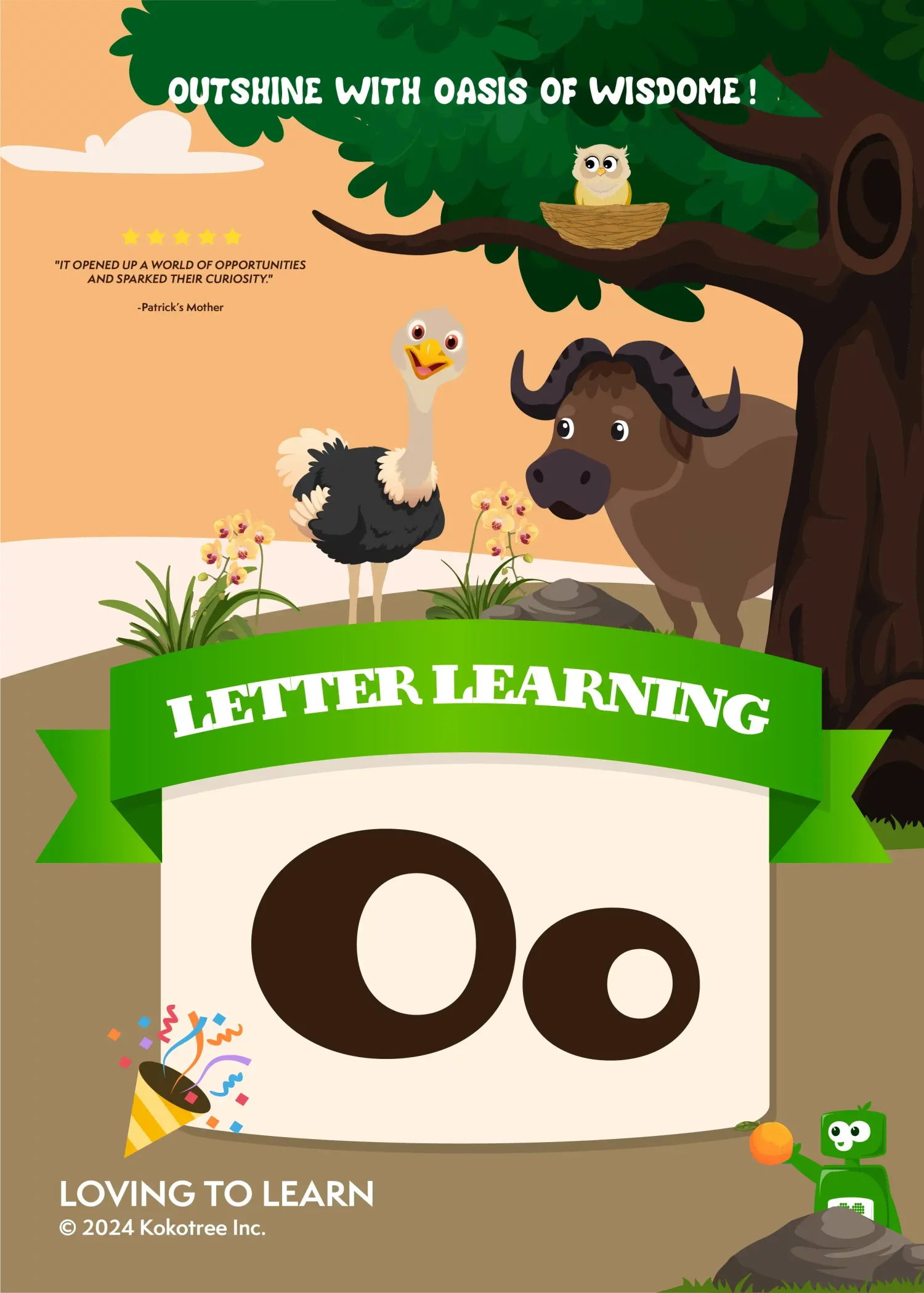
Your little one joins the Kokotree Class under the orange tree to discover the magical Letter O through a special poem, sound practice, and hands-on writing! They'll confidently identify O-words everywhere and write the letter themselves.
7 minutes
Ages 3-6
Skill: Letter recognition, phonics, and handwriting
Your kid watches friendly animals discover O sounds through poetry. You get 7 minutes to enjoy your coffee in peace.
Miss Meera arrives with beautiful orchid flowers from Mister Oliver the Ostrich. Oscar the Owl swoops in to help teach the two sounds of Letter O—the long "ooh" (like in oats and oval) and the short "auh" (like in octopus and orange). The class listens to a fun poem packed with O-words, then learns to write both uppercase and lowercase O.
What your child learns:
This video builds essential pre-reading skills by teaching children to hear and distinguish between two different O sounds. They'll also develop fine motor skills through guided letter formation practice.
- Recognizes uppercase O and lowercase o by sight
- Distinguishes between long O sound ("ooh") and short O sound ("auh")
- Identifies O-words at the beginning of common words
- Writes uppercase O using proper circular motion
- Writes lowercase o starting from the midline
They'll use these skills when:
- Spotting the letter O on cereal boxes, street signs, and book covers
- Sounding out new words while learning to read
- Writing their name if it contains the letter O
- Playing alphabet games and singing ABC songs with friends
The Story (what keeps them watching)
Miss Meera brings gorgeous orchid flowers to class—a gift from Mister Oliver the Ostrich! The kids quickly guess today's letter is O. Oscar the Owl makes a surprise entrance ("Who-who-who is talking about Letter O?") and helps explain that O makes two sounds. The class listens to Mister Oliver's poem about an otter and an ox searching for olives in an orchard. When the wind blows, olives rain down everywhere! Kids hunt for long O and short O words, then practice writing the letter in the air. Simple, memorable, and packed with O-words!
How We Teach It (the clever part)
- First 2 minutes: Miss Meera introduces the Letter O through orchid flowers and connects it to Mister Oliver the Ostrich, building curiosity and context
- Minutes 2-5: Oscar the Owl teaches the two O sounds with clear examples, then the class listens to a poem loaded with O-words and identifies them together
- Final 2 minutes: Step-by-step handwriting instruction shows exactly how to form uppercase O ("big circle to the left") and lowercase o ("small circle from the midline")
Teaching trick: The poem creates a memorable story context where O-words appear naturally—kids hear "Oliver," "Otter," "Ox," "orchard," "olives," "ocean," and more in a fun narrative, making abstract phonics feel like a treasure hunt!
After Watching: Quick Wins to Reinforce Learning
- Mealtime activity: "Can you find something on your plate that starts with O?" Point to oranges, oatmeal, or even the O-shape of onion rings. Practice saying "auh...orange!" together.
- Car/travel activity: "Let's play O-spy! Can you spot any O's on signs or license plates?" Count how many O's you find on your trip—circles are everywhere once you start looking!
- Bedtime activity: "Let's draw an O in the air together before sleep." Trace big circles and small circles while saying "start at the top, circle to the left."
- Anytime activity: "What sound does O make in your name?" If their name has an O, figure out if it's the long "ooh" or short "auh" sound together.
When Kids Get Stuck. And How to Help.
- "My child mixes up the two O sounds." Totally normal! The long and short sounds take time to distinguish. Focus on one sound per day and use exaggerated pronunciation: "Ooooooh-cean" vs "Ah-ctopus."
- "They can't remember which way to draw the circle." Many kids struggle with directionality at first. Try placing a small sticker on their left hand as a reminder, or guide their finger in the air before they try it alone.
- "My child gets frustrated that O looks the same uppercase and lowercase." Great observation skills! Celebrate that they noticed, then explain that O is special because both versions are circles—just different sizes. It's actually one of the easiest letters to master!
What Your Child Will Learn
Prerequisites and Building Blocks
Children watching this video benefit from prior exposure to the concept that letters represent sounds. Familiarity with letters A, E, and I (mentioned as also having two sounds) provides helpful context. This video builds on basic circle-drawing skills and auditory discrimination abilities. It fits within the alphabetic knowledge progression, preparing children for blending sounds into words and eventually reading simple text independently.
Cognitive Development and Teaching Methodology
This video leverages narrative context to anchor abstract phonetic concepts—the poem creates episodic memory hooks that help children recall O-words. The multi-sensory approach addresses diverse learning styles: visual learners see illustrated words, auditory learners hear distinct sound pronunciations, and kinesthetic learners practice air-writing. Repetition through class participation models active learning and builds confidence through peer validation.
Alignment with Educational Standards
This content aligns with Common Core Foundational Skills for Kindergarten (RF.K.1d, RF.K.3a) emphasizing letter recognition and letter-sound correspondence. It supports Head Start Early Learning Outcomes for Literacy Knowledge, specifically phonological awareness benchmarks. The handwriting component addresses fine motor development standards expected for kindergarten readiness, including proper letter formation and spatial awareness on writing lines.
Extended Learning Opportunities
Pair this video with Letter O tracing worksheets focusing on proper circular motion. The Kokotree app's letter recognition games reinforce visual identification skills. Extend learning by creating an "O Collection" box where children gather household items starting with O. Reading simple books featuring O-words (about owls, oceans, or oranges) reinforces phonetic patterns in meaningful contexts.
Transcript Highlights
- "Just like the Letter A, E, and I, Letter O also has two sounds: a long sound and a short sound."
- "And it has a short 'auh' sound: like in octopus and orange."
- "We start at the top and make a big circle to the left."
- "Start from the middle and make a small circle to the left."
Character Development and Story Arc
Oscar the Owl models enthusiastic participation by voluntarily joining the lesson—demonstrating that learning is exciting and worth engaging with. The Kokotree Class characters take turns identifying words, showing collaborative learning and building confidence through group participation. Miss Meera consistently celebrates attempts with specific praise ("Superb job everyone!"), modeling growth mindset encouragement that children can internalize.
Phonics Deep Dive: Understanding Vowel Sounds
The Letter O presents a fascinating phonological challenge for young learners because it represents multiple sounds in English. The "long O" sound (/oʊ/) as heard in "oats," "oval," and "ocean" is actually a diphthong—a vowel sound that glides from one position to another within the mouth. The "short O" sound (/ɒ/ or /ɑ/) as in "octopus," "olive," and "October" is a pure monophthong produced with the mouth more open.
This video wisely introduces both sounds simultaneously rather than teaching them separately, which reflects how children actually encounter these sounds in real reading experiences. Research in phonemic awareness shows that children benefit from explicit instruction in vowel sounds, as vowels are more variable and challenging than consonants.
The poem serves as an excellent teaching tool because it embeds target sounds in meaningful context. When children hear "Oliver Otter and an Ox entered an open orchard," they're processing multiple O-words naturally while following a story. This contextual learning creates stronger neural pathways than isolated drill practice.
The handwriting instruction emphasizes counter-clockwise circular motion, which is developmentally appropriate and prepares children for other curved letters (C, G, Q). Starting at the top and moving left establishes proper letter formation habits that support fluent handwriting development. The distinction between "big circle" for uppercase and "small circle from midline" for lowercase builds spatial awareness and proportional understanding essential for legible writing.