
What's Letter P About?
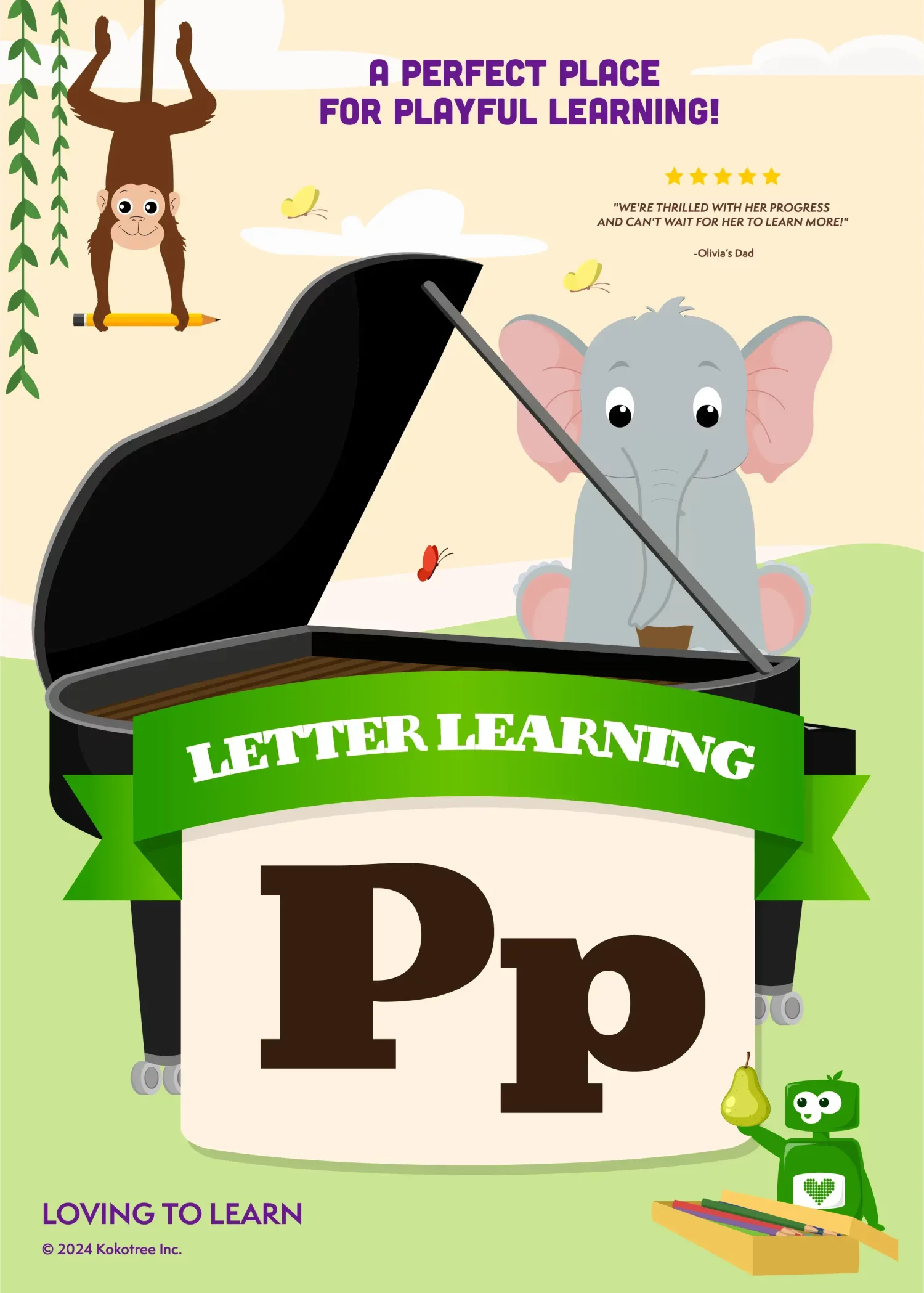
Your little learner joins the Kokotree animal friends on a delightful journey through the letter P—from piano keys to penguin drawings! They'll master the 'puh' sound and confidently write both uppercase and lowercase P.
7 minutes
Ages 3-5
Skill: Letter recognition, phonics, and handwriting
Your kid watches friendly animals discover P-words everywhere. You get 7 minutes to enjoy your coffee in peace.
The Kokotree classroom buzzes with excitement when Miss Meera reveals a surprise piano! The animal friends notice that piano, pear, and papa all share the same 'puh' sound. Bobby Bear shares stories about his pilot papa and his pets—a parrot, pigeon, pig, and poodle—while everyone creates birthday cards featuring their favorite P-words.
What your child learns:
This video transforms letter learning into a memorable adventure. Children connect the abstract 'puh' sound to concrete objects they can see and touch, building strong phonemic awareness that's essential for reading success.
- Recognizes the letter P in both uppercase and lowercase forms
- Produces the 'puh' sound correctly and consistently
- Identifies 15+ words that begin with the letter P
- Writes uppercase P using proper stroke order (line down, curve from top)
- Writes lowercase p with correct baseline placement
They'll use these skills when:
- Spotting the P on a pizza box or peanut butter jar at the grocery store
- Writing their name if it contains the letter P
- Sounding out words in their first picture books
- Playing alphabet games with friends at preschool
The Story (what keeps them watching)
Miss Meera surprises her class with a piano, and clever Ruby Rabbit notices something special—piano and pear both start with 'puh!' When Bobby Bear shares that it's his papa's birthday, the whole class decides to make cards featuring P-words. Gina Giraffe draws a pond, Tiki Tiger sketches a peacock, and Maddy Monkey creates a plant with pink flowers. Miss Meera's penguin drawing reveals a clever trick—you can trace the letter P right on a penguin's shape! The episode ends with everyone learning to write P and planning a popcorn party.
How We Teach It (the clever part)
- First 2 minutes: The 'puh' sound is introduced naturally through discovery—children hear piano, pear, and papa, connecting the sound to familiar objects before the letter is even named.
- Minutes 2-5: Vocabulary explosion! Bobby's story about his pilot papa and pets (parrot, pigeon, pig, poodle, penguin, panda) reinforces the sound through repetition while the card-making activity adds plant, pineapple, peacock, pond, pear, and popcorn.
- Final 2 minutes: Handwriting instruction breaks down letter formation into simple steps with visual guides, practiced twice for both uppercase and lowercase.
Teaching trick: Miss Meera shows how a penguin's silhouette actually forms the letter P—giving children a memorable visual anchor they'll recall every time they see the letter.
After Watching: Quick Wins to Reinforce Learning
- Mealtime activity: "Can you find something on your plate that starts with 'puh'?" (Peas, pasta, potatoes, peppers—practice connecting the sound to real foods)
- Car/travel activity: "Let's play P-spy! Who can spot something outside that starts with 'puh'?" (Parks, parking lots, people walking pets—builds observation skills)
- Bedtime activity: "Let's trace a big P on your back with my finger. Can you feel the line going down and the bump at the top?" (Kinesthetic reinforcement of letter shape)
- Anytime activity: "Draw your favorite P-word from the video!" Grab paper and crayons and let them recreate a penguin, peacock, or pineapple while saying 'puh-puh-penguin.'
When Kids Get Stuck. And How to Help.
- "My child mixes up P and B sounds." - Totally normal! These sounds are made the same way in your mouth. Have them put their hand in front of their lips—P has a little puff of air, B doesn't. Practice with 'puh-puh-pop' versus 'buh-buh-ball.'
- "The lowercase p confuses them because it goes below the line." - Great observation skills! Lowercase p is tricky because it dips down. Try saying 'p goes down to dig in the ground' as a memory helper. Many kids master uppercase first, and that's perfectly fine.
- "They can make the sound but can't remember words that start with P." - Keep a 'P collection' this week! Point out P-words during daily routines—purple shirt, playground, puddle. The more real-world connections, the stickier the learning becomes.
What Your Child Will Learn
Prerequisites and Building Blocks
Children benefit from prior exposure to basic letter concepts and the understanding that words are made of individual sounds. This video builds on foundational phonemic awareness skills introduced in earlier alphabet episodes. It fits within the systematic letter-learning progression, where each letter receives dedicated focus before moving to blending and word building. Familiarity with classroom routines and following multi-step instructions helps children engage fully with the handwriting segments.
Cognitive Development and Teaching Methodology
The video leverages the concrete operational thinking typical of preschoolers by connecting abstract letter sounds to tangible objects. Visual learners benefit from on-screen text labels and the penguin-P shape connection. Auditory learners absorb the repeated 'puh-puh-word' pattern throughout. Kinesthetic learners are engaged through the handwriting demonstration, which breaks complex motor tasks into simple, repeatable steps. The story-based context creates emotional engagement that enhances memory encoding.
Alignment with Educational Standards
This content aligns with Common Core Foundational Skills RF.K.1d (recognize uppercase and lowercase letters) and RF.K.3a (demonstrate letter-sound knowledge). It supports Head Start Early Learning Outcomes for Literacy Knowledge and Skills, specifically phonological awareness benchmarks. Kindergarten readiness indicators include identifying letters by name and sound, and demonstrating proper pencil grip and stroke direction—all addressed in this episode.
Extended Learning Opportunities
Pair this video with Kokotree's letter P tracing worksheets for fine motor practice. The app's 'Letter Hunt' game reinforces P-word identification through interactive play. Extend learning with a 'P scavenger hunt' around your home—finding pillows, pots, and pencils. Create a P-word collage by cutting pictures from magazines. Practice writing P in sand, shaving cream, or with finger paint for sensory-rich reinforcement.
Transcript Highlights
- "Puh is the sound of the Letter P and that's what we are going to learn about today." (Clear concept introduction)
- "Puh...puh...piano, puh...puh...pear." (Phonemic awareness through repetition)
- "We start from the top and make a straight line down to the baseline. Now go back to the top line, and slide right to make a curve to the midline." (Explicit handwriting instruction)
- "If you observe my penguins closely, you can even trace the letter P on it." (Visual memory anchor technique)
Character Development and Story Arc
Bobby Bear models enthusiasm for sharing and connecting learning to personal life when he tells the class about his papa. The entire class demonstrates collaborative creativity by making birthday cards together, showing children how learning can be an act of kindness. Miss Meera exemplifies patient, encouraging teaching—celebrating each child's contribution equally. The characters show curiosity without competition, modeling how learners can support each other's discoveries.
Phonics Deep Dive: The Letter P and Early Reading Development
The letter P represents one of the 'stop consonants' in English—sounds made by briefly stopping airflow and then releasing it. This makes P an excellent early letter to teach because children can feel the distinct 'pop' of air when they say it correctly, providing immediate sensory feedback.
Phonemic awareness—the ability to hear and manipulate individual sounds in words—is the strongest predictor of early reading success. This video builds phonemic awareness through initial sound isolation, helping children recognize that 'piano,' 'pear,' and 'papa' all begin with the same sound before connecting that sound to its written symbol.
The video introduces an impressive 20+ P-words: piano, pear, papa, pilot, plane, planet, pets, parrot, pigeon, pig, poodle, penguin, panda, pond, peacock, plant, pink, pineapple, popcorn, party, and perfect. This vocabulary flooding technique creates multiple neural pathways connecting the 'puh' sound to meaning, strengthening both phonological processing and vocabulary development simultaneously.
The handwriting instruction follows developmentally appropriate practice by teaching uppercase P first. The uppercase form uses simpler motor patterns and appears more frequently in a child's environment (signs, logos, books). The explicit stroke-by-stroke instruction—'start from the top, straight line down, back to top, curve to midline'—builds procedural memory through verbal mediation, a technique proven effective for young learners developing fine motor control.
The penguin-as-P visual mnemonic is particularly powerful. Research shows that pairing abstract symbols with concrete images dramatically improves letter retention in young children. This 'embedded picture' technique gives children a retrieval cue they can access independently whenever they encounter the letter P.