
What's Letter W About?
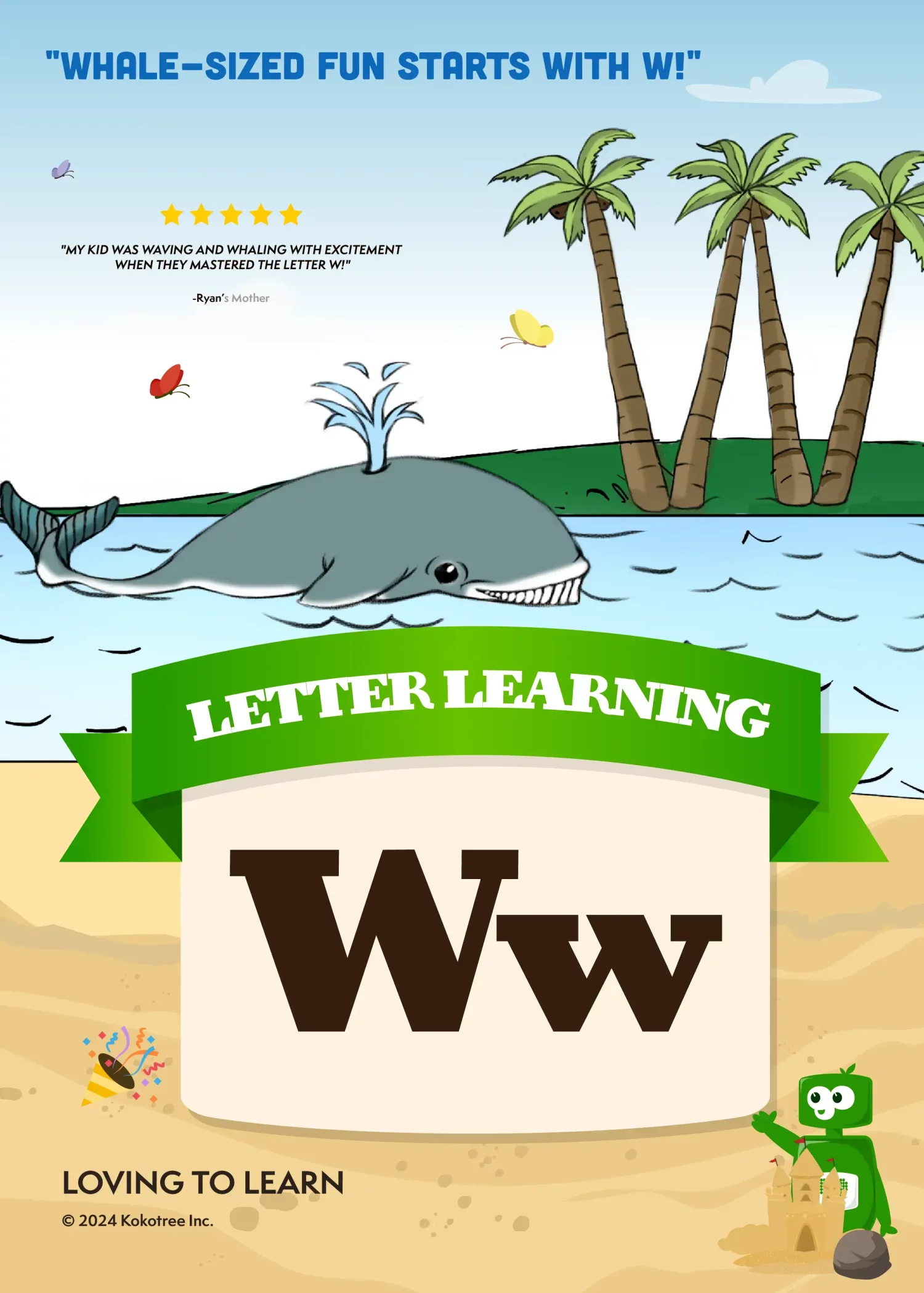
Your child joins their animal friends on a sunny beach adventure to master the letter W! They'll trace waves, sing catchy songs, and discover W words hiding all around them—then practice writing W in the sand.
9 minutes
Ages 3-5
Skill: Letter recognition, phonics, and handwriting
Your kid watches friendly animals discover W at the beach. You get 9 minutes to enjoy your coffee while it's still warm.
Miss Meera gathers the Kokotree Class under a shady tree at the beach. She shows them her wave painting and traces the letter W right over the ocean waves. The kids sing silly songs about wheels, walnuts, and whales while practicing the "wuah" sound together.
What your child learns:
This video teaches letter W through multi-sensory learning—visual recognition in wave shapes, auditory practice with the "wuah" sound, and kinesthetic reinforcement through handwriting. Your child connects the abstract letter to concrete, familiar objects.
- Recognizes uppercase W and lowercase w by sight
- Produces the "wuah" sound correctly (mouth shaped like whistling)
- Identifies W words: waves, watch, whale, wind, walk, whistle, world, walnut, wheels, water
- Writes uppercase W using "down, up, down, up" strokes
- Writes lowercase w starting from the midline
They'll use these skills when:
- Pointing out W words on signs, books, and food packages at the store
- Sounding out new words that start with W during reading time
- Writing their name if it contains the letter W
- Playing "I Spy" games looking for W objects around the house
The Story (what keeps them watching)
The Kokotree Class is relaxing at the beach when Miss Meera blows her whistle—it's lesson time! She reveals that the ocean waves actually look like the letter W, and the kids are amazed. They discover the "wuah" sound together, then break into a catchy song where each animal adds their own W word verse: Bobby sings about wheels, Maddy cracks open a walnut, Ruby spots a whale, and Gina feels the wind. The adventure ends with everyone practicing their W handwriting right in the beach sand. Learning has never felt more like a vacation!
How We Teach It (the clever part)
First 3 minutes: Miss Meera introduces the letter W by tracing it over her wave painting, connecting the abstract shape to something kids can see and understand. The "wuah" sound is taught with a memorable tip: shape your mouth like you're going to whistle.
Minutes 3-6: Vocabulary explosion through song! Each character adds a W word in a fun, repetitive melody that reinforces the sound-letter connection. Words appear on screen with the W highlighted.
Final 3 minutes: Handwriting instruction breaks down both uppercase and lowercase W into simple strokes: "slant down, slant up, slant down, slant up." Miss Meera writes in the sand, making practice feel playful.
Teaching trick: The video connects W to ocean waves—a shape kids already know. This visual anchor makes the abstract letter concrete and memorable. Every time your child sees waves, they'll think of W!
After Watching: Quick Wins to Reinforce Learning
Mealtime activity: "Can you find anything on your plate that starts with W?" (Think water, waffle, watermelon—practice identifying the "wuah" sound in real food items)
Car/travel activity: "Let's look out the window for W words!" (Wheels on cars, wind moving trees, water—turns travel time into a W scavenger hunt)
Bedtime activity: "Draw a W in the air with your finger—down, up, down, up!" (Reinforces the handwriting strokes without needing paper or pencils)
Anytime activity: "Whisper a W word to me!" (The whisper naturally creates the "wuah" mouth shape, reinforcing proper pronunciation)
When Kids Get Stuck. And How to Help.
"My child keeps confusing W and M" - This is completely normal! They're the same shape flipped. Point out that W has the points at the bottom like ocean Waves going down, while M has points at the top like Mountains going up.
"They can't make the 'wuah' sound correctly" - Have them pretend to blow out a candle slowly. The lip position for "wuah" is similar to blowing. Practice with "wow" since kids usually say that word naturally.
"The handwriting seems too complicated with all those strokes" - Start big! Use sidewalk chalk or finger paint to make giant W's. The muscle memory from large movements transfers to smaller pencil work later.
What Your Child Will Learn
Prerequisites and Building Blocks
Before watching Letter W, children benefit from familiarity with basic letter concepts and the understanding that letters have sounds. This video builds on earlier Kokotree alphabet lessons, particularly letters with similar stroke patterns like V and M. The beach setting and wave connection work best when children have been introduced to the concept that letters represent sounds. Letter W typically appears mid-alphabet in most curricula, making this appropriate after foundational vowels and common consonants.
Cognitive Development and Teaching Methodology
This video leverages the concrete operational thinking stage, where 3-5 year olds learn best through tangible connections. The wave-to-W visual metaphor transforms an abstract symbol into something children can see and touch. Multi-sensory instruction addresses diverse learning styles: visual learners see the highlighted W, auditory learners hear the repeated "wuah" sound, and kinesthetic learners trace along. The call-and-response format maintains engagement while the song segment uses musical intelligence for deeper encoding.
Alignment with Educational Standards
This lesson aligns with Common Core Foundational Skills RF.K.1d (recognize and name uppercase and lowercase letters) and RF.K.3a (demonstrate basic knowledge of letter-sound correspondence). The handwriting component addresses kindergarten readiness benchmarks for fine motor development and print concepts. Teachers expect incoming kindergarteners to recognize most alphabet letters and produce their sounds—this video directly supports that preparation through explicit phonics instruction.
Extended Learning Opportunities
Pair this video with Kokotree's letter W tracing worksheets for additional handwriting practice. The app's "W Word Hunt" game reinforces vocabulary recognition. Extend learning with water play—let children trace W in wet sand, shaving cream, or finger paint. Create a W collage by cutting W shapes from magazines. Connect to nature walks where children spot wind, water, and wildlife—all W words they learned in this video.
Transcript Highlights
- Sound introduction: "When you say the 'wuah' sound, you shape your mouth as if you're going to whistle. Repeat after me: wuah...wuah."
- Visual connection: "Look at this painting... This is what the letter W looks like. And you draw it like this: Down, up, down, up!"
- Handwriting instruction: "We'll start at the top and slant right to the baseline. Then slant up to the topline. Now slant another line down to the right and one more up to the right."
- Reinforcement: "Wuah...wuah...waves. Wuah...wuah...wow! Wuah...wuah...water."
Character Development and Story Arc
Miss Meera models patient, encouraging teaching throughout—she never rushes and celebrates every attempt. The Kokotree Class demonstrates collaborative learning beautifully: Tiki asks questions without embarrassment, Ruby makes observations, and each animal contributes their own W word to the song. This shows children that learning is a group activity where everyone's ideas matter. Bobby's spontaneous song creation models creative thinking, while Gina's "World!" discovery shows the joy of independent connections.
Phonics and Letter Formation Deep Dive
The letter W presents unique challenges in early literacy. It's the only English letter with a three-syllable name ("double-u") that doesn't match its sound, which can confuse young learners. This video wisely sidesteps this complexity by focusing exclusively on the "wuah" sound rather than the letter name.
The /w/ phoneme is a voiced labio-velar approximant—produced by rounding the lips while raising the back of the tongue. The video's instruction to "shape your mouth as if you're going to whistle" provides an accurate, child-friendly description of this articulation. This physical anchor helps children produce the sound correctly and consistently.
From a handwriting perspective, W is one of the most stroke-intensive letters, requiring four diagonal lines. The video's "down, up, down, up" verbal cue creates a rhythmic pattern that supports motor memory. Research shows that verbal accompaniment during letter formation significantly improves retention in preschoolers.
The vocabulary selection strategically uses high-frequency, concrete nouns (water, watch, wheel) that children encounter regularly. This builds practical phonemic awareness—children can apply their W knowledge immediately when they see these familiar objects. The wave metaphor is particularly effective because it provides a permanent visual reference; every beach visit or bathtub wave reinforces the letter shape.
The progression from recognition to sound production to handwriting follows the established phonics sequence: see it, say it, write it. This comprehensive approach ensures multiple neural pathways encode the letter W, supporting both reading recognition and writing production.