
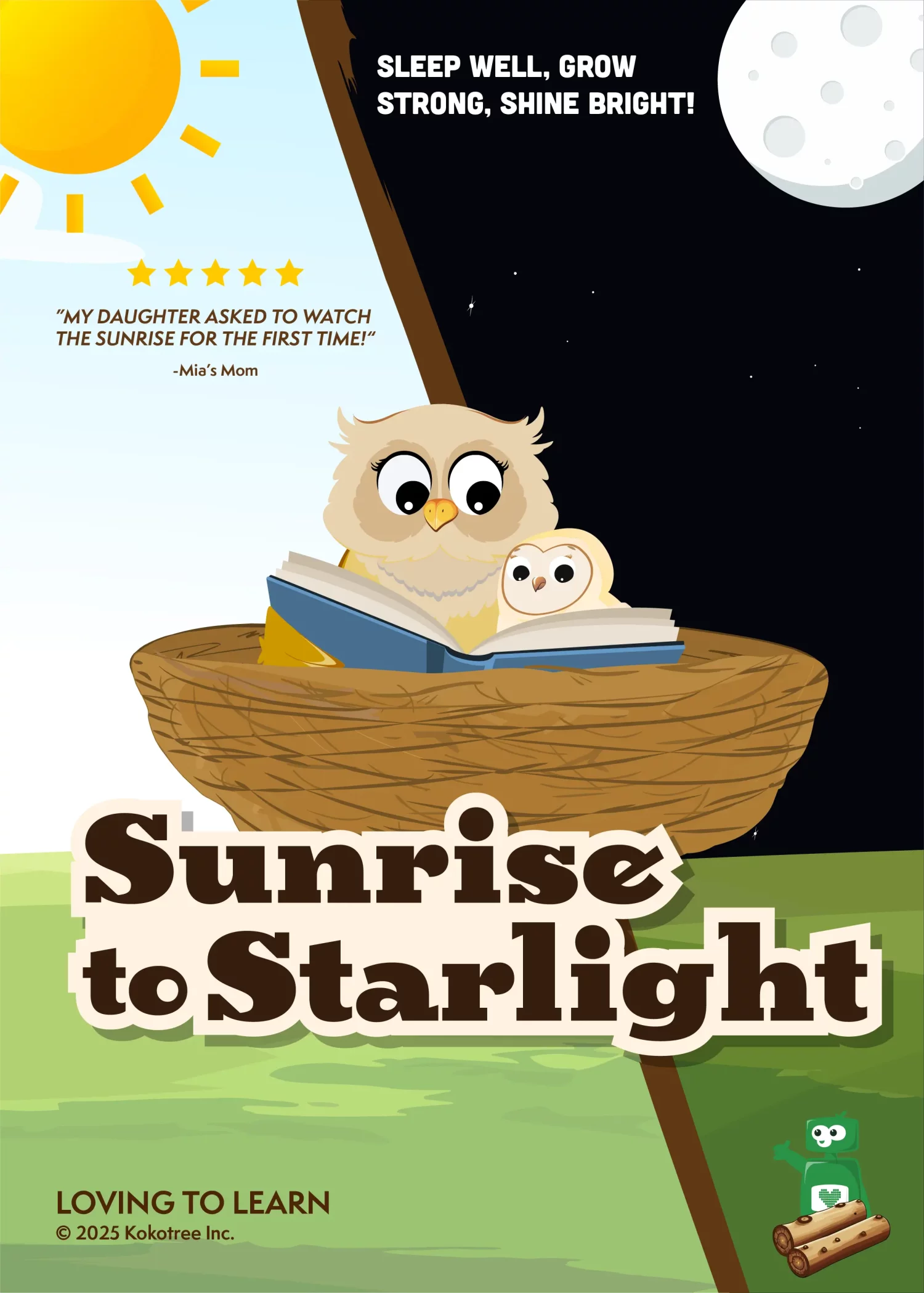
What's Sunrise to Starlight About?
Your little one will journey through a complete day with Elizabeth and friends, discovering how the Sun tells us when to wake up, eat lunch, play, and sleep. They'll master the four times of day and learn the perfect greeting for each one!
12 minutes
Ages 3-6
Skill: Understanding daily time cycles and routines
Your kid watches friendly animals explore morning, afternoon, evening, and night. You get 12 minutes to enjoy your coffee in peace.
Elizabeth gathers Eddie Elephant, Tiki Tiger, Gina Giraffe, and all their friends in a bright, cheerful circle. Together they discover why the Sun rising means it's time to wake up, how the sky changes throughout the day, and what activities belong to each time period. The animals share their own daily routines—from breakfast to bedtime stories.
What your child learns:
This video teaches children to recognize and name the four parts of the day by observing the Sun's position in the sky. They'll connect abstract time concepts to concrete daily activities they already do, making the learning stick.
- Names and identifies morning, afternoon, evening, and night
- Connects the Sun's position to different times of day
- Uses appropriate greetings: "Good Morning," "Good Afternoon," "Good Evening," "Good Night"
- Sequences daily activities in the correct time period
- Understands why routines and sleep schedules matter
They'll use these skills when:
- Waking up and recognizing it's morning time to get ready
- Telling you "Good Afternoon" when picked up from preschool
- Understanding why bedtime happens when the sky gets dark
- Predicting what comes next in their daily schedule
The Story (what keeps them watching)
Eddie Elephant arrives to class looking exhausted—he stayed up all night trying to count the stars! Elizabeth uses this as the perfect teaching moment to explore why day and night matter. The class discovers how birds wake with the sunrise, butterflies rest at night, and fireflies take over when darkness falls. Each animal shares what they do during different parts of the day, from Maddy's beloved snack time to Ronnie's nightly story time with family. By the end, everyone understands the beautiful rhythm of sunrise to starlight.
How We Teach It (the clever part)
First 4 minutes: Elizabeth introduces day versus night through Eddie's sleepy arrival. Children see visual comparisons of daytime and nighttime—birds flying versus resting, busy streets versus quiet ones, and the Sun versus moon and stars.
Minutes 4-9: The lesson breaks down the four times of day with clear visual labels. Each time period is connected to activities children already know: breakfast in the morning, lunch in the afternoon, playtime in the evening, and dinner at night.
Final 3 minutes: Animals share personal routines for each time of day, reinforcing that everyone follows similar patterns. The class practices all four greetings together.
Teaching trick: The video uses a split-screen visual showing the Sun's position alongside a table with Morning, Afternoon, Evening, and Night columns—so children literally see time as a progression they can track.
After Watching: Quick Wins to Reinforce Learning
Mealtime activity: "What time of day do we eat this meal?" Have your child identify whether it's breakfast (morning), lunch (afternoon), or dinner (night). Bonus: practice the matching greeting!
Car/travel activity: "Look at the sky—where's the Sun? What time of day is it?" Point out the Sun's position and have your child guess if it's morning, afternoon, or evening based on what they learned.
Bedtime activity: "The Sun went down and the stars are out—what time is it now?" Review the day's activities: "What did we do this morning? This afternoon? This evening?"
Anytime activity: Practice all four greetings throughout the day. Make it a game—when you wake up, prompt "How do we greet the morning?" and celebrate their "Good Morning!"
When Kids Get Stuck. And How to Help.
"My child mixes up afternoon and evening." This is completely normal—both happen after morning! Focus on the Sun's position: afternoon means Sun high and bright, evening means Sun going down and sky turning pink or orange.
"They don't understand why we can't play at night." Connect it to the video's examples: birds rest, butterflies sleep, even the swings rest at night. Our bodies need rest too, just like Eddie learned!
"The concept of time seems too abstract for my 3-year-old." Stick to the concrete activities: "Morning is when we eat breakfast and go to school. Night is when we sleep." The routine connection makes the abstract tangible.
What Your Child Will Learn
Prerequisites and Building Blocks
Children watching this video benefit from basic familiarity with the Sun and moon as objects in the sky. This lesson builds on foundational observation skills and connects to previous Kokotree content about nature and daily life. It serves as an excellent introduction to more advanced time concepts like telling time on a clock, understanding calendars, and learning about seasons. The video bridges concrete daily experiences with abstract temporal concepts.
Cognitive Development and Teaching Methodology
This video leverages the preoperational stage child's ability to learn through concrete examples and visual associations. By connecting abstract time concepts to tangible activities (breakfast, school, bedtime), the lesson uses schema-building techniques appropriate for ages 3-6. The call-and-response format engages auditory learners, while the visual split-screen comparisons support visual processors. Kinesthetic learners benefit from the suggested greeting practice with arm movements.
Alignment with Educational Standards
This video addresses kindergarten readiness indicators for understanding time sequences and daily routines. It aligns with early learning standards requiring children to "sequence events in the order they occur" and "use vocabulary related to time." The greeting practice supports social-emotional standards for appropriate communication. These skills directly prepare children for elementary expectations around following schedules and understanding classroom routines.
Extended Learning Opportunities
Pair this video with Kokotree's printable daily routine chart where children can mark activities in the correct time column. The app's "My Day" interactive game reinforces sequencing skills. Extend learning by creating a simple picture schedule at home showing morning, afternoon, evening, and night activities. Nature walks at different times of day help children observe the Sun's position firsthand.
Transcript Highlights
- "When the Sun rises in the morning we can see the Sun moving higher and becoming brighter."
- "Just after the afternoon the sun starts to move down. The sky looks dusky but it is not dark yet. This time of the day is called 'Evening.'"
- "What we need to do in the morning, can't be done in the evening. And what we need to do in the afternoon can't be done at night."
- "So finally we all sleep throughout the night looking forward to the sunrise again and doing things together right through the Morning, Afternoon, Evening and Night, repeating the same rhythm day after day."
Character Development and Story Arc
Eddie Elephant models a relatable mistake—staying up too late—and learns why routines matter without being shamed. Elizabeth demonstrates patient, curious teaching by turning Eddie's tiredness into a learning opportunity rather than a lecture. Each animal character contributes their personal routine, showing diverse but equally valid ways to structure a day. This collaborative sharing models how friends can learn from each other's experiences.
Understanding Time Cycles: A STEAM Deep Dive
The concept of day and night represents one of children's first encounters with Earth science and astronomy. This video introduces the foundational understanding that the Sun's apparent movement across the sky creates predictable patterns we call "times of day." While the video doesn't delve into Earth's rotation (appropriate for older learners), it establishes the crucial observation skills that make later scientific understanding possible.
From a cognitive development perspective, understanding time sequences is a significant milestone. Young children live in the "eternal present"—they struggle to conceptualize past and future. By anchoring abstract time to concrete, repeatable activities (breakfast happens in morning, dinner happens at night), this video builds temporal reasoning skills essential for executive function development.
The four-part day structure (morning, afternoon, evening, night) provides a framework children can immediately apply. Research shows that children who understand daily routines demonstrate better self-regulation and reduced anxiety—they can predict what comes next. The video's emphasis on the "rhythm" of day after day reinforces this predictability.
The inclusion of natural world examples (birds chirping at dawn, fireflies at night, butterflies resting) connects human routines to broader patterns in nature. This plants early seeds for understanding ecosystems, animal behavior, and eventually circadian rhythms. The observation that "even the swings come to rest" personifies objects in a way that resonates with animistic thinking common in this age group while reinforcing the universal nature of rest cycles.
The greeting practice (Good Morning, Good Afternoon, Good Evening, Good Night) serves dual purposes: it provides concrete verbal markers for each time period, and it builds social communication skills children will use throughout their lives.