
What's Phonics & Numbers Playtime About?
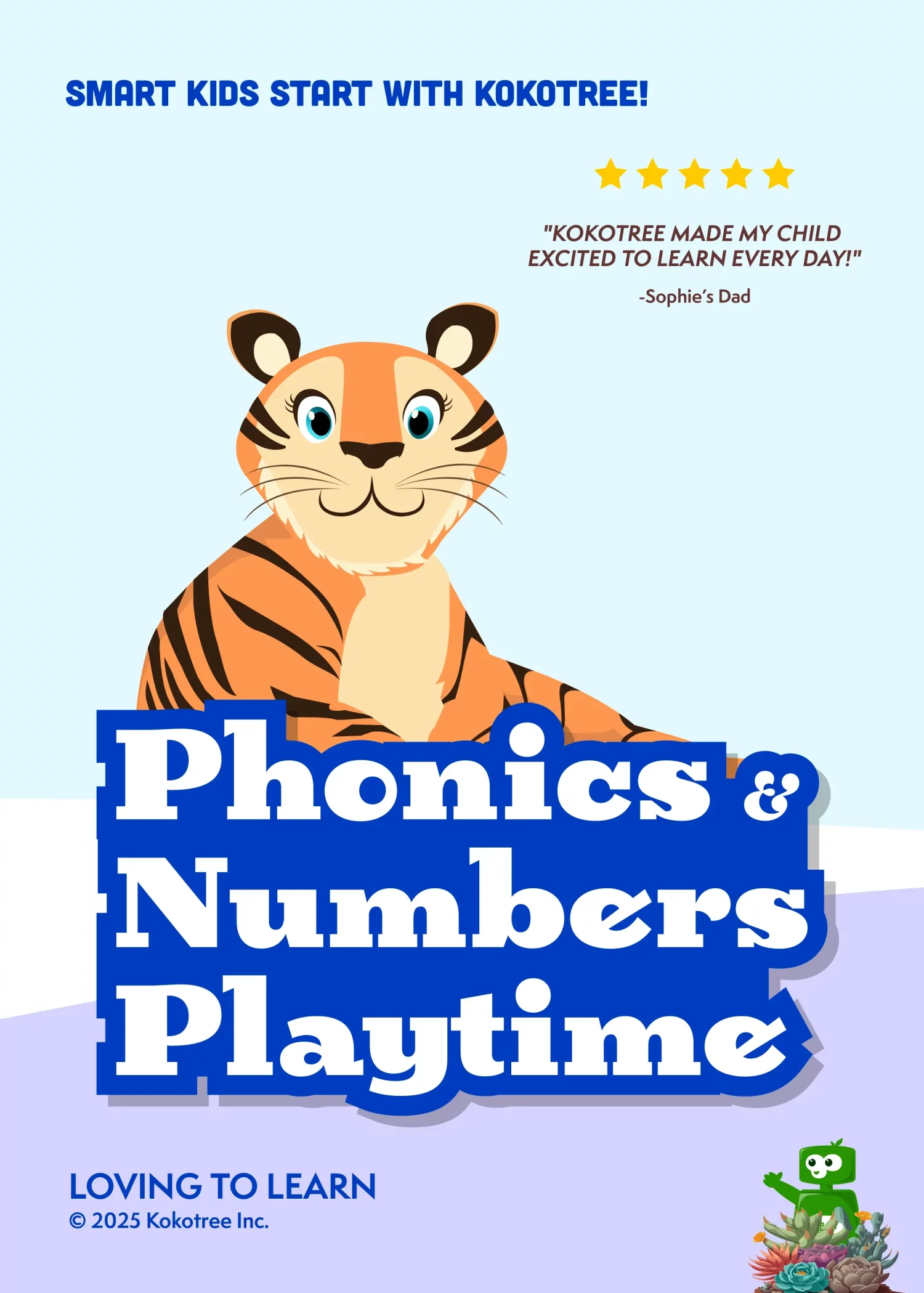
Your child joins two friendly animal teachers for a fun-filled lesson in letter sounds and counting! They'll practice pronouncing all 26 phonics sounds and count from 1-10 with confidence.
5 minutes
Ages 1-6
Skill: Letter sounds and number recognition
Your kid watches friendly animals teach phonics and counting basics. You get 5 minutes to enjoy your coffee in peace.
Meera the tiger guides children through all 26 letter sounds with clear pronunciation. Then Rocko the rhino takes over for an energetic counting session from 1-10, complete with repeat-after-me practice that gets kids actively participating.
What your child learns:
This video builds two essential foundations: phonemic awareness (the sounds letters make) and number sense (understanding quantities 1-10). Children practice both listening and speaking as they follow along with their animal teachers.
- Pronounces all 26 letter sounds correctly
- Counts from 1-10 in sequence
- Follows verbal instructions and repeats sounds
- Builds confidence through guided practice
- Develops early reading and math readiness
They'll use these skills when:
- Sounding out words on cereal boxes at breakfast
- Counting toys during cleanup time
- Recognizing letters on street signs during walks
- Sharing snacks equally with friends at the playground
The Story (what keeps them watching)
Meera the tiger welcomes your child to phonics class with warmth and enthusiasm. She guides them through every letter sound in the alphabet, making each one clear and fun to repeat. Then Rocko the rhino bounds in with his friendly, casual style for math class. He counts from 1-10 twice—first demonstrating, then inviting kids to repeat after him. Both teachers celebrate your child's efforts and encourage daily practice, leaving little learners feeling proud and motivated to keep going.
How We Teach It (the clever part)
- First 2 minutes: Meera introduces phonics, explaining that each of the 26 letters makes its own special sound, then models each one clearly
- Minutes 2-4: Rocko takes over for counting, first demonstrating 1-10, then guiding children to repeat each number after him
- Final minute: Both segments wrap with encouragement and a reminder to practice daily, reinforcing the habit of learning
Teaching trick: The repeat-after-me approach in the counting section transforms passive watching into active learning—when kids say numbers out loud, they're three times more likely to remember them!
After Watching: Quick Wins to Reinforce Learning
- Mealtime activity: "Can you count your peas before you eat them?" (Practices 1-10 counting with real objects they can touch and move)
- Car/travel activity: "What sound does that letter make?" Point to letters on signs and have them say the phonics sound. (Reinforces letter-sound connections in the real world)
- Bedtime activity: "Let's count to 10 together while we put your stuffed animals to bed." (Makes counting part of a cozy routine)
- Anytime activity: "I spy something that starts with the 'buh' sound!" Play a quick phonics I-spy game anywhere. (Connects letter sounds to familiar objects)
When Kids Get Stuck. And How to Help.
- "My child can't remember all 26 sounds yet." - Totally normal! Focus on 3-5 letters at a time. Meera encourages daily practice because repetition is how little brains build these connections.
- "They skip numbers or get the order mixed up." - Number sequencing takes time to stick. Try counting physical objects together—touching each one helps the brain connect the number word to the quantity.
- "The video seems too easy/hard for my child." - This video is designed as a foundation builder. If it feels easy, celebrate their confidence! If it's tricky, watch it together and pause to practice sections that need extra time.
What Your Child Will Learn
Prerequisites and Building Blocks
This video works best for children who can focus on a screen for short periods and attempt to repeat sounds. No prior letter or number knowledge is required—this is designed as a true starting point. It builds the foundation for future phonics videos that combine sounds into words, and counting videos that introduce numbers beyond 10. In the Budding Sprouts progression, this establishes the core skills that all literacy and numeracy content builds upon.
Cognitive Development and Teaching Methodology
The dual-teacher format leverages young children's need for variety and novelty to maintain attention. Meera's phonics segment uses auditory modeling, while Rocko's repeat-after-me counting activates verbal production—both proven techniques for memory encoding in ages 1-6. The friendly animal characters reduce performance anxiety, making children more willing to practice aloud. Short segments respect limited attention spans while maximizing learning density.
Alignment with Educational Standards
This video addresses foundational literacy standards requiring children to "recognize and produce rhyming words and demonstrate knowledge of letter sounds" (phonemic awareness). For math, it aligns with counting and cardinality standards expecting children to "count to 10 by ones" and "understand the relationship between numbers and quantities." These are core kindergarten readiness indicators assessed in early childhood screenings nationwide.
Extended Learning Opportunities
Pair this video with Kokotree's letter tracing activities and number matching games in the app. Print simple 1-10 number cards for hands-on counting practice. Alphabet puzzles and magnetic letters extend phonics learning tactilely. For screen-free reinforcement, create a "counting jar" where children add one item daily and count the total. Revisit this video weekly as a warm-up before advancing to more complex phonics and math content.
Transcript Highlights
- "There are 26 letters in the alphabet. Each letter makes a sound. Just follow my voice, and follow along." — Meera sets clear expectations and invites participation
- "Now, you might know some of these already, and that's great. Just follow along." — Rocko validates prior knowledge while encouraging continued engagement
- "This time, repeat after me." — Explicit instruction shifts children from passive to active learning
- "Make sure you practice this every day." — Both teachers reinforce the importance of repetition for skill building
Character Development and Story Arc
Meera the tiger models enthusiasm for learning, greeting children warmly and celebrating their participation in phonics. Her encouraging tone shows that learning is enjoyable, not intimidating. Rocko the rhino demonstrates a relaxed, approachable teaching style with his casual "Hi, how ya doin?" opening—showing kids that math class can feel friendly and fun. Both characters explicitly praise effort and encourage daily practice, modeling growth mindset by framing learning as an ongoing journey rather than a one-time achievement.
Foundational Literacy and Numeracy: Why These Skills Matter First
Phonemic awareness—the ability to hear and produce individual letter sounds—is the single strongest predictor of early reading success. Research consistently shows that children who master letter sounds before kindergarten learn to read faster and with greater comprehension. This video introduces all 26 phonics sounds in a systematic way, giving children repeated exposure to the building blocks they'll use to decode words.
The counting segment addresses number sense, which is equally critical for mathematical thinking. Counting from 1-10 isn't just memorization—it builds one-to-one correspondence (understanding that each number word represents one object) and stable order principle (numbers always come in the same sequence). Rocko's repeat-after-me approach engages procedural memory, helping children internalize the number sequence through verbal production.
The combination of phonics and counting in one video is intentional. Both skills require similar cognitive processes: sequencing, pattern recognition, and verbal recall. Practicing them together strengthens the neural pathways children need for all academic learning. The 5-minute format respects developmental attention limits while providing enough repetition for initial encoding. Daily practice, as both Meera and Rocko encourage, moves these skills from short-term to long-term memory—transforming exposure into mastery.