
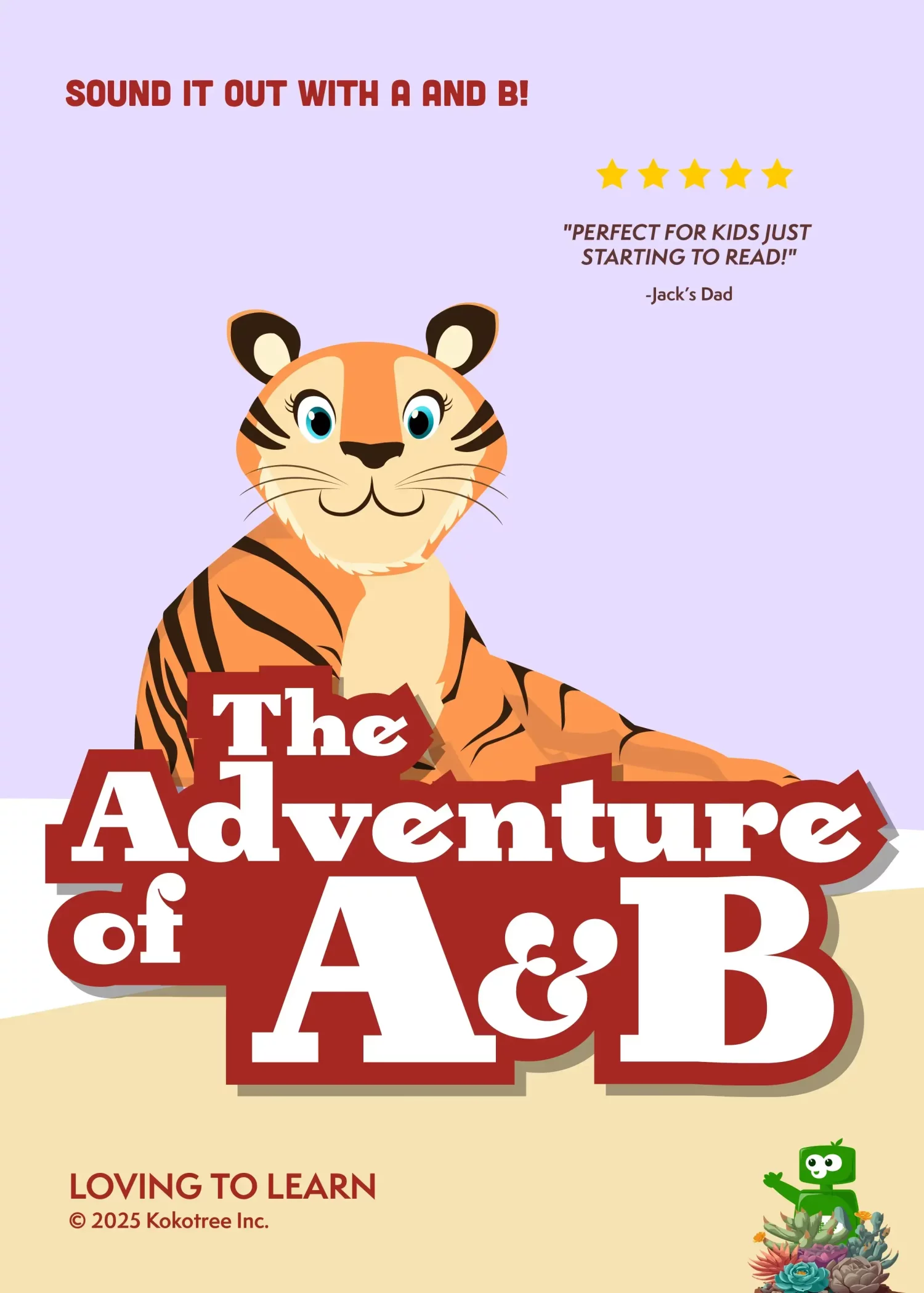
What's The Adventure of A and B About?
Your little one joins Miss Meera's classroom for an enchanting story-based adventure into the sounds of letters A and B! They'll practice phonics through engaging tales and walk away recognizing letter sounds in everyday words.
14 minutes
Ages 3-6
Skill: Letter sounds and phonics foundations
Your kid watches friendly animals discover letter sounds through stories. You get 14 minutes to enjoy your coffee while it's still warm.
Miss Meera gathers her animal students—Tiki Tiger, Bobby Bear, Ruby Rabbit, and friends—around for magical storytelling. Through tales about angels giving sounds to the world and a baby butterfly making her first friend, children hear letter sounds repeated naturally and practice saying them along with the class.
What your child learns:
This video introduces both the long and short sounds of the letter A, plus the consonant sound of B. Children hear these sounds embedded in memorable stories, then practice identifying them in familiar words like apple, ape, bird, and butterfly.
- Distinguishes between long "ay" and short "ae" sounds of the letter A
- Recognizes the "buh" sound of the letter B at the beginning of words
- Identifies letter sounds in common vocabulary words
- Practices phonemic awareness through call-and-response repetition
- Connects letter sounds to real objects (apples, ants, butterflies, bees)
They'll use these skills when:
- Sounding out words in their first picture books
- Recognizing letters on signs at the grocery store
- Playing "I Spy" games with letter sounds during car rides
- Singing along to alphabet songs with confidence
The Story (what keeps them watching)
Miss Meera's curious students spot ants marching and wonder how they communicate. This sparks a magical tale about angels giving sounds to everything on Earth! Children learn the long and short sounds of A through words like "ape" and "apple." Then silly Maddy Monkey's upside-down banana-eating leads into a sweet story about Booboo the butterfly and Bruce the bee becoming best buddies—packed with B words that kids repeat along with the class. Stories make sounds stick!
How We Teach It (the clever part)
- First 5 minutes: Miss Meera hooks kids with curiosity about ant communication, then introduces the magical origin story of sounds. The long "ay" and short "ae" sounds of A are woven into an engaging angel tale.
- Minutes 5-10: Children practice identifying A words through call-and-response ("Ae, ae, apple!"). The classroom animals model participation, making kids want to join in.
- Final 4 minutes: Bobby Bear's name introduces the letter B, followed by an alliterative story about Booboo and Bruce packed with B words. Kids practice "buh" sounds with birds, bees, and butterflies.
Teaching trick: Each letter sound is taught through immersive storytelling first, THEN isolated for practice. Kids absorb sounds naturally before drilling them—exactly how language acquisition works!
After Watching: Quick Wins to Reinforce Learning
- Mealtime activity: "Can you find something on your plate that starts with the 'ae' sound?" Point to an apple slice, banana, or anything beginning with A or B. Practice saying "Ae, ae, apple!" together.
- Car/travel activity: "Let's spot things that start with B!" Look for buses, birds, buildings, or blue cars. Say "Buh, buh, bus!" each time you find one.
- Bedtime activity: "What animal friends did we meet today?" Recall Booboo the butterfly and Bruce the bee. Ask your child to make the "buh" sound like a buzzing bee.
- Anytime activity: March like ants around the house saying "Ae, ae, ant!" with each step. Then flutter like butterflies saying "Buh, buh, butterfly!" Movement locks in learning.
When Kids Get Stuck. And How to Help.
- "My child can't tell the difference between long and short A sounds." Totally normal! Use physical cues: stretch your arms wide for the long "aaay" and tap quickly for the short "ae." The body remembers what the ears forget.
- "They just want to watch, not repeat the sounds." Silent processing counts as learning! Many children need several viewings before participating aloud. Watch together and model the sounds yourself without pressure.
- "The video seems too long for my child's attention span." Try watching the A section one day and the B section another. Each letter segment works as a standalone mini-lesson, and shorter sessions can be just as effective.
What Your Child Will Learn
Prerequisites and Building Blocks
Children benefit most from this video if they can recognize that letters exist as distinct symbols and understand that words are made of sounds. This video builds on basic alphabet familiarity and prepares children for blending sounds into words. It serves as an excellent introduction to phonemic awareness, bridging letter recognition with the crucial skill of connecting letters to their sounds—the foundation of reading readiness.
Cognitive Development and Teaching Methodology
The narrative-based approach leverages children's natural love of stories to embed phonics instruction in meaningful context. This aligns with research showing 3-6 year olds learn best through emotionally engaging content. The call-and-response format activates auditory processing, while the visual storytelling supports visual learners. Kinesthetic learners benefit from the marching ant activity, creating a multi-sensory phonics experience.
Alignment with Educational Standards
This video addresses Common Core Foundational Skills RF.K.2 (phonological awareness) and RF.K.3 (phonics and word recognition). It specifically targets the kindergarten benchmark of isolating initial sounds in words. The distinction between long and short vowel sounds prepares children for first-grade decoding standards. Head Start Early Learning Outcomes include this phonemic awareness as a key literacy indicator.
Extended Learning Opportunities
Pair this video with letter A and B tracing worksheets to connect sounds with letter formation. The Kokotree app's letter games reinforce these phonics concepts through interactive play. Create a simple scavenger hunt for A and B objects around your home. Reading picture books featuring alliterative text (like the Booboo story) extends the learning naturally into shared reading time.
Transcript Highlights
- "The short sound for letter A is 'ae.' You will hear the short sound 'ae' if you listen to the steps of those marching ants on the apple."
- "Ae...ae...apple. Can you all say, 'apple'?" / "Apple!" / "That's right! Ae, ae, apple. Repeat after me."
- "Blue sky, birds, bright flowers, buzzing bees, beautiful butterflies, Booboo and Bruce, best buddies. There is a sound that you hear again and again."
- "It's the 'buh' sound of the B, right?" / "Yes, Bobby Bear. It has the B sound. Just like your name."
Character Development and Story Arc
Miss Meera models patient, encouraging teaching—never criticizing wrong answers, always celebrating attempts. Bobby Bear demonstrates pride in connecting learning to personal identity ("I have LOTS of Bs in my name!"). The curious students (wondering about ant communication) show that questions lead to discovery. Maddy Monkey's silliness is gently redirected, modeling classroom behavior without shame. Each character shows enthusiasm for learning.
Phonics Deep Dive: Understanding Vowel Sounds and Consonant Foundations
The distinction between long and short vowel sounds is one of the most critical phonics concepts for early readers. Long vowels "say their name" (the A in "ape" sounds like the letter name), while short vowels have a different, clipped sound (the A in "apple"). This video brilliantly introduces this concept through contrast and repetition.
Research in reading science shows that explicit phonemic awareness instruction—the ability to hear and manipulate individual sounds—is the strongest predictor of reading success. By isolating the initial sounds ("Ae, ae, apple") and having children repeat them, this video builds the auditory discrimination skills essential for decoding words.
The letter B introduction demonstrates consonant sound instruction best practices: consistent sound production ("buh"), multiple examples in meaningful context (the alliterative story), and immediate practice opportunities. The story about Booboo and Bruce contains over fifteen B-words, providing the repetition young brains need to cement sound-symbol connections.
Importantly, this video avoids a common phonics pitfall: adding an unnecessary vowel sound to consonants. The "buh" sound is kept short and crisp, preparing children for accurate blending. When children later encounter the word "bat," they'll be ready to smoothly connect "buh-ae-t" rather than saying "buh-uh-ae-tuh."
The narrative framing (angels giving sounds, butterflies making friends) creates emotional hooks that enhance memory encoding. Children remember stories far better than isolated drills, making this approach both developmentally appropriate and scientifically sound.