
What's Sound Safari C and D About?
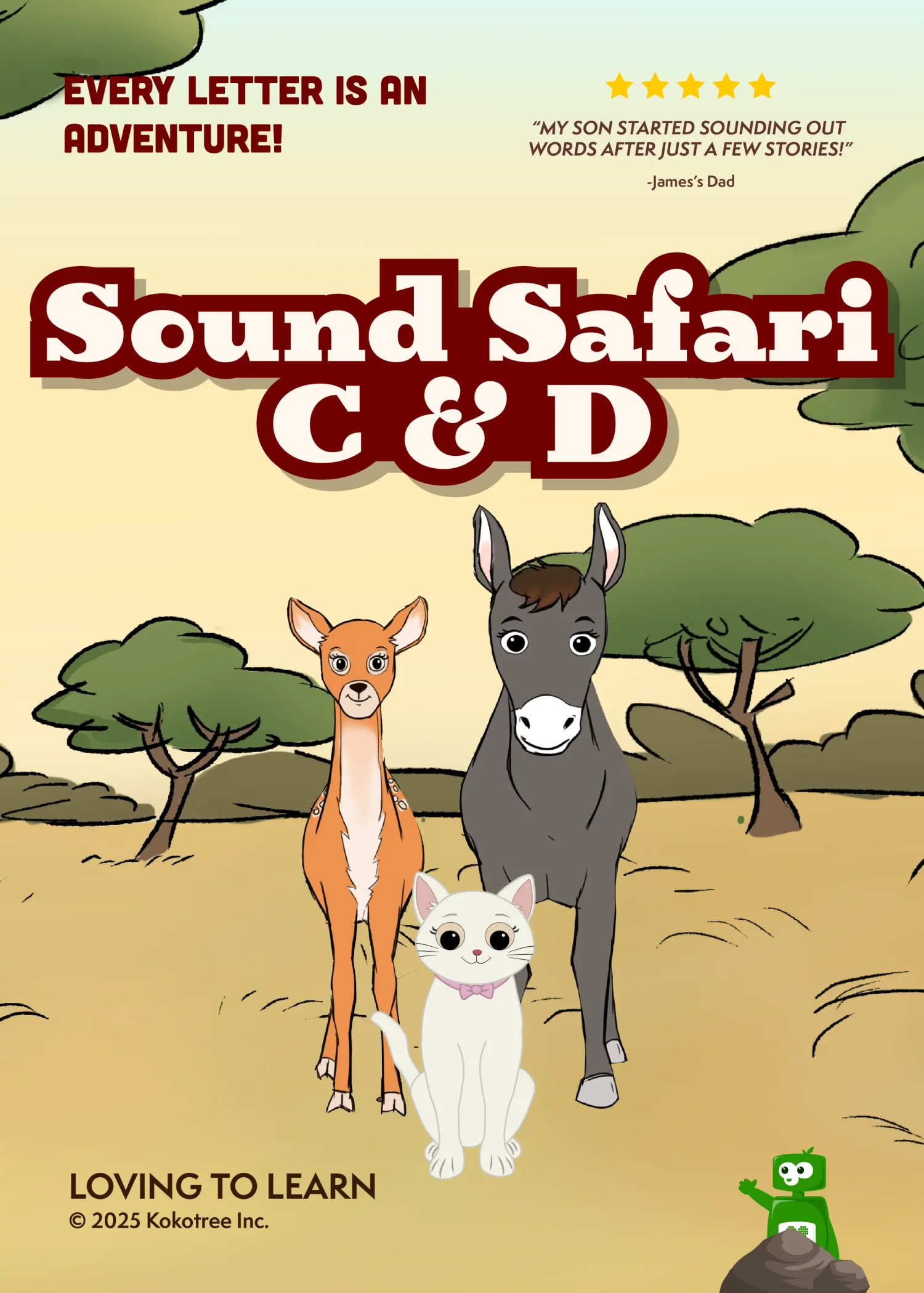
Your little learner goes on a phonics adventure with Miss Meera, discovering the sounds that letters C and D make through storytelling and interactive games. They'll walk away recognizing these letter sounds in everyday words—from "cat" to "dinosaur"!
7 minutes
Ages 3-5
Skill: Letter sounds and phonemic awareness
Your kid watches Miss Meera tell stories and play sound games. You get 7 minutes to drink your coffee while it's still warm.
Miss Meera introduces the letter C through an engaging story about Callie, a curious cat who loves cabinets, carrots, and crayons. Then the class discovers the letter D through a riddle game where they guess "duh" words like doll, dinosaur, and drum.
What your child learns:
This video builds essential pre-reading skills by teaching children to isolate and identify beginning letter sounds. Through repetition and real-word examples, kids learn to hear the "cuh" and "duh" sounds in familiar words they already know.
- Recognizes the hard "C" sound (cuh) at the beginning of words
- Identifies the "D" sound (duh) in common vocabulary
- Connects letter sounds to objects they see every day
- Practices phonemic awareness through call-and-response
- Builds vocabulary with 20+ new "C" and "D" words
They'll use these skills when:
- Spotting the letter C on cereal boxes at breakfast
- Pointing out "D" words like "door" and "dog" on walks
- Sounding out words in picture books at bedtime
- Playing "I Spy" games with letter sounds in the car
The Story (what keeps them watching)
Meet Callie—a curious, cute cat who never does what you expect! When her master puts her in a cot, she jumps in a cardboard box. Offer her a cookie? She wants corn instead. This silly story is packed with "cuh" words that kids can't help but notice. Then Bobby Bear, Maddy Monkey, and friends join Miss Meera for a guessing game about "duh" words, solving riddles about dolls and dinosaurs. The friendly classroom energy keeps little ones engaged and eager to shout out answers!
How We Teach It (the clever part)
- First 3 minutes: Miss Meera introduces the letter C through Callie's story, naturally embedding 25+ "cuh" words so children hear the sound repeatedly without realizing they're learning
- Minutes 3-5: The class practices together with call-and-response ("cuh-cuh-cat!"), building muscle memory for the sound
- Final 2 minutes: Letter D gets introduced through an interactive riddle game, making children active participants in discovering the "duh" sound
Teaching trick: The story about Callie the Cat uses what educators call "sound flooding"—packing so many C-words into one narrative that the "cuh" sound becomes impossible to miss. Kids naturally start predicting the pattern!
After Watching: Quick Wins to Reinforce Learning
- Mealtime activity: "Can you find something on your plate that starts with 'cuh'?" (Carrots, corn, crackers, cheese—this reinforces connecting sounds to real objects)
- Car/travel activity: "Let's play the D game—every time you see a dog, say 'duh-duh-dog!'" (Turns any car ride into phonics practice)
- Bedtime activity: "What 'cuh' sound would Callie the Cat make if she saw your cozy covers?" (Connects the story character to their own environment)
- Anytime activity: Grab some crayons and paper—"Can you draw something that starts with 'duh'? A dinosaur? A duck? A drum?" (Combines creativity with sound recognition)
When Kids Get Stuck. And How to Help.
- "My child says 'cuh-AH' instead of just 'cuh'" - Totally normal! Many kids add a vowel sound at first. Model the crisp "cuh" sound and have them watch your mouth. It clicks with practice.
- "They can repeat the sounds but can't find C or D words on their own" - This skill develops in stages. Keep playing the games from the video, and one day they'll surprise you by pointing out a "duh" word unprompted!
- "Is learning two letters at once too much?" - Miss Meera separates them into distinct segments for a reason. If your child seems overwhelmed, watch just the C portion today and save D for tomorrow.
What Your Child Will Learn
Prerequisites and Building Blocks
Children watching this video should have basic alphabet familiarity—recognizing that letters exist and have names. This episode builds on foundational letter recognition and prepares children for blending sounds into words. It's ideal for learners who've completed introductory alphabet videos and are ready to connect letter symbols with their phonetic sounds. Sound Safari C and D fits mid-sequence in a comprehensive phonics program, after vowel awareness and before consonant blends.
Cognitive Development and Teaching Methodology
This video leverages narrative embedding, a research-backed approach where target sounds appear naturally within engaging stories rather than isolated drills. The call-and-response technique activates working memory and builds phonological processing speed. Visual learners benefit from on-screen imagery matching each "cuh" and "duh" word, while auditory learners thrive with the repetitive sound patterns. The riddle game engages kinesthetic learners through mental participation and anticipation.
Alignment with Educational Standards
This content aligns with Common Core RF.K.3 (knowing letter-sound correspondences) and Head Start Early Learning Outcomes Framework literacy goals. Kindergarten teachers expect incoming students to identify consonant sounds in initial word positions—exactly what this video practices. The lesson supports Pre-K phonemic awareness benchmarks and builds toward the decoding skills assessed in kindergarten readiness screenings nationwide.
Extended Learning Opportunities
Pair this video with printable C and D letter tracing worksheets available in the Kokotree app. The "Sound Match" game reinforces these specific letter sounds through interactive play. Extend learning with a kitchen scavenger hunt for C-words (cups, cans, containers) or a bedroom search for D-words (desk, drawer, dolls). Creating a simple picture dictionary with magazine cutouts of C and D objects makes excellent screen-free reinforcement.
Transcript Highlights
- "There is a common sound in the words: Callie, curious, cat, cotton, candy, crayons, cabinet, coconut, carrot." — Miss Meera explicitly connects multiple examples to one sound
- "So children, repeat after me: cuh cuh cat." — Direct phonics instruction with guided practice
- "Can anyone guess how the letter D sounds?" "You mean like, 'duh'?" — Student-led discovery validates children's attempts
- "I will describe a 'duh' word and you try and figure out what it is." — Gamification transforms passive watching into active thinking
Character Development and Story Arc
Miss Meera models patient, encouraging teaching—celebrating every attempt with "Excellent!" and "Fantastic!" The classroom characters demonstrate collaborative learning, building on each other's answers without competition. Callie the Cat, though fictional within the story, models curiosity and playfulness, showing children that being "different" and exploring unconventionally is delightful. Bobby Bear's honest "Now I'm hungry for cake" moment normalizes authentic responses to learning.
Phonemic Awareness Deep Dive: Why Letter Sounds Matter More Than Letter Names
Phonemic awareness—the ability to hear, identify, and manipulate individual sounds in spoken words—is the strongest predictor of early reading success. This video specifically targets phoneme isolation, teaching children to identify the initial sound in words. The "cuh" sound for C (technically the voiceless velar stop /k/) and "duh" sound for D (the voiced alveolar stop /d/) are among the first consonants children master because they're acoustically distinct and appear in high-frequency vocabulary.
The video wisely focuses on the "hard C" sound, avoiding the complexity of soft C (as in "city") which follows different phonetic rules. This scaffolded approach prevents cognitive overload while building confidence. Research from the National Reading Panel confirms that systematic phonics instruction—teaching letter-sound relationships in a planned sequence—produces significant benefits for children's reading development.
The call-and-response technique ("cuh-cuh-cat") isn't just fun—it builds automaticity. When children can rapidly produce letter sounds without conscious effort, cognitive resources free up for higher-level comprehension tasks. Each repetition strengthens neural pathways between the visual symbol (letter C), the auditory representation (the "cuh" sound), and the motor memory of producing that sound. This multi-sensory encoding creates robust, retrievable memories that transfer to real reading situations.