
What's Rectangle and Blue About?
Your little one joins a fun classroom adventure where they'll master rectangle shapes and discover the color blue everywhere! After watching, they'll confidently point out rectangles at home and spot blue objects in their world.
7 minutes
Ages 1-6
Skill: Shape recognition and color identification
Your kid watches friendly animals discover shapes in everyday objects. You get 7 minutes to enjoy your coffee in peace.
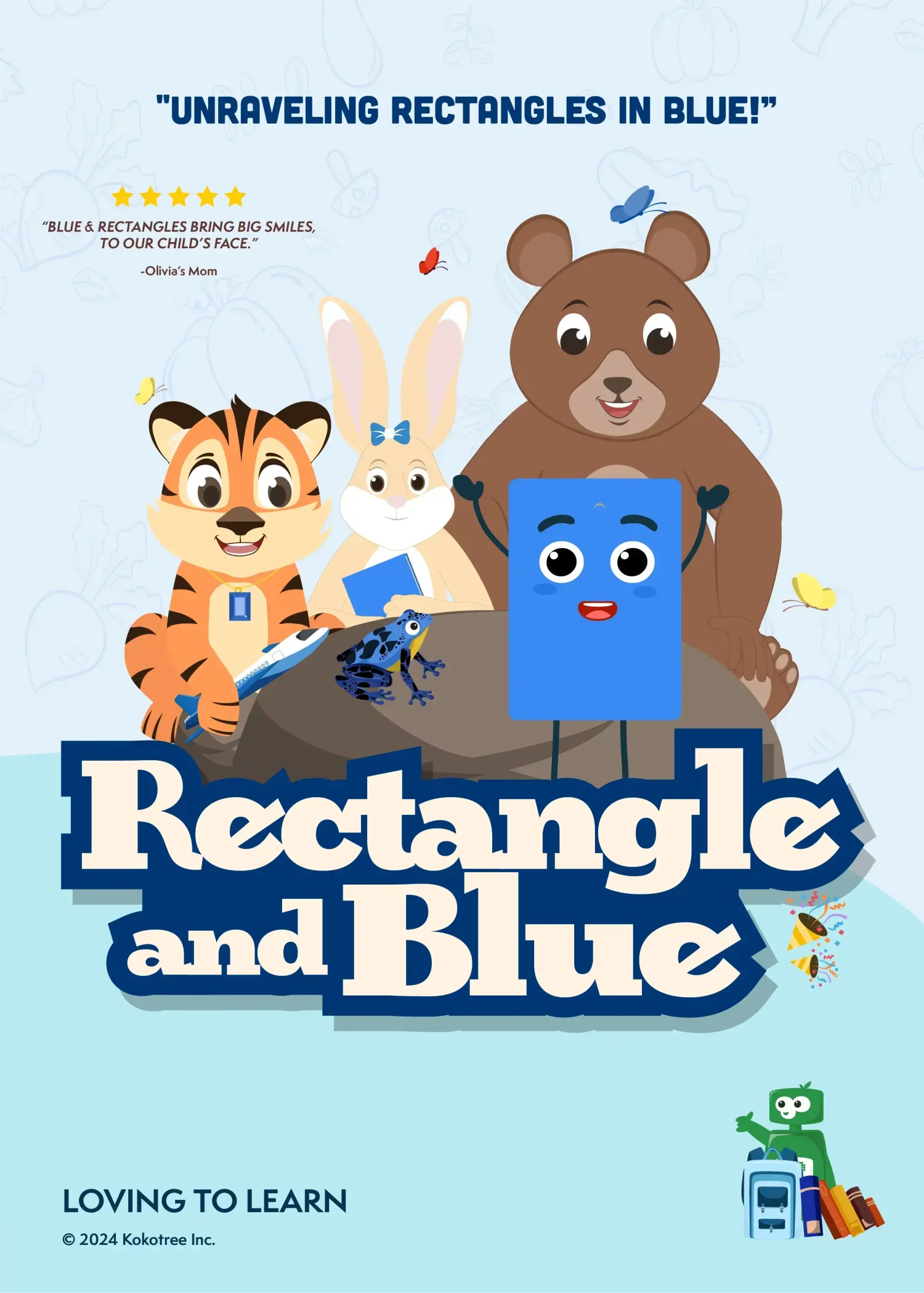
Miss Elizabeth's classroom comes alive when Ruby Rabbit's notebook transforms into the lovable Mr. Rectangle! The adorable animal students hunt for rectangles around their classroom—finding them in erasers, school bags, rulers, and lockets. Then a catchy song about blue takes them on a colorful journey through oceans, skies, and blueberries.
What your child learns:
This video teaches the key properties of rectangles (four sides, opposite sides equal, four corners) and how they differ from squares. Children also explore the color blue through real-world examples and a memorable song.
- Identifies rectangles by their properties (opposite sides equal, four corners)
- Distinguishes rectangles from squares
- Recognizes blue objects in nature and everyday life
- Practices drawing rectangles step-by-step
- Connects shapes and colors to familiar items
They'll use these skills when:
- Setting the table and noticing the rectangular placemats and napkins
- Reading books and pointing out the rectangular pages
- Getting dressed and finding blue items in their wardrobe
- Building with blocks and sorting rectangular pieces from square ones
The Story (what keeps them watching)
Ruby Rabbit proudly shows off a new notebook, calling it a square—but wait! Miss Elizabeth gently guides the class to discover it's actually a rectangle. Cue Mr. Rectangle, who pops to life and teaches everyone his special properties through dance and fun facts. The whole class goes on a rectangle hunt, finding shapes in erasers, bags, and rulers. When Tiki Tiger reveals a blue locket, the lesson shifts to exploring the color blue through a catchy song about oceans, whales, and blueberries. Eddie Elephant even shares his love for blueberries!
How We Teach It (the clever part)
- First 2 minutes: Ruby's "mistake" creates curiosity—is it a square or rectangle? Miss Elizabeth guides discovery through questioning, not lecturing.
- Minutes 3-5: Mr. Rectangle teaches properties through movement and visual highlights, then the class practices drawing rectangles with simple "standing lines" and "sleeping lines" instructions.
- Final 2 minutes: A classroom scavenger hunt reinforces rectangle recognition, then transitions smoothly to color learning through Tiki's blue locket and an engaging song.
Teaching trick: The video uses the "standing lines" and "sleeping lines" language to make drawing rectangles intuitive for little hands—no confusing terms like "vertical" or "horizontal" needed!
After Watching: Quick Wins to Reinforce Learning
Mealtime activity: "Can you find something rectangular on the table?" Point to placemats, napkins, or phones. Ask your child to trace the edges with their finger to feel those "two long sides and two short sides."
Car/travel activity: "Let's count blue things we see!" Windows, signs, and cars become a color-spotting game. Bonus points for finding something that's BOTH blue AND rectangular.
Bedtime activity: "Let's draw a rectangle together!" Use the video's method: two standing lines, then connect with sleeping lines. Your child can decorate it as a door, window, or picture frame.
Anytime activity: "Is this a square or rectangle?" Hold up books, phones, or crackers. Have your child check if ALL sides are equal (square) or just the opposite sides (rectangle).
When Kids Get Stuck. And How to Help.
"My child keeps calling rectangles squares." Totally normal! The shapes look similar. Grab two objects—one square, one rectangle—and line them up. Let your child physically compare the sides with their fingers.
"They can't draw a rectangle yet." Drawing comes after recognition. Focus on finding and tracing rectangles first. Use cookie cutters, blocks, or stencils to build confidence before freehand drawing.
"They only remember blue, not the rectangle part." That catchy song is memorable! Revisit the video and pause during the rectangle hunt. Ask "What shape is that?" before Miss Elizabeth answers.
What Your Child Will Learn
Prerequisites and Building Blocks
Children benefit from basic familiarity with squares before this video, as the lesson builds on comparing the two shapes. Prior exposure to the concept of "sides" and "corners" helps, though the video explains these clearly. This episode connects to foundational shape recognition skills and prepares children for more complex geometry concepts like comparing and categorizing shapes. It pairs well with videos about squares, circles, and other basic shapes in the learning progression.
Cognitive Development and Teaching Methodology
This video leverages discovery-based learning—Ruby's initial "mistake" creates cognitive engagement as children naturally want to solve the puzzle. The multi-sensory approach includes visual highlighting of shape properties, kinesthetic learning through drawing practice, and auditory reinforcement through the blue song. Repetition through the classroom scavenger hunt solidifies recognition. The anthropomorphized Mr. Rectangle makes abstract concepts concrete, perfect for preoperational-stage learners who think symbolically.
Alignment with Educational Standards
This video addresses Common Core Kindergarten Geometry standards (K.G.A.2: correctly naming shapes regardless of orientation or size, K.G.B.4: analyzing and comparing shapes). It also supports Head Start Early Learning Outcomes for Mathematics Knowledge and Skills. The rectangle-square relationship introduces early logical reasoning. Color identification aligns with preschool readiness benchmarks for visual discrimination and vocabulary development essential for kindergarten entry.
Extended Learning Opportunities
Pair this video with printable rectangle tracing worksheets and "find the rectangle" activity sheets. The Kokotree app's shape sorting games reinforce this learning digitally. Extend offline with rectangle hunts around your home, blue object collections, or creating rectangle art using rectangular sponges for stamping. Building with rectangular blocks or creating picture frames from cardboard rectangles makes learning tactile and memorable.
Transcript Highlights
- Teaching shape properties: "A square has all four sides equal... I have four sides and my opposite sides are equal."
- Explaining the square-rectangle relationship: "All squares ARE rectangles. But not all rectangles are squares... Since a square has ALL sides equal, it also has the OPPOSITE sides equal, which makes it a rectangle too!"
- Simple drawing instructions: "Draw two standing lines of equal size at a distance. One on the left and another on the right. Now join them using sleeping lines."
- Encouraging real-world connections: "See if you can find blue and rectangular items in your life."
Character Development and Story Arc
Ruby Rabbit models how making mistakes leads to learning—there's no embarrassment when the notebook isn't a square, just curiosity. Miss Elizabeth demonstrates excellent teaching by asking guiding questions rather than simply correcting. Mr. Rectangle shows enthusiasm for learning ("Can I draw one too?"), modeling engagement. The whole class participates eagerly in the scavenger hunt, showing collaborative discovery. Gina Giraffe's observation about Mr. Rectangle being blue demonstrates how children can make connections independently.
Shape Recognition and Geometric Reasoning Deep Dive
Understanding rectangles represents a significant cognitive milestone in early geometry development. At ages 3-6, children move from simply recognizing shapes by appearance ("it looks like a door") to understanding defining properties ("it has four corners and opposite sides are equal"). This property-based thinking is foundational for all future mathematical reasoning.
The rectangle-square relationship introduced in this video is a child's first encounter with hierarchical classification in mathematics—the idea that one category can contain another. This concept ("all squares are rectangles, but not all rectangles are squares") develops logical thinking skills that transfer to science classification, reading comprehension, and problem-solving.
The video's drawing instruction using "standing lines" and "sleeping lines" is developmentally appropriate because it connects to children's spatial vocabulary and body awareness. Young children understand vertical and horizontal through their own experiences of standing and lying down, making these terms intuitive bridges to geometric concepts.
Color recognition, paired with shape learning, strengthens neural pathways by engaging multiple cognitive systems simultaneously. The blue song creates episodic memory through melody, while the visual examples (ocean, whale, sky, blueberries) build semantic connections. This dual-coding approach—learning shapes AND colors together—increases retention and helps children categorize their world along multiple dimensions, a key skill for scientific thinking and observation.