
What's Sleeping Lines About?
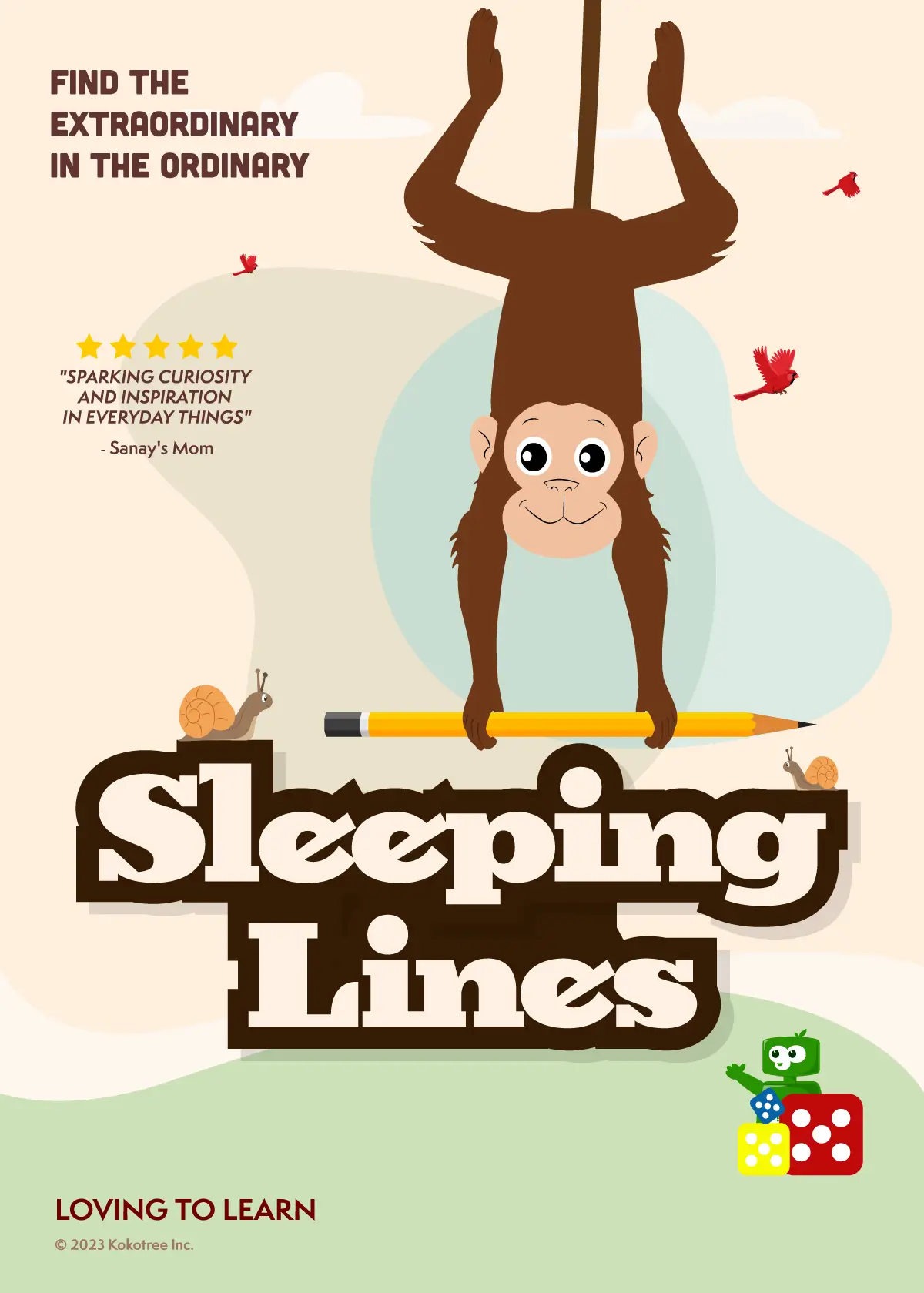
Your little one joins a classroom of adorable jungle animals on a real-world treasure hunt for horizontal lines! They'll learn to spot "sleeping lines" in tree branches, flowing rivers, and monkey huts—then practice drawing them too.
9 minutes
Ages 2-5
Skill: Recognizing horizontal lines in the world around us
Your kid watches jungle friends hunt for lines everywhere. You get 9 minutes to finish that coffee while it's actually hot.
Elizabeth Elephant takes her class on a field trip through the jungle, pointing out horizontal lines on tree branches, in flowing river water, on boat hulls, and even on Maddy Monkey's treehouse. The animals practice tracing lines in the sand and sing "Row, Row, Row Your Boat" together while rowing in boats.
What your child learns:
This video builds essential pre-writing foundations by teaching children to recognize and identify horizontal lines in their environment. They'll connect the fun term "sleeping lines" to the concept of things lying flat—a skill that directly supports letter formation later.
- Identifies horizontal (sleeping) lines in nature and structures
- Distinguishes between vertical (standing) and horizontal (sleeping) lines
- Traces horizontal lines from left to right (pre-writing direction)
- Connects abstract line concepts to real-world objects
- Builds observation skills through guided visual search
They'll use these skills when:
- Noticing the horizon line at the beach or park
- Drawing pictures with ground lines and sky lines
- Learning to write letters like E, F, H, and L
- Sorting and organizing toys by shape and orientation
The Story (what keeps them watching)
After learning about standing lines, Elizabeth Elephant's jungle class heads outside to hunt for "sleeping lines"—the fun name for horizontal lines! Bobby Bear demonstrates by pretending to nap (he loves naps), and then the real adventure begins. The friends discover sleeping lines on tree branches, in river water, on snail trails in the sand, and all over Maddy Monkey's treehouse. Gina Giraffe even traces one between two friendly crabs! The day ends with everyone becoming sleeping lines themselves under the trees—except Maddy, who sleeps on a branch because, well, he's a monkey.
How We Teach It (the clever part)
- First 3 minutes: Elizabeth reviews standing (vertical) lines, then introduces the concept of "sleeping lines" using Bobby Bear's hilarious napping demonstration. The memorable nickname makes the abstract concept stick.
- Minutes 3-7: The class explores the jungle finding real examples—tree branches, river water patterns, snail trails, boat hulls, and the monkey hut. Each discovery is highlighted with a visual line overlay so kids clearly see the concept.
- Final 2 minutes: Children practice distinguishing between sleeping and standing lines on the same structure (Maddy's hut), reinforcing both concepts. The cozy ending with everyone "becoming sleeping lines" creates a memorable physical connection.
Teaching trick: Every time a sleeping line is found, a white animated line appears on top of the real object—helping kids isolate the abstract concept from the complex visual environment.
After Watching: Quick Wins to Reinforce Learning
Mealtime activity: "Can you find a sleeping line on your plate?" Point to the edge of the table, a placemat border, or even a french fry lying flat. Count how many sleeping lines you can spot together!
Car/travel activity: "Let's look for sleeping lines outside!" Horizon lines, fence rails, and road markings are everywhere. Make it a game: who can spot one first?
Bedtime activity: "When you lie down, you're a sleeping line just like Bobby Bear!" Have your child trace a sleeping line in the air with their finger before closing their eyes.
Anytime activity: "Draw a sleeping line for me!" Use a finger on a foggy window, a stick in dirt, or crayons on paper. Celebrate every horizontal attempt!
When Kids Get Stuck. And How to Help.
"My child keeps mixing up sleeping and standing lines." Totally normal! Use body movements: stand up tall like a standing line, lie down flat like a sleeping line. The physical connection helps the concept click faster than any explanation.
"She can find lines in the video but not in real life." Real-world objects are visually busier than cartoon examples. Start with obvious ones like table edges or book spines, then gradually point out trickier examples. Her observation skills are building!
"He gets frustrated when drawing horizontal lines—they come out wobbly." Wobbly is wonderful at this age! The goal is direction (left to right) and concept understanding, not perfection. Praise the effort and watch those lines straighten naturally over time.
What Your Child Will Learn
Prerequisites and Building Blocks
This video builds directly on the "Standing Lines" lesson referenced at the beginning, making it ideal for children who've already learned about vertical lines. Children should have basic shape awareness and the ability to follow visual demonstrations. The sleeping/standing line pair creates a foundational framework for understanding how lines combine to form letters (like E, F, H, L, T) and shapes (rectangles, squares). This lesson sits early in the pre-writing progression, preparing children for slanted lines and curves next.
Cognitive Development and Teaching Methodology
The video leverages multiple learning modalities effectively: visual learners see animated line overlays on real objects; auditory learners hear the "sleeping" metaphor explained repeatedly; kinesthetic learners watch Bobby Bear physically demonstrate the concept. The outdoor exploration format taps into children's natural curiosity and movement needs. Spaced repetition through multiple examples (branch, water, sand, boats, hut, mountains) builds pattern recognition without drill-style monotony—matching the 2-5 age group's need for varied, engaging presentation.
Alignment with Educational Standards
This lesson addresses Common Core Kindergarten Geometry standard K.G.4 (analyzing and comparing shapes) by building foundational line recognition. It supports pre-writing standards requiring children to demonstrate directionality (left-to-right progression shown in line tracing). Early learning frameworks emphasize environmental print awareness—this video teaches children to "read" their visual environment. Teachers expect incoming kindergarteners to hold writing implements and attempt horizontal strokes; this video builds the conceptual understanding that makes physical practice meaningful.
Extended Learning Opportunities
Pair this video with printable line-tracing worksheets featuring horizontal paths (help the snail reach the beach!). The Kokotree app's drawing activities let children practice tracing sleeping lines on-screen. Create a "line hunt" photo journal—snap pictures of sleeping lines around your home or neighborhood. Use painter's tape on floors to create sleeping and standing lines children can walk along, jump over, or drive toy cars across. Playdough rolled into "snakes" can be positioned as sleeping or standing lines.
Transcript Highlights
- "They call them 'sleeping lines' because they look like they're lying down. So it's also called a 'horizontal line.'" — Elizabeth introduces the core concept with the memorable metaphor.
- "A sleeping line looks like Bobby Bear while he's pretending to nap." — Connecting abstract concept to concrete, funny visual demonstration.
- "Can you hear the sound of water? The river is flowing gently today. Look at the pattern of the flowing water. Do you see the sleeping lines?" — Multi-sensory teaching connecting sound, sight, and concept.
- "When I go to bed inside my hut at night, I become a sleeping line! A snoring sleeping line!" — Maddy models personal connection to the concept.
Character Development and Story Arc
Each character models different learning behaviors: Bobby Bear uses physical demonstration (kinesthetic learning), Gina Giraffe volunteers to try drawing in the sand (showing courage to attempt new skills), and Tiki Tiger asks "Where else can we find sleeping lines?" (modeling curiosity and inquiry). Maddy Monkey's enthusiasm—jumping out windows, doing handstands—shows that active learners belong in classrooms too. Elizabeth Elephant demonstrates patient teaching, redirecting Maddy gently while celebrating every student's discoveries equally.
Pre-Writing Development: Why Lines Matter for Future Learning
Horizontal line recognition is far more than a simple observation skill—it's a critical building block for literacy and mathematical thinking. When children learn to identify and draw sleeping lines, they're developing the visual-motor integration necessary for writing letters. Nearly half of uppercase letters contain horizontal strokes: A, B, D, E, F, G, H, I, J, L, P, R, T, and Z all require children to draw or recognize horizontal components.
The left-to-right directionality emphasized in this video (watch how Elizabeth traces lines and how the animated overlays appear) directly prepares children for reading and writing in English and many other languages. This seemingly simple directional awareness prevents later letter reversals and supports reading fluency.
Beyond literacy, horizontal line recognition supports mathematical concepts. Understanding horizontal orientation helps children grasp number lines, bar graphs, and coordinate planes in later years. The video's emphasis on finding lines in nature (tree branches, water flow, mountain bases) builds the spatial reasoning that underlies geometry.
The "sleeping" metaphor is developmentally brilliant—it connects an abstract concept to a physical experience every child understands. When children lie down to sleep, they now have a bodily reference point for horizontal orientation. This embodied cognition approach aligns with research showing that physical movement and metaphor significantly improve concept retention in early childhood. The video's ending, where all animals "become sleeping lines," reinforces this mind-body connection beautifully.