
What's The Brave Little Mouse About?
Your child will dive into a classic tale reimagined with lovable animal characters while mastering the concept of big versus small. After watching, they'll confidently compare sizes and understand that everyone—no matter their size—has something valuable to offer!
5 minutes
Ages 1-6
Skill: Size comparison and opposites
Your kid watches a tiny mouse save a mighty lion. You get 5 minutes to enjoy your coffee while it's still warm.
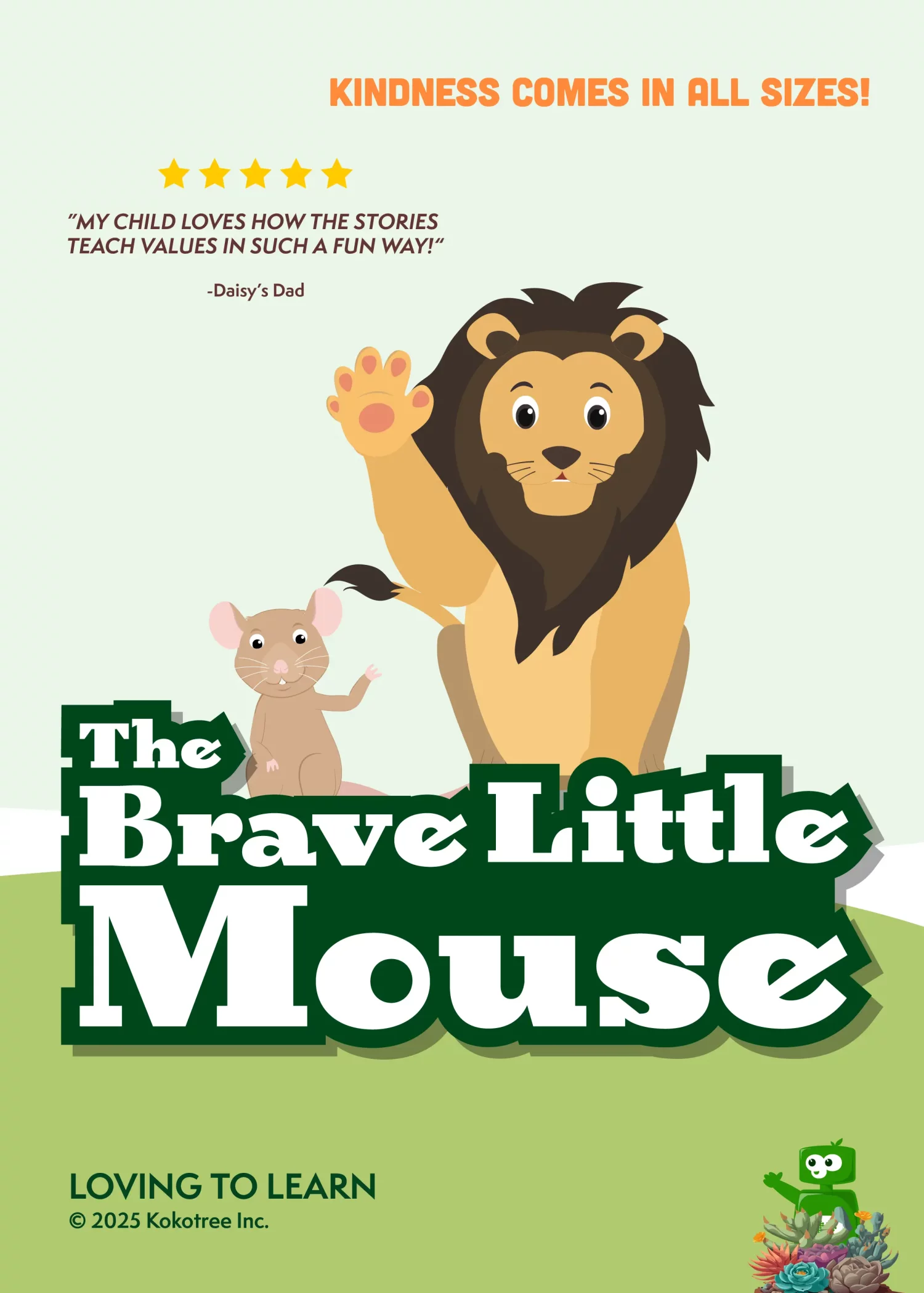
Elizabeth introduces Looka, a proud lion who thinks he's too big to befriend tiny Shoomy the mouse. Through colorful jungle scenes, children watch as the small mouse proves his worth by using his sharp little teeth to free the trapped lion from a hunter's net.
What your child learns:
This story weaves size comparison throughout an engaging narrative, helping children naturally absorb the concepts of big and small through repetition and visual examples. They'll hear "big" and "small" used in meaningful contexts—big trees, small mice, big nets, small teeth.
- Identifying and comparing big versus small objects
- Understanding that opposites can work together
- Recognizing that size doesn't determine ability
- Building vocabulary around size descriptors
- Following a narrative with problem and solution
They'll use these skills when:
- Sorting laundry into big towels and small socks
- Choosing between the big cup or small cup at snack time
- Comparing toy cars, blocks, or stuffed animals during play
- Describing animals at the park or in picture books
The Story (what keeps them watching)
Looka the Lion is king of the jungle—big, strong, and proud. When tiny Shoomy the Mouse asks to be friends, Looka laughs him off. "I'm so big, and you are so small. We could never be friends!" But when a hunter's net traps the mighty lion, guess who comes to the rescue? Shoomy's small but sharp teeth chew right through that big net! Looka learns his lesson, apologizes, and the two become unlikely best friends. Cue the happy ending!
How We Teach It (the clever part)
- First 2 minutes: Elizabeth introduces the concept of big and small, then sets up the story with Looka (big lion) and Shoomy (small mouse), emphasizing size words throughout.
- Minutes 2-4: The conflict unfolds—children hear "big" and "small" repeated naturally as Looka dismisses Shoomy, then gets trapped in a big net that only small teeth can solve.
- Final minute: Elizabeth reinforces the lesson, explaining that big or small, everyone can help, and reminds children of the key vocabulary.
Teaching trick: The script pairs size words with concrete visuals—"big rock under a big green tree," "small mouse," "sharp little teeth"—so children connect abstract concepts to things they can see and understand.
After Watching: Quick Wins to Reinforce Learning
- Mealtime activity: "Can you find something big on your plate? Now something small?" (Practices size identification with familiar foods—big piece of bread, small peas)
- Car/travel activity: "Let's play I Spy! I spy something BIG outside the window." (Extends size comparison to the real world—big trucks, small birds)
- Bedtime activity: "Which stuffed animal is the biggest? Which is the smallest? Can they be friends like Looka and Shoomy?" (Reinforces the story's message while practicing comparison)
- Anytime activity: "Show me your BIG stretch! Now make yourself as SMALL as Shoomy the mouse!" (Uses body movement to internalize size concepts)
When Kids Get Stuck. And How to Help.
- "My child keeps mixing up big and small." - Totally normal! Use your hands to show big (arms wide) and small (fingers close together) every time you say the words. Physical gestures help cement abstract concepts.
- "They can identify sizes but can't explain why something is big or small." - Comparison is the key! Put two objects side by side and ask, "Which one is bigger?" Starting with "bigger than" is easier than labeling something as just "big."
- "The story seems too simple for my 5-year-old." - Level it up! Ask them to find three things in order from smallest to biggest, or have them retell the story in their own words. Narrative skills grow alongside size concepts.
What Your Child Will Learn
Prerequisites and Building Blocks
This video works beautifully as an introduction to size comparison, requiring no prior knowledge. Children who have basic vocabulary and can follow a simple story will thrive. "The Brave Little Mouse" builds foundational comparison skills that lead to more complex concepts like ordering objects by size, understanding measurement, and eventually mathematical comparisons. It pairs well with other opposites content (tall/short, long/short) in the Budding Sprouts program.
Cognitive Development and Teaching Methodology
At ages 1-6, children learn best through story and repetition—this video delivers both. The narrative structure engages emotional learning centers while the repeated use of "big" and "small" in context builds neural pathways for vocabulary retention. Visual learners see size differences on screen, auditory learners hear the words emphasized, and the suggested follow-up activities address kinesthetic learners through movement and hands-on comparison.
Alignment with Educational Standards
Size comparison aligns with early math standards across educational frameworks, including NAEYC guidelines for preschool mathematics and Common Core kindergarten measurement standards (K.MD.A.2: directly compare two objects). Understanding opposites supports language development benchmarks, while the narrative comprehension element addresses early literacy standards for following and retelling stories.
Extended Learning Opportunities
Pair this video with printable size-sorting worksheets featuring animals from the story. Explore related Kokotree content on opposites, shapes, and animal habitats. Extend learning with a "size hunt" around your home—photograph big and small versions of the same object (big spoon, small spoon). Create a simple craft where children draw Looka and Shoomy, emphasizing their size difference.
Transcript Highlights
- "I'm a big lion, and you are a small mouse. What makes you think we could be friends? I'm so big, and you are so small."
- "Don't worry, my friend, I may be small as can be. But I will cut the big net with my sharp little teeth."
- "No matter how big or how small you are, you can do anything you set your mind to."
- "Even though you are small, and I am so big, you helped me escape from this large net."
Character Development and Story Arc
Looka demonstrates a growth mindset transformation—moving from fixed thinking ("We could never be friends!") to openness and gratitude. Shoomy models persistence and confidence despite being dismissed, showing children that believing in yourself matters. The characters' journey from rejection to friendship teaches problem-solving through an emotional arc children naturally understand and remember.
Understanding Size Comparison: The Foundation of Mathematical Thinking
Size comparison is one of the earliest mathematical concepts children can grasp, and it forms the foundation for measurement, ordering, and eventually numerical comparison. When children learn to identify "big" and "small," they're developing what educators call "relational thinking"—the ability to understand that properties like size exist on a spectrum and depend on context.
This video cleverly uses animals of dramatically different sizes (a lion and a mouse) to make the comparison obvious and memorable. Research shows that high-contrast examples help young children form clearer mental categories. The repetition of size vocabulary in meaningful contexts—"big rock," "big tree," "small mouse," "small teeth"—follows evidence-based vocabulary instruction principles.
Importantly, the story also introduces the concept that size doesn't determine capability—a sophisticated idea presented simply. This plants early seeds for understanding that different attributes (size, strength, speed) serve different purposes. The mouse's small teeth become an advantage, not a limitation.
For children ready to advance, this video opens doors to comparative language (bigger, smaller, biggest, smallest), ordering activities (arranging objects by size), and eventually standard measurement. Parents can build on this foundation by introducing measuring cups during cooking, comparing shoe sizes, or sorting toys from smallest to largest.