
What's Turtle in Trouble About?
Your little one joins Miss Meera's cozy classroom for story time and discovers why listening carefully and knowing when to stay quiet are superpowers! Through Tutu the turtle's sky-high adventure, children learn that self-control helps us achieve amazing things.
7 minutes
Ages 3-6
Skill: Self-control and active listening
Your kid watches a turtle learn to stay quiet while flying. You get 7 minutes to finish that cup of coffee.
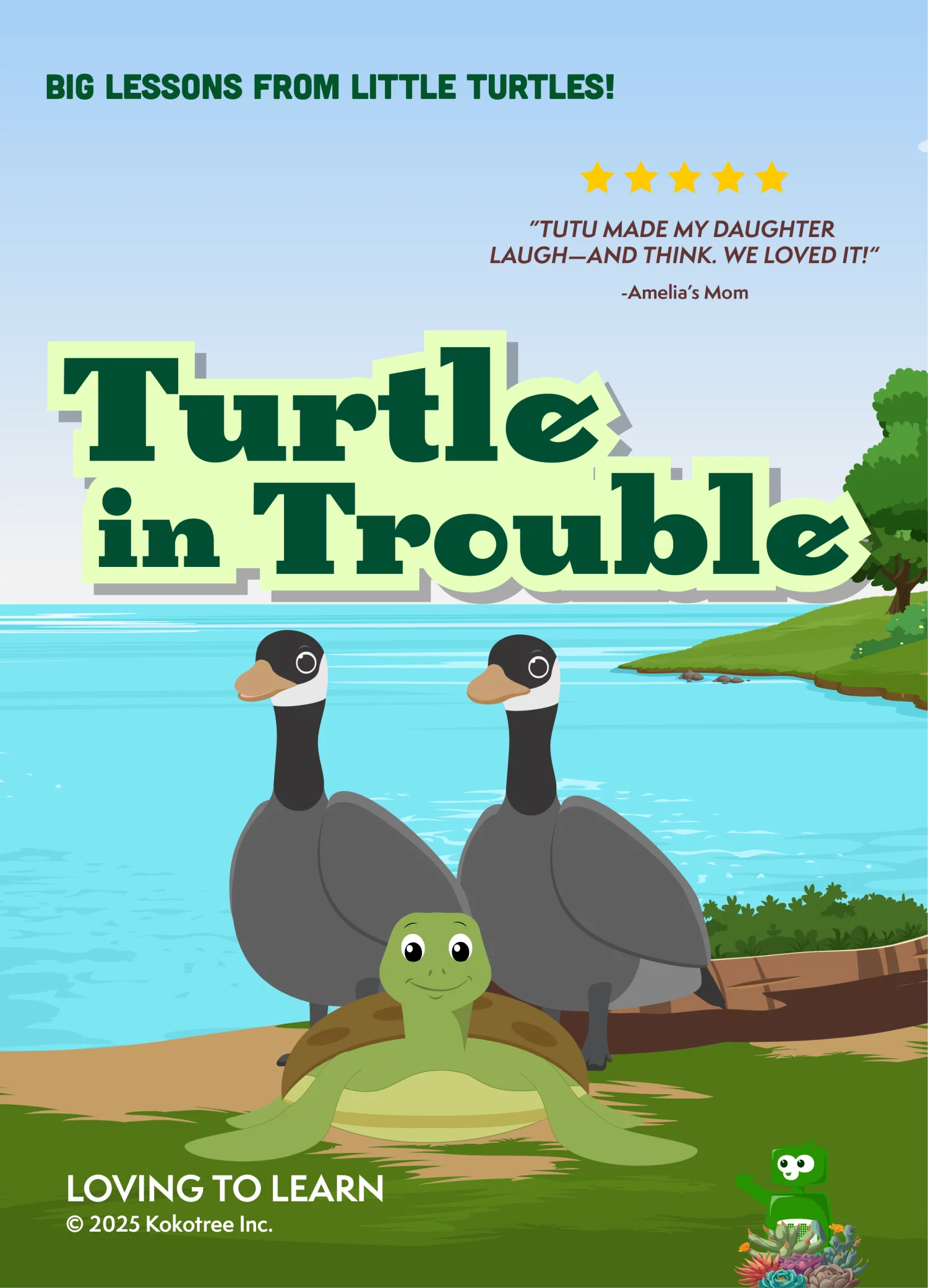
Miss Meera gathers her animal students for story time and shares "The Tale of The Talkative Turtle." Children watch Tutu the turtle befriend two geese brothers and face a big challenge: he must keep his mouth closed on a stick to fly to a new home. The colorful animation shows forests, lakes, and villages from a bird's-eye view.
What your child learns:
This story teaches children that self-control is a skill we can practice and improve. Tutu shows that even when we really want to talk, staying quiet at important moments helps us succeed—and that good friends support each other through challenges.
- Recognizing when to listen vs. when to speak
- Practicing self-control in challenging situations
- Understanding cause and effect (opening mouth = falling)
- Building patience and delayed gratification
- Valuing friendship and teamwork
They'll use these skills when:
- Waiting their turn to speak during circle time at preschool
- Staying quiet during important moments (library visits, nap time)
- Following multi-step instructions that require focus
- Working with friends on a shared goal or game
The Story (what keeps them watching)
Tutu is the friendliest, most talkative turtle in the forest! When a drought forces his goose friends Greg and Gronk to fly away, they hatch a clever plan: Tutu can bite onto a stick while they carry him through the sky. There's just one catch—he absolutely cannot open his mouth. Tutu sees amazing sights from above, but when curious villagers start guessing what the geese are carrying, he just can't resist answering. Down he tumbles! Luckily, kind villagers help him, and the friends discover an even better lake to call home.
How We Teach It (the clever part)
- First 2 minutes: Miss Meera models calming breaths and sets expectations for listening, showing children how to prepare their bodies and minds for a story.
- Minutes 2-5: The story builds tension as Tutu promises to stay quiet, practices nodding instead of talking, and then faces the ultimate test while flying high above villages.
- Final 2 minutes: Tutu experiences the natural consequence of breaking his promise, then demonstrates wisdom by knowing when speaking IS important (spotting the new lake!).
Teaching trick: The story shows Tutu actively practicing self-control ("See! I nodded instead of talking!") then immediately slipping up—normalizing that learning self-control takes practice and mistakes are part of the process.
After Watching: Quick Wins to Reinforce Learning
- Mealtime activity: "Let's play the quiet game for 30 seconds while we chew!" (Practices self-control in a low-stakes, fun way—celebrate success with silly faces)
- Car/travel activity: "What do you think Tutu saw from way up high? What would YOU see if you could fly?" (Builds imagination while reinforcing story comprehension)
- Bedtime activity: "Let's do Miss Meera's breathing—breathe in like we're smelling cookies, breathe out like we're blowing bubbles." (Reinforces the calming technique shown at story start)
- Anytime activity: "Can you show me how Tutu nodded instead of talking? Let's have a conversation using only nods and head shakes!" (Practices non-verbal communication and self-control)
When Kids Get Stuck. And How to Help.
- "My child talks constantly—will they think something's wrong with them?" - The story celebrates Tutu's friendly, talkative nature! It simply shows that SOMETIMES staying quiet helps us. Point out that Tutu's talking at the end actually saved the day.
- "They don't understand why Tutu fell." - Use a simple demonstration: have them hold a toy in their mouth and try to talk. They'll feel how opening their mouth means letting go. Hands-on beats explanation every time.
- "My child gets frustrated when they can't stay quiet." - Remind them even Tutu said "Whoops!" when he accidentally talked. Practice with short, silly quiet games (10 seconds!) and gradually increase. Progress over perfection!
What Your Child Will Learn
Prerequisites and Building Blocks
Children benefit most from this video if they can follow a simple narrative and understand basic cause-and-effect relationships. This story builds on foundational social-emotional concepts like friendship and cooperation introduced in earlier Kokotree content. It serves as an excellent bridge to more complex self-regulation skills, preparing children for classroom expectations where listening and turn-taking become essential for group learning success.
Cognitive Development and Teaching Methodology
The storytelling format leverages children's natural love of narrative to teach abstract concepts like self-control. Miss Meera's breathing exercise at the start activates the parasympathetic nervous system, modeling regulation techniques. The visual consequence of Tutu falling provides concrete understanding of cause-and-effect. Repetition of the "keep quiet" rule through multiple characters reinforces the concept across auditory and visual channels.
Alignment with Educational Standards
This video addresses key kindergarten readiness indicators in social-emotional development, specifically self-regulation and impulse control. It aligns with early learning standards requiring children to "demonstrate self-control" and "follow simple rules." The story format supports language development benchmarks for listening comprehension and narrative understanding, while the classroom framing models expected school behaviors.
Extended Learning Opportunities
Pair this video with Kokotree's listening games and turn-taking activities. Create a simple "Tutu's Quiet Challenge" chart where children earn stickers for practicing self-control moments. Use stuffed animals to act out the story, letting children practice the flying scene. Draw pictures of what children would see if they could fly, connecting imagination to the story's visual elements.
Transcript Highlights
- "Okay. Breathe in and breathe out" — Miss Meera models calming techniques before story time
- "I just won't open my mouth. I can keep quiet when it's important." — Tutu expresses confidence in self-control
- "See! I nodded instead of talking! I told you I could be quiet." / "But you're talking right now, Tutu." — Humorous moment normalizing the challenge of self-control
- "Any place can be home if you have good friends there!" — Reinforces friendship theme
Character Development and Story Arc
Tutu demonstrates a realistic growth arc: he's confident, struggles, faces consequences, and ultimately shows wisdom. His immediate slip-up after promising to stay quiet ("Whoops") models that self-control requires practice—not perfection. Greg and Gronk show supportive friendship by problem-solving together rather than excluding Tutu. The villagers' kindness adds a layer showing community care, and Tutu's final observation about the lake proves that speaking up at the RIGHT time is equally valuable.
Self-Regulation and Impulse Control: A Deep Dive
Self-regulation—the ability to manage impulses, emotions, and behaviors—is one of the most critical skills children develop between ages 3-6. Research consistently shows that early self-regulation predicts academic success, social competence, and overall well-being far into the future.
For preschoolers, impulse control is genuinely difficult because the prefrontal cortex (the brain's "brake pedal") is still developing. This is why Tutu's struggle feels so relatable to young viewers—they experience this challenge daily! The story wisely shows that self-control isn't about never talking; it's about recognizing WHEN to exercise restraint.
The physical nature of Tutu's challenge (biting a stick) makes the abstract concept concrete. Children can visualize and even physically mimic the action. When Tutu opens his mouth and falls, the cause-and-effect is immediate and clear—no lengthy explanation needed.
Importantly, the story avoids shaming Tutu for his talkative nature. His friendliness is presented as a positive trait that simply needs situational awareness. This balanced message helps children understand that self-control doesn't mean suppressing their personalities—it means making thoughtful choices about when and how to express themselves.
The breathing exercise Miss Meera introduces at the story's start isn't just classroom management—it's teaching a genuine self-regulation tool. Deep breathing activates the body's calming response, and children who learn this technique early have a lifelong strategy for managing big feelings and impulses.