
What's 3D Shapes About?
Your child joins Andy and Greg on a jungle quest to discover six amazing 3D shapes—learning to count faces, edges, and vertices along the way. By the end, they'll be pointing out spheres, cubes, and pyramids in your living room!
11 minutes
Ages 3-6
Skill: Identifying and describing 3D shapes
Your kid watches friendly animals hunt for shapes in a magical jungle. You get 11 minutes to finish that coffee in peace.
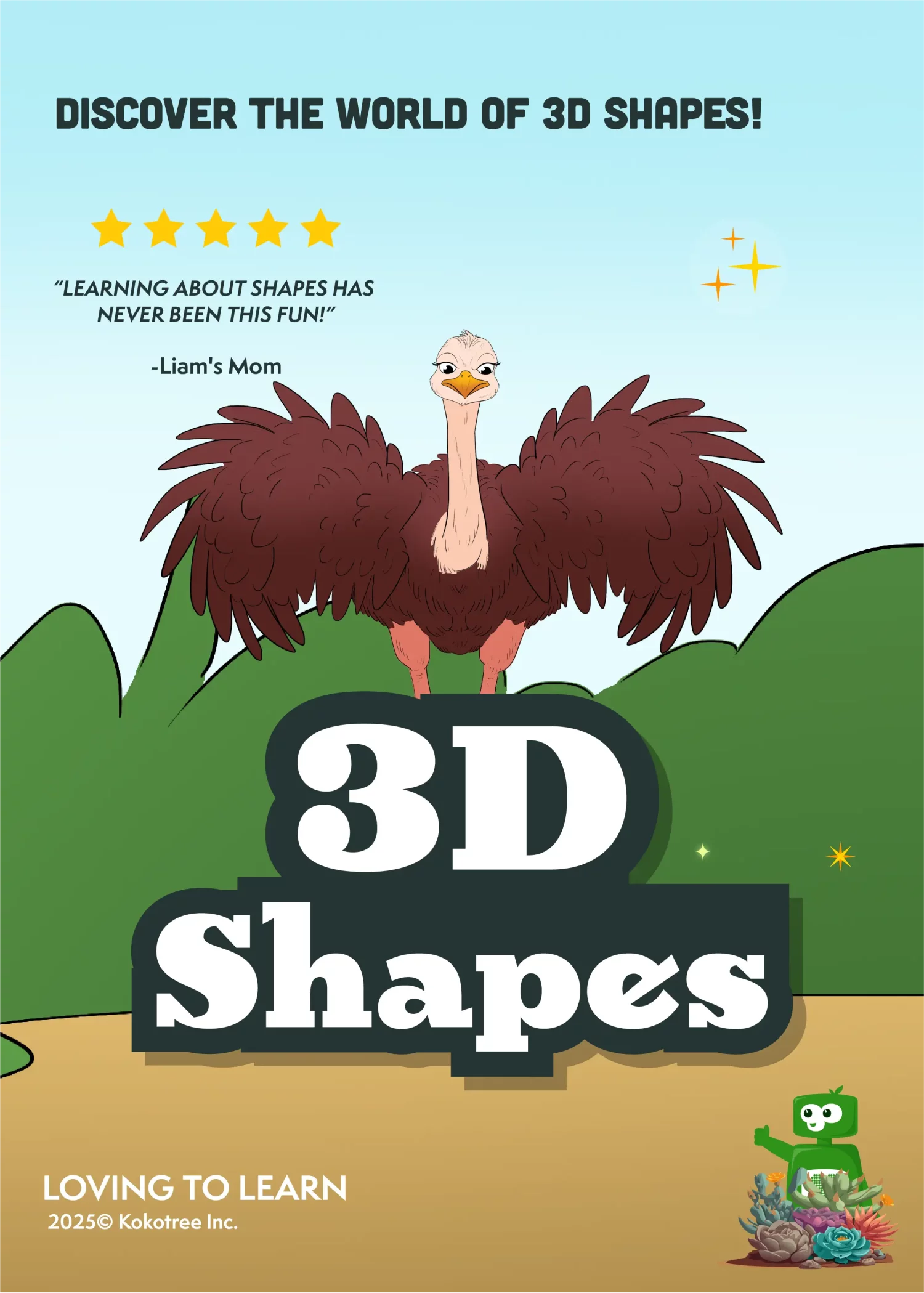
Andy the ant and Greg the grasshopper explore a colorful jungle, discovering 3D shapes hidden in everyday objects—from a giant ostrich egg (sphere!) to dice in a ladybug's house (cube!) to ice cream cones and even the Pyramids of Giza. Each shape comes with hands-on counting of faces, edges, and vertices.
What your child learns:
This video transforms abstract geometry into a treasure hunt. Children learn to recognize six 3D shapes and understand what makes each one unique—flat faces, curved surfaces, pointy vertices, and straight edges.
- Identifies 6 different 3D shapes: sphere, cube, cuboid, cone, cylinder, pyramid
- Counts faces, edges, and vertices on each shape
- Understands the difference between 2D shapes (flat) and 3D shapes (solid)
- Connects geometric shapes to real-world objects
- Develops spatial reasoning and observation skills
They'll use these skills when:
- Sorting blocks and building towers during playtime
- Helping unpack groceries ("That's a cylinder, Mom!")
- Playing with balls, dice, and party hats at birthday parties
- Describing objects to friends and family using proper shape names
The Story (what keeps them watching)
When a football bonks Meera on the head, she turns it into a teaching moment—what shape IS a football anyway? Cue storytime! Andy and Greg accept Wise Owl's challenge to find six 3D shapes hidden in the jungle. They dodge an angry ostrich guarding a sphere-shaped egg, visit ladybugs playing dice in a mushroom house, cool off with cone-shaped ice cream, and soar in a hot air balloon over the Pyramids of Giza. Back in the classroom, the Kokotree kids race to find shapes around them—and challenge viewers to do the same at home!
How We Teach It (the clever part)
- First 2 minutes: Meera introduces the key concept—3D shapes aren't flat like 2D shapes. The football isn't a circle; it's a sphere!
- Minutes 2-9: Andy and Greg discover each shape through adventure, with Wise Owl explaining faces, edges, and vertices. Visual animations highlight features as characters count them aloud.
- Final 2 minutes: Classroom wrap-up reinforces learning as kids identify shapes in familiar objects, then viewers get a take-home challenge.
Teaching trick: Each shape appears in a relatable context (eggs, dice, ice cream cones, refrigerators) so kids instantly connect abstract geometry to objects they already know and love.
After Watching: Quick Wins to Reinforce Learning
- Kitchen shape hunt: "Can you find something shaped like a cylinder?" Point to cans, cups, or rolled-up towels. Count the flat faces together (two!) and feel the curved surface.
- Car ride I-Spy: "I spy something shaped like a cuboid!" Look for buildings, trucks, and boxes. Ask: "Is it more like a cube or stretched out like a cuboid?"
- Bedtime book stack: Grab a few books and stack them. "Each book is a cuboid! How many faces does your stack have on the outside?" Let them touch and count.
- Ball bounce test: Gather different balls and round objects. "Which ones are spheres? Can you find something round that ISN'T a sphere?" (Hint: coins are circles, not spheres!)
When Kids Get Stuck. And How to Help.
- "My child keeps saying 'circle' instead of 'sphere.'" - Totally normal! Hand them a ball and a coin. Ask which one they can roll in ALL directions. The ball wins—that's how you know it's a sphere, not a circle.
- "Counting edges and vertices seems too hard." - Start with just identifying shapes by name. Edge and vertex counting develops with practice. Use play dough to build shapes together—touching the corners (vertices) makes them real.
- "They can't tell a cube from a cuboid." - Great observation skills, actually! Show them a dice (cube—all sides equal) versus a cereal box (cuboid—stretched). Ask: "Are all the faces the same size?" That's the secret difference.
What Your Child Will Learn
Prerequisites and Building Blocks
Children benefit from prior exposure to basic 2D shapes (circles, squares, triangles) before tackling 3D geometry. This video explicitly bridges that knowledge gap by comparing flat shapes to solid ones. It builds on foundational spatial awareness and counting skills (1-12). Ideal for children who've mastered shape recognition in the Kokotree basics series and are ready to explore dimensional thinking—a key stepping stone toward more complex geometry and measurement concepts.
Cognitive Development and Teaching Methodology
This video leverages narrative-based learning, proven effective for preschoolers who learn best through story and emotional engagement. The adventure format activates episodic memory, helping children retain shape names and properties. Multi-sensory reinforcement occurs through visual animations highlighting edges/vertices, auditory counting, and prompts for kinesthetic exploration at home. The progression from concrete (real objects) to abstract (geometric properties) follows Piaget's preoperational stage principles.
Alignment with Educational Standards
This video addresses Common Core Kindergarten Geometry standards (K.G.A.2, K.G.A.3) requiring children to correctly name shapes regardless of orientation and identify shapes as 2D or 3D. It also supports NAEYC guidelines for early mathematics, specifically spatial relationships and geometry. Kindergarten readiness assessments often include 3D shape identification—this video prepares children to confidently name and describe spheres, cubes, cones, and cylinders.
Extended Learning Opportunities
Pair this video with Kokotree's 3D Shape Sorting Game for interactive practice. Print shape hunt worksheets for car rides or waiting rooms. Build shapes with play dough or marshmallows and toothpicks to reinforce vertex/edge concepts tactilely. Create a household shape scavenger hunt checklist. Follow up with the "2D vs 3D Shapes" comparison video to deepen dimensional understanding and prepare for more advanced geometry concepts.
Transcript Highlights
Introducing the 2D vs 3D distinction:
"A circle is a 2D shape - flat, like a drawing. But this football isn't flat, is it?"
Teaching edges and vertices:
"In a 2D shape, like this square, the edges are the straight lines, and the vertices are the corners where the lines meet!"
Counting cube properties:
"A cube has… 1, 2, 3, 4, 5, 6 - six faces!" ... "And if we count its edges… 1, 2, 3, 4, 5, 6, 7, 8, 9, 10, 11, 12 - twelve edges!"
Comparing cube to cuboid:
"A cuboid is similar to a cube, but it's longer or wider in one direction. It still has 6 faces, 12 edges, and 8 vertices, just like a cube!"
Character Development and Story Arc
Andy and Greg model ideal learning behaviors throughout their quest. They demonstrate curiosity (eagerly accepting challenges), collaboration (working together to identify shapes), and persistence (continuing despite the ostrich scare). Wise Owl represents guided discovery—asking questions rather than simply providing answers. The classroom scene shows peer learning as Maddy, Gina, and Ronnie enthusiastically apply new knowledge, modeling how viewers can do the same.
Understanding 3D Geometry: Why Shapes Matter for Young Minds
Three-dimensional geometry forms the foundation of spatial reasoning—a cognitive skill linked to success in mathematics, science, engineering, and even reading comprehension. When children learn to identify 3D shapes, they're developing their ability to mentally manipulate objects, understand perspective, and navigate physical space.
This video introduces six fundamental 3D shapes, each with distinct properties:
- Sphere: 0 faces, 0 edges, 0 vertices (completely curved)
- Cube: 6 equal square faces, 12 edges, 8 vertices
- Cuboid: 6 rectangular faces, 12 edges, 8 vertices
- Cone: 1 curved face, 1 flat circular face, 1 vertex (apex)
- Cylinder: 1 curved face, 2 flat circular faces, 0 vertices
- Pyramid: 5 faces (4 triangular + 1 square base), 8 edges, 5 vertices
The vocabulary introduced—faces, edges, vertices—provides children with precise mathematical language. Research shows that early exposure to geometric terminology correlates with stronger math performance in elementary school. By connecting abstract concepts to familiar objects (dice, ice cream cones, refrigerators), the video creates "anchor examples" that children can reference when encountering new shapes.
The counting exercises (tallying faces, edges, and vertices) also reinforce one-to-one correspondence and number recognition up to 12—integrating numeracy practice within geometry instruction. This cross-domain approach maximizes learning efficiency while keeping content engaging.