
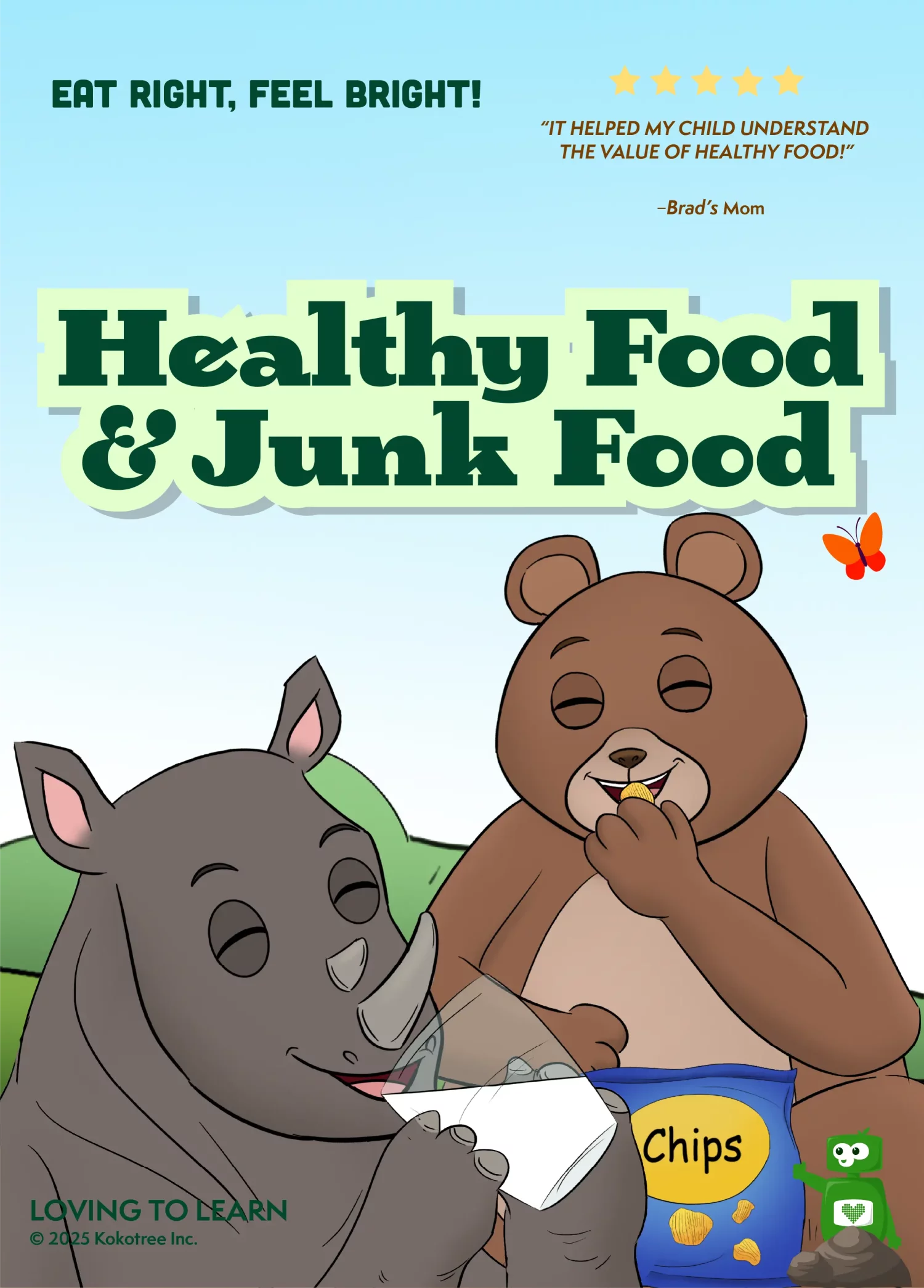
What's Healthy Food & Junk Food About?
Your little one joins Bobby Bear on a fun discovery about why some foods make us zoom with energy while others leave us feeling sluggish. After watching, they'll confidently sort foods into "healthy" and "junk" categories—and actually understand WHY it matters!
7 minutes
Ages 3-6
Skill: Nutrition basics and healthy food identification
Your kid watches friendly animals learn about food energy. You get 7 minutes to enjoy your coffee while it's still warm.
Bobby Bear loves his chips and pizza, but when the jungle friends have a race, he runs out of steam fast! Meera the owl guides the curious animal friends through a colorful sorting game and catchy song that makes healthy eating click.
What your child learns:
This video transforms abstract nutrition concepts into something kids can see and feel. Through Bobby's experience, children understand the direct connection between what they eat and how their body performs.
- Identifies healthy foods: fruits, vegetables, eggs, milk, nuts, and grains
- Recognizes junk food: chips, soda, candy, and fried foods
- Understands that food gives our body energy (like fuel)
- Connects food choices to how we feel and perform
- Builds vocabulary around nutrition and body energy
They'll use these skills when:
- Choosing between snacks at home or school
- Understanding why parents encourage certain foods at mealtimes
- Grocery shopping and spotting healthy options in the store
- Explaining to friends or siblings why some foods are better choices
The Story (what keeps them watching)
It's lunchtime in the Kokotree Jungle, and Bobby Bear is happily crunching through bags of chips while his friends munch on fruits, veggies, and eggs. When Meera suggests a race, Bobby's confident his "yummy" chips will fuel him to victory. Spoiler: they don't! As Bobby huffs and puffs mid-race, he starts wondering why his friends have so much more energy. Through a fun sorting game and an irresistible song about pears, apples, and broccoli, Bobby learns that healthy food is the real superpower—and promises to give it a try!
How We Teach It (the clever part)
- First 2 minutes: Sets up the problem—Bobby eats junk food while friends eat healthy options. Kids see the contrast without being told what's "right."
- Minutes 2-5: The race reveals consequences naturally. Bobby experiences low energy firsthand, making the lesson feel discovered, not lectured.
- Final 2 minutes: Interactive food sorting game and memorable song cement the categories. Bobby's attitude shift models growth mindset.
Teaching trick: Instead of telling kids junk food is "bad," the video lets Bobby experience the natural consequence (running out of energy), so children draw their own conclusions. This discovery-based approach makes the lesson stick.
After Watching: Quick Wins to Reinforce Learning
- Mealtime activity: "Can you find something healthy on your plate?" Point to each item and let your child sort it as healthy or junk. They'll love being the "food detective" at dinner.
- Grocery store activity: "Let's find three healthy foods that give us running energy!" Hand them a small bag and let them choose fruits or veggies. Real-world sorting practice!
- Bedtime activity: "What healthy food should Bobby Bear pack for lunch tomorrow?" Let them plan a pretend lunch for Bobby. Reinforces categories through imaginative play.
- Anytime activity: "If you were racing your friends, what would you eat first?" Ask during snack time to connect food choices to energy they can feel in their own body.
When Kids Get Stuck. And How to Help.
- "My child still asks for chips and candy constantly." Totally normal! The goal isn't perfection—it's awareness. When they ask, try: "That's a sometimes food! What healthy food should we have first?" You're building a framework, not banning treats.
- "They can't remember which foods are healthy." Focus on one category at a time. Start with fruits (easy wins!) and celebrate when they spot them. Add veggies next week. Small victories build confidence.
- "This seems too simple for my 5-year-old." Level up by asking WHY foods are healthy. "What does milk help build?" (Bones!) "What do eggs help?" (Muscles and brain!) The video plants seeds for deeper conversations.
What Your Child Will Learn
Prerequisites and Building Blocks
Children benefit most from this video when they can already name common foods and understand basic cause-and-effect relationships. This lesson builds on foundational vocabulary about fruits, vegetables, and everyday meals. It serves as an excellent introduction to the broader "My Body" learning track, preparing children for future lessons about exercise, sleep, and overall wellness. No prior nutrition knowledge is required—the video starts from scratch with clear visual examples.
Cognitive Development and Teaching Methodology
This video leverages experiential learning principles perfect for ages 3-6. Rather than abstract lecturing, children watch Bobby experience natural consequences—a technique aligned with how young minds process information. The multi-sensory approach includes visual food sorting, auditory reinforcement through song, and kinesthetic engagement as children mentally "race" alongside characters. Repetition through the sorting game and song addresses different learning styles while the narrative arc maintains emotional engagement throughout.
Alignment with Educational Standards
This lesson addresses Head Start Early Learning Outcomes Framework domains in Physical Development and Health, specifically nutrition awareness indicators. It aligns with kindergarten readiness expectations that children "identify foods that are healthy choices" and "understand that food provides energy." The sorting activity supports classification skills found in early math standards, while vocabulary development (healthy, junk, energy, fuel) builds language foundations expected by preschool educators.
Extended Learning Opportunities
Pair this video with our printable "Healthy Food Sorting" worksheet where children cut and paste foods into categories. The Kokotree app features the "Lunch Box Builder" game reinforcing these concepts through play. Extend learning by creating a simple food journal where children draw one healthy food they ate each day. Consider a "rainbow eating" challenge—can they eat healthy foods in every color this week?
Transcript Highlights
- Introducing the concept: "Junk food might make your tummy happy for a little while, but it doesn't give your body the super energy it needs to have fun all day!"
- Making it relatable: "Our food is like fuel for our body."
- Peer learning moment: "Bobby only eats junk food, and junk food doesn't give us the right kind of energy we need!"
- Positive reinforcement: "When you eat the right food, your body gets stronger, and you'll have all the energy you need to run, play, and have fun!"
Character Development and Story Arc
Bobby Bear's journey models authentic learning behavior beautifully. He starts confident (even boastful) about his food choices, experiences a setback, asks questions with genuine curiosity, and ultimately commits to change. This arc demonstrates growth mindset without using that terminology. The other characters—Ruby, Gina, Eddie, Ronnie, Maddy, and Tiki—model healthy choices naturally, showing rather than preaching. Bobby's final gratitude toward Meera shows children that accepting guidance is positive, not embarrassing.
Nutrition Science for Growing Bodies: A Deep Dive
Understanding nutrition at ages 3-6 isn't about memorizing food pyramids—it's about building intuitive connections between eating and feeling. This video introduces the foundational concept of "food as fuel," which developmental research shows children can grasp when presented through concrete experiences like the race scenario.
The healthy foods highlighted—fruits, vegetables, eggs, milk, nuts, grains, and lean proteins—represent nutrient-dense options that provide sustained energy through complex carbohydrates, proteins, and essential vitamins. The "junk foods" identified—chips, soda, candy, and fried items—are characterized by high sugar, sodium, and processed ingredients that cause energy spikes followed by crashes.
For young children, the most effective nutrition education focuses on binary categories (healthy vs. junk) before introducing nuance. This aligns with Jean Piaget's preoperational stage, where children think in concrete, either/or terms. The video wisely avoids "good" and "bad" moral language, instead focusing on functional outcomes: "gives energy" versus "makes us tired."
The song component serves a specific pedagogical purpose—musical learning activates different memory pathways than spoken instruction, making food categories easier to recall. The rhyming structure ("Eggs, nuts, seeds, and grains / You must eat these for a brilliant brain") creates memorable hooks that children can access during actual food decisions.
Importantly, the video models balanced messaging. Bobby isn't shamed; he's educated. The phrase "too much of them" acknowledges that occasional treats exist while emphasizing everyday choices. This approach prevents the restrictive thinking patterns that nutrition researchers warn against in early childhood education.