
What's Addition and Subtraction About?
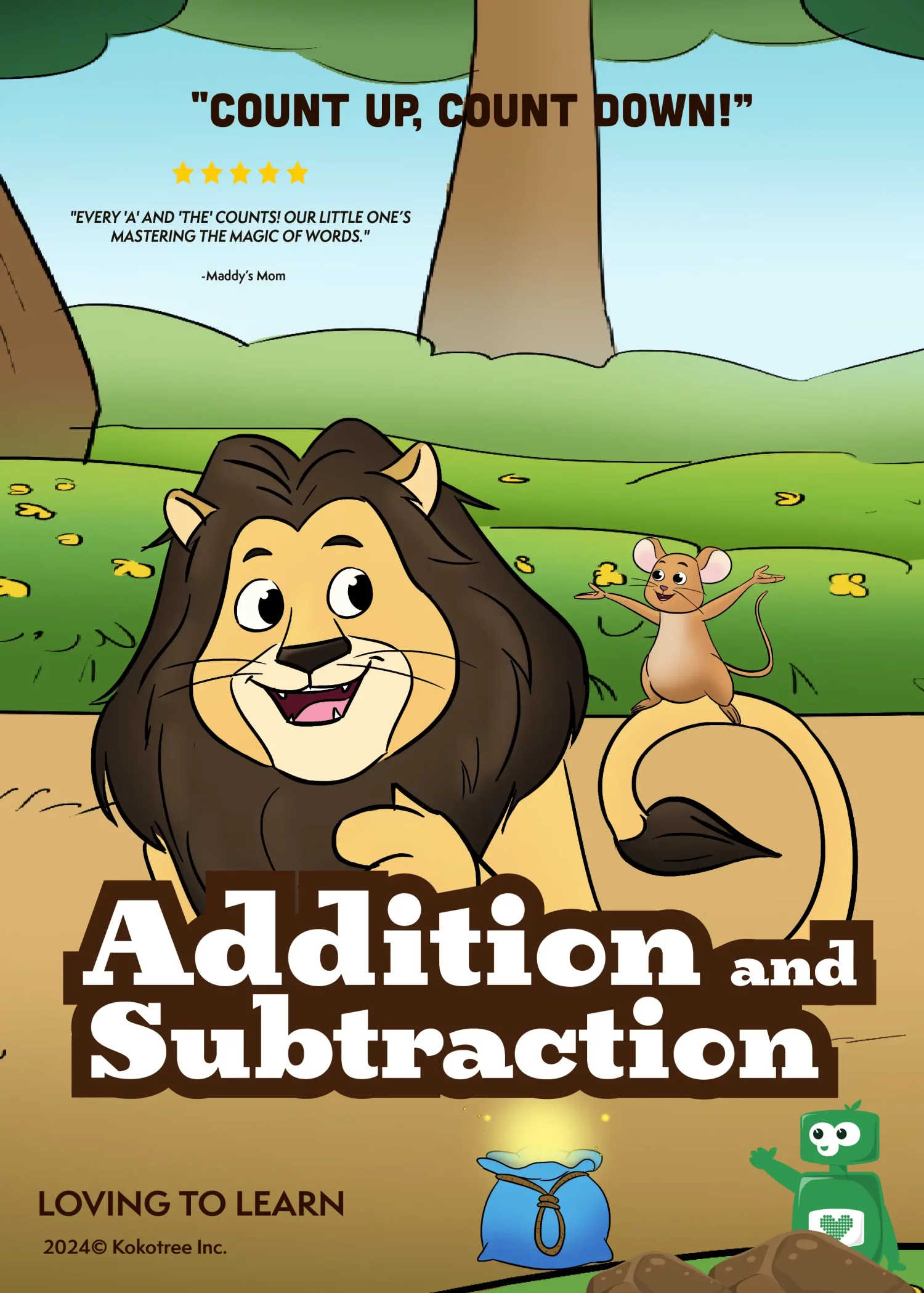
Your child joins brave friends Leo and Mika on an epic quest through the magical kingdom of Numeralia, solving addition and subtraction puzzles to collect Golden Numbers and save the land! They'll see math as an exciting adventure tool, not just numbers on a page.
10 minutes
Ages 4-6
Skill: Adding and subtracting numbers up to 10
Your kid watches animal friends solve math puzzles on a quest. You get 10 minutes to drink that coffee while it's hot.
Leo the lion and Mika the mouse travel through enchanted forests, cross magical bridges, and visit sparkling caves—each location presenting a new math challenge. A friendly caterpillar asks "2 + 3 = ?", a butterfly poses apple problems, and a wise owl tests them with star-counting riddles. The colorful kingdom of Numeralia comes alive with floating numbers and glowing rewards.
What your child learns:
This video introduces addition and subtraction as problem-solving tools, not abstract concepts. Children see characters work through math step-by-step, counting objects and explaining their thinking out loud—exactly what builds real number sense.
- Solving addition problems with sums up to 10 (like 4 + 6 = 10)
- Working through subtraction problems (like 7 - 4 = 3)
- Understanding that addition means "putting together" and subtraction means "taking away"
- Using mental math strategies to combine numbers
- Recognizing that math helps solve real problems
They'll use these skills when:
- Counting snacks at the table ("You have 3 crackers, here are 2 more—how many now?")
- Sharing toys with siblings or friends ("You had 5 blocks and gave away 2...")
- Playing with building blocks and counting their creations
- Helping sort items at the grocery store or during cleanup time
The Story (what keeps them watching)
Meera tells the Kokotree kids about Leo the lion and Mika the mouse, best friends who receive a mysterious letter from the Wise Old Owl. Numeralia needs help! Golden Numbers have scattered across the land, and only by solving addition and subtraction challenges can balance be restored. From Addition Bridge (where a caterpillar guards the crossing) to Subtraction Cave (home of riddle-loving owls) to the River of Reflections, Leo and Mika work together, combining 4 + 6 to unlock the final Golden Number 10 and save the kingdom!
How We Teach It (the clever part)
First 3 minutes: The story hook draws children in with the caterpillar observation, then transitions to Numeralia where addition is introduced with simple problems like 2 + 3 = 5 using magical stones.
Minutes 3-7: Complexity builds gradually—the butterfly introduces both addition AND subtraction in the same scene (4 + 2 = 6, then 6 - 2 = 4), showing how the operations relate. The wise owl reinforces subtraction with visual scenarios like stars being covered by clouds.
Final 3 minutes: The River of Reflections tests multiple skills rapidly (10 - 1, 0 + 1, 9 - 1, 6 + 1), and the grand finale requires combining learned numbers (4 + 6 = 10) to demonstrate mastery.
Teaching trick: Every math problem uses concrete, countable objects—stones, apples, stars, feathers. Children see the quantities before hearing the equation, building true number sense rather than rote memorization.
After Watching: Quick Wins to Reinforce Learning
Mealtime activity: "Let's play Golden Numbers! You have 3 carrot sticks. I'm giving you 2 more. How many do you have now?" (Practices addition with real objects they can touch and count)
Car/travel activity: "I spy 4 red cars! Oh no, 2 drove away. How many red cars can we still see?" (Practices subtraction using the environment around them)
Bedtime activity: "Let's count the stuffed animals on your bed. If we add your favorite bear, how many will there be?" (Reinforces addition in a calm, cozy context)
Anytime activity: "You're on a quest like Leo and Mika! Find 5 toys, then take away 2. How many are left in your collection?" (Combines storytelling with hands-on subtraction practice)
When Kids Get Stuck. And How to Help.
"My child always counts on their fingers—is that okay?" - Absolutely! Finger counting is a legitimate math strategy that many mathematicians use. It builds the connection between abstract numbers and physical quantities. Let them count away!
"They get addition but subtraction confuses them." - Subtraction is trickier because it requires "thinking backward." Try using the phrase "taking away" and always start with objects they can physically remove. "You have 5 grapes. Eat 2. Count what's left!"
"The problems in the video seem too easy/hard." - Every child develops at their own pace. If it's too easy, celebrate their confidence and try bigger numbers at home. If it's hard, focus on the smallest problems (2 + 1) with real objects until they click.
What Your Child Will Learn
Prerequisites and Building Blocks
Before watching, children should recognize numbers 1-10 and understand basic counting. This video builds on number recognition and counting skills, introducing the next step: manipulating quantities. It bridges the gap between "knowing numbers" and "using numbers," preparing children for more complex operations. Ideally, children have explored counting objects in previous activities and can answer "how many?" questions confidently.
Cognitive Development and Teaching Methodology
This video leverages narrative transportation—children become emotionally invested in Leo and Mika's quest, making abstract math concepts personally meaningful. The progressive difficulty (simple addition → subtraction → mixed operations) follows scaffolded learning principles. Visual representations of quantities before equations support concrete-to-abstract thinking appropriate for preoperational stage learners. Repetition across different scenarios builds procedural fluency.
Alignment with Educational Standards
This content aligns with Common Core Kindergarten standards K.OA.A.1 (represent addition and subtraction) and K.OA.A.2 (solve addition and subtraction word problems within 10). It supports kindergarten readiness indicators for mathematical reasoning and problem-solving. Teachers expect entering kindergartners to understand that quantities can be combined or separated—this video builds exactly that foundational understanding.
Extended Learning Opportunities
Pair this video with counting manipulatives like blocks or buttons for hands-on practice. The Kokotree app's number games reinforce these skills through interactive play. Create a "Golden Number Hunt" at home where children solve simple equations to find hidden objects. Drawing pictures of math stories ("Draw 3 apples, then 2 more") extends learning through artistic expression.
Transcript Highlights
- Teaching addition concretely: "If you have 2 magical stones and I give you 3 more, how many stones will you have?" / "Let's see... 2 plus 3 equals... 5 stones!"
- Connecting operations: "If we have 4 apples and find 2 more, how many apples do we have?" followed by "Now, if we have 6 apples and give away 2, how many are left?"
- Visual subtraction: "If there are 7 stars twinkling in the sky and clouds cover 4 stars, how many stars can you see now?" / "7 minus 4 equals 3 stars visible!"
- Combining knowledge: "We have numbers 4 and 6..." / "I got it! 4 plus 6 equals 10!"
Character Development and Story Arc
Leo and Mika model collaborative problem-solving throughout their quest. Leo often pauses to think ("Let's see..."), demonstrating that taking time is okay. Mika frequently solves problems, showing that size doesn't determine capability. Together, they celebrate each success and encourage each other through challenges. Their teamwork reinforces that math is more fun—and easier—when you work together and talk through your thinking.
Mathematical Foundations: Understanding Addition and Subtraction
Addition and subtraction are inverse operations—they "undo" each other—and this video cleverly demonstrates this relationship when the butterfly asks both 4 + 2 and 6 - 2 in sequence. This builds algebraic thinking foundations that will serve children for years.
For young learners, addition represents the concept of "joining" or "putting together," while subtraction represents "separating" or "taking away." The video consistently uses concrete scenarios (stones, apples, stars, feathers) because children ages 4-6 are in Piaget's preoperational stage, where abstract symbols must connect to tangible experiences.
The number combinations presented strategically stay within 10, which aligns with "making ten" strategies foundational to later mental math. When Leo and Mika combine 4 + 6 = 10 at the climax, they're demonstrating a "number bond"—understanding which numbers combine to make ten. This skill dramatically accelerates future addition and subtraction with larger numbers.
The River of Reflections sequence introduces adding and subtracting 1, which builds understanding of number succession (each number is one more than the previous). Problems like 10 - 1 = 9 and 6 + 1 = 7 reinforce this pattern recognition.
Importantly, the video presents math as purposeful. Every equation solves a problem—crossing a bridge, earning a reward, completing a quest. This positions mathematics as a useful tool rather than arbitrary exercises, building intrinsic motivation for mathematical learning.