
What's Patterns About?
Your little one joins Eddie Elephant and friends on a pattern-finding adventure through the jungle! They'll learn to recognize, create, and continue patterns—a foundational math skill that helps with everything from counting to problem-solving.
10 minutes
Ages 3-6
Skill: Recognizing and creating repeating patterns
Your kid watches a bear solve pattern puzzles to find food. You get 10 minutes to finish that coffee.
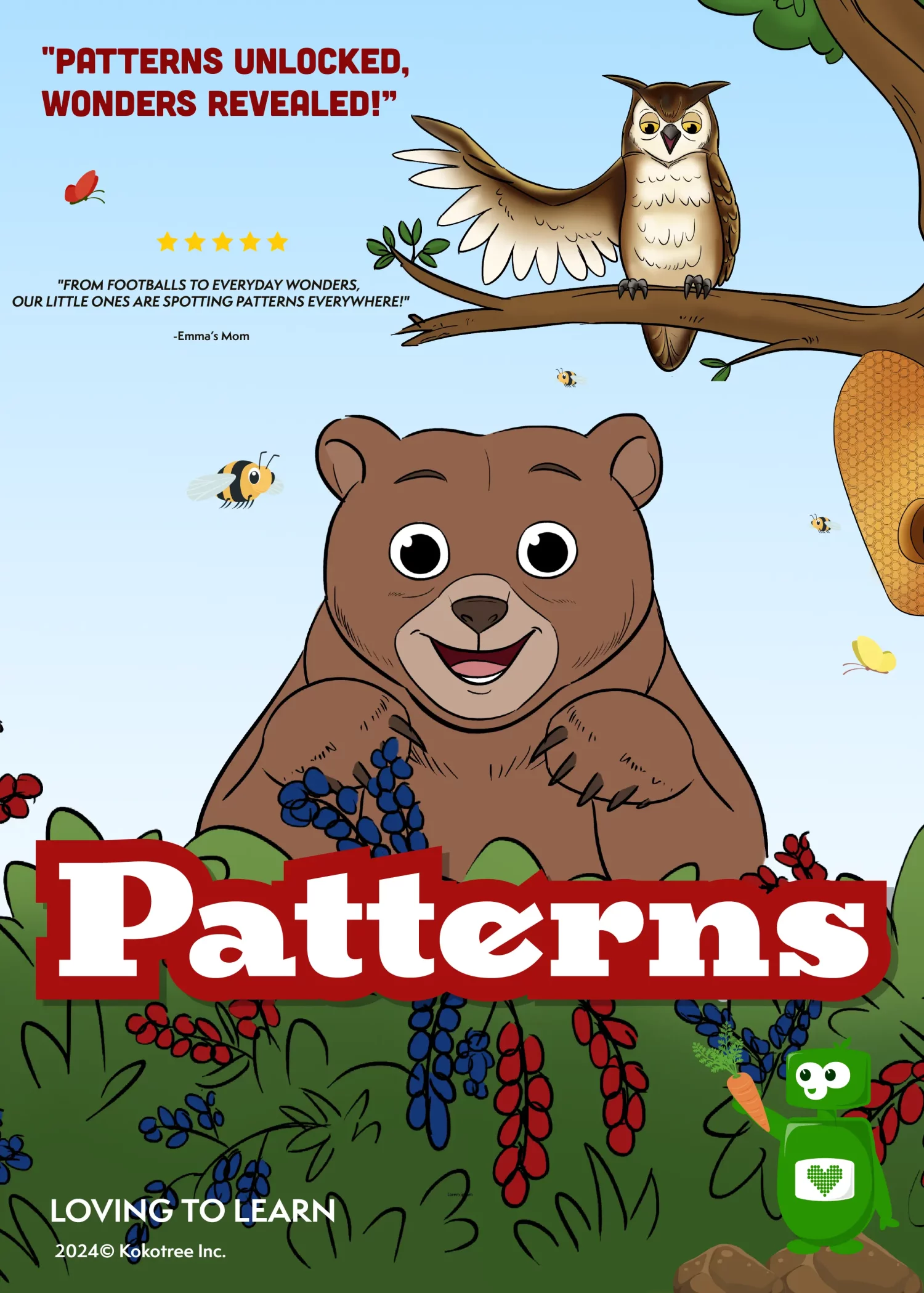
Eddie Elephant notices something cool about a football—it's covered in a pattern of hexagons and pentagons! Miss Elizabeth tells an engaging story about Benji the Bear, who must find and create patterns to earn yummy treats from a Wise Owl. Kids watch Benji arrange red and blue berries, spot patterns in flower meadows, and discover hexagons in honeycomb.
What your child learns:
This video introduces pattern recognition as a fun treasure hunt rather than abstract math. Children see patterns in nature, objects, and animals—making the concept feel real and relevant to their world.
- Identifying repeating patterns in everyday objects (footballs, flowers, animal coats)
- Creating simple AB patterns using colors (red-blue-red-blue)
- Recognizing shape patterns like hexagons and pentagons
- Understanding that patterns exist everywhere in nature
- Predicting what comes next in a sequence
They'll use these skills when:
- Setting the table (fork-plate-fork-plate) or sorting laundry by color
- Noticing stripes on their shirt or spots on a ladybug at the park
- Building with blocks in repeating color sequences
- Taking turns during games (my turn-your turn-my turn)
The Story (what keeps them watching)
When Eddie Elephant gets distracted by the cool pattern on a football, Miss Elizabeth shares a story about Benji the Bear. Hungry Benji meets a Wise Owl who challenges him: find or create patterns, and you can eat! Benji arranges berries in red-blue sequences, spots flower patterns in a meadow, and even earns honey by recognizing hexagons in a honeycomb. Back in class, the Kokotree kids realize patterns are everywhere—even on Gina Giraffe's spots!
How We Teach It (the clever part)
- First 2 minutes: Eddie's curiosity about the football introduces the concept naturally—patterns aren't just worksheets, they're on things kids already know!
- Minutes 2-8: Benji's adventure provides three different pattern examples (color sequences, flower arrangements, geometric shapes) with increasing complexity.
- Final 2 minutes: The Kokotree class connects patterns to their own world—Gina's spots, zebra stripes, the football—reinforcing that pattern-spotting is a real-world skill.
Teaching trick: The video uses a "puzzle reward" system—Benji only gets to eat when he solves patterns. This gamification keeps kids engaged and shows that pattern recognition has real payoffs!
After Watching: Quick Wins to Reinforce Learning
Mealtime activity: "Can you make a pattern with your grapes and cheese cubes?" Let them arrange snacks in AB patterns before eating. They practice creating sequences with real objects.
Car/travel activity: "Let's find patterns outside! Look for stripes, spots, or repeating colors." Point out brick patterns on buildings, fence posts, or lines on the road. They practice spotting patterns in their environment.
Bedtime activity: "What pattern is on your pajamas?" Talk about stripes, dots, or pictures that repeat. They connect the video's lessons to familiar items.
Anytime activity: "Red sock, blue sock, red sock... what comes next?" Use laundry, toys, or crayons to create and continue patterns together. They practice predicting sequences.
When Kids Get Stuck. And How to Help.
"My child just sees random colors, not patterns" - Start with just two items and exaggerate the difference. "BIG block, little block, BIG block, little block!" Physical size differences are often easier to spot than color at first.
"They can copy a pattern but can't continue it" - This is totally normal! Say the pattern out loud as a chant: "red-blue-red-blue-red-WHAT?" The rhythm helps their brain predict what's next.
"The shapes like hexagons seem too advanced" - Don't worry about the names yet! Focus on "this shape, that shape" repeating. Shape vocabulary comes naturally with exposure—Eddie learned it just by being curious!
What Your Child Will Learn
Prerequisites and Building Blocks
Children benefit from basic color recognition (red, blue, yellow) and familiarity with simple shapes before watching. This video builds on earlier Kokotree content about shapes and colors, bridging those isolated concepts into relational thinking. Pattern recognition sits at the foundation of mathematical reasoning—it's the precursor to skip counting, multiplication concepts, and algebraic thinking that children will encounter later. No prior pattern experience is required; the video starts from curiosity and builds systematically.
Cognitive Development and Teaching Methodology
At ages 3-6, children are in Piaget's preoperational stage, where they learn best through concrete examples and storytelling. This video leverages narrative transportation—Benji's hunger creates stakes that keep children invested. The teaching progression moves from observation (Eddie noticing the football) to identification (spotting flower patterns) to creation (arranging berries). Visual learners see colorful examples; auditory learners hear patterns described; kinesthetic concepts are modeled through Benji's hands-on arranging.
Alignment with Educational Standards
This video addresses Common Core Math Standard K.G.A.1 (describing objects using shape names) and NCTM's Algebra strand for Pre-K through Grade 2, which emphasizes recognizing, describing, and extending patterns. Kindergarten readiness assessments frequently include pattern completion tasks. Teachers expect incoming students to identify and continue simple AB patterns—exactly what Benji demonstrates with his berry arrangement. The hexagon recognition supports geometry standards while remaining age-appropriate.
Extended Learning Opportunities
Pair this video with printable pattern strips for cutting and sequencing practice. The Kokotree app's shape-sorting games reinforce geometric pattern recognition. Parents can extend learning with pattern block manipulatives, bead-stringing activities, or nature walks to find patterns on leaves, bark, and insects. Creating patterns with stickers, stamps, or even body movements (clap-stomp-clap-stomp) provides multi-sensory reinforcement beyond screen time.
Transcript Highlights
- "Let's see... What if I place a red berry here, then a blue one next to it, then red, then blue... Hey, that's a pattern!" - Benji models the thinking process of pattern creation out loud.
- "The honeycomb has a pattern of hexagons!" - Connects geometric shapes to real-world objects children might encounter.
- "Patterns are everywhere around us!" - Miss Elizabeth's key message that transforms pattern-finding from classroom exercise to life skill.
- "Each unique pattern you discover will unlock something delicious for you!" - The Wise Owl gamifies learning, showing patterns have real rewards.
Character Development and Story Arc
Benji the Bear demonstrates a perfect growth mindset arc. He starts hungry and frustrated, then embraces the Wise Owl's challenge with enthusiasm rather than complaint. When he almost grabs berries without thinking, he catches himself and problem-solves instead. His celebration dance after creating patterns models the joy of learning. Eddie Elephant shows how curiosity leads to discovery—his "distraction" from football becomes a learning moment. Miss Elizabeth validates curiosity rather than redirecting to the game.
The Mathematics of Pattern Recognition: Building Blocks for Algebraic Thinking
Pattern recognition is often called the foundation of mathematical thinking, and for good reason. When children identify that "red-blue-red-blue" continues with red, they're performing early algebraic reasoning—understanding that relationships between elements follow rules that can predict outcomes.
This video introduces three pattern types of increasing complexity. First, AB color patterns (red-blue-red-blue) represent the simplest repeating unit. Second, ABC patterns appear in the flower meadow (red-yellow-blue-red-yellow-blue), requiring children to track three elements. Third, geometric tessellation patterns on the football and honeycomb introduce how shapes fit together—a concept that connects to spatial reasoning and geometry.
The cognitive skill being developed is called "pattern abstraction"—the ability to see beyond specific colors or shapes to the underlying structure. When Benji says "red, blue, red, blue," he's not just naming colors; he's recognizing a rule. This same skill helps children later understand that 2, 4, 6, 8 follows a rule (add 2) even though no colors are involved.
Research shows that early pattern instruction significantly predicts later mathematics achievement. Children who can extend patterns demonstrate stronger number sense, better problem-solving abilities, and smoother transitions to formal math instruction. The video's approach—embedding patterns in a motivating story with concrete, visual examples—aligns with best practices for early mathematical instruction.