
What's Andy the Brave Ant About?
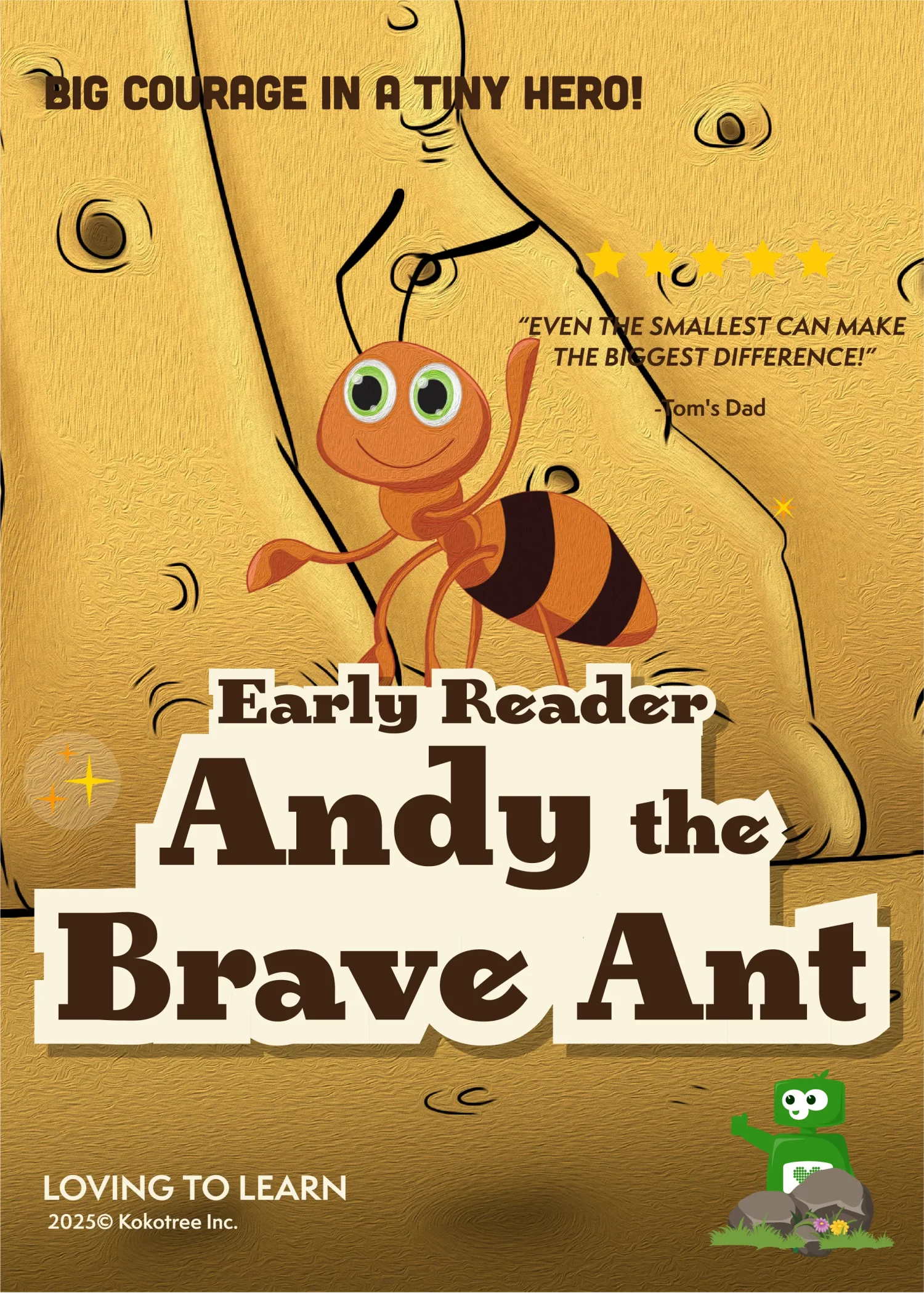
Watch Andy prove that being small doesn't mean you can't do BIG things! Your child will discover how quick thinking and courage can solve problems, building their own confidence along the way.
13.5 minutes
Ages 2-6
Skill: Problem-Solving & Perseverance
Your kid watches a tiny ant save his entire anthill from flooding. You get 13 minutes to [drink your coffee while it's still warm].
Andy is a small ant who dreams of joining the ant army, but everyone tells him he's too little. When a storm threatens the anthill, Andy spots a dangerous hole in the wall and uses his quick thinking to roll a mud ball down the hill to block it—saving the queen and everyone inside!
What your child learns:
This story teaches children that their size or age doesn't limit what they can accomplish. Through Andy's journey, kids learn to identify problems, think creatively about solutions, and take action even when they feel unsure.
- Recognizing that everyone has something valuable to contribute
- Using creative problem-solving when facing challenges
- Understanding cause and effect (hole in wall → water gets in → danger)
- Building persistence when first attempts don't work out
- Identifying weather patterns and nature observations (rain, thunder, storms)
They'll use these skills when:
- Figuring out how to reach a toy on a high shelf using safe alternatives
- Trying again after a block tower falls down instead of giving up
- Helping with small household tasks and feeling proud of their contribution
- Comforting a friend or sibling by thinking of ways to help
The Story (what keeps them watching)
Andy wants to join the ant army SO badly, but the soldiers say he's too small. The nurse ants shoo him away too. Poor Andy! Then a storm rolls in, and Andy spots a worm hole in the anthill wall—uh oh, water's coming! With no one around to help, Andy gets a brilliant idea: roll a mud ball to plug the hole! He hops ON the mud ball (yes, really!) and steers it right into place. The queen is saved, the army cheers, and guess who gets to be a soldier now? Our hero Andy!
How We Teach It (the clever part)
- First 4 minutes: Andy faces rejection from the army and nursery, establishing the challenge of feeling too small or not good enough—something every child relates to
- Minutes 4-10: The storm creates urgency, and Andy must observe, think, and act independently. Children watch him identify the problem (hole), consider solutions (mud), and execute his plan (rolling the mud ball)
- Final 3.5 minutes: Andy's efforts are recognized and celebrated, reinforcing that persistence and creative thinking lead to positive outcomes
Teaching trick: The story uses dramatic weather sounds and visual tension (water approaching the hole) to help children understand urgency and cause-effect relationships without scary content. Andy talks through his thinking process out loud, modeling how to approach problems step-by-step.
After Watching: Quick Wins to Reinforce Learning
- Mealtime activity: "What's one small thing you did today that helped someone?" (Builds awareness that small actions matter—just like Andy blocking the hole with one mud ball)
- Car/travel activity: "If you were an ant and saw a puddle blocking your path, what would you do?" (Practices creative problem-solving with no wrong answers)
- Bedtime activity: "Andy felt sad when the ants said he was too small. Have you ever felt too little to do something? What happened?" (Opens conversation about perseverance and trying anyway)
- Anytime activity: Roll a small ball across the floor together and try to "steer" it by tapping it gently—just like Andy steered his mud ball! (Reinforces the story while practicing coordination)
When Kids Get Stuck. And How to Help.
- "My child says they're too little to help with things." - This is actually the perfect teaching moment! Reference Andy: "Remember how Andy was small but saved everyone? Let's find YOUR way to help." Start with tiny tasks they can succeed at.
- "They got frustrated and gave up on a puzzle/task after watching." - Remind them that Andy got turned away TWICE before he found his moment. Say: "Andy didn't give up. Let's try one more time together."
- "My child didn't understand why the hole was dangerous." - Use bath time to demonstrate! Poke a small hole in a plastic cup and show how water leaks in. "See? That's what would have happened to Andy's home!"
What Your Child Will Learn
Prerequisites and Building Blocks
This video works beautifully as a standalone story, requiring no prior viewing. Children benefit from basic vocabulary around weather (rain, thunder, storm) and animals (ants, worms), though the visuals support understanding. This story builds on foundational social-emotional concepts introduced in earlier Curious Tots episodes—particularly persistence and helping others. It prepares children for more complex problem-solving narratives and serves as an excellent bridge to STEAM concepts about cause and effect.
Cognitive Development and Teaching Methodology
At ages 2-6, children are developing "theory of mind"—understanding that others have different thoughts and feelings. Andy's internal dialogue ("What can this little ant do now?") models self-reflection. The story uses scaffolded problem-solving: Andy observes (hole), analyzes (water coming), plans (get mud), and executes (rolls ball). Visual storytelling supports pre-readers, while descriptive narration builds vocabulary. Kinesthetic learners connect through Andy's physical actions—running, pushing, balancing.
Alignment with Educational Standards
This video aligns with Head Start Early Learning Outcomes Framework domains: Approaches to Learning (persistence, problem-solving) and Social-Emotional Development (self-concept, self-efficacy). It supports kindergarten readiness indicators for SEL competencies including identifying problems and generating solutions. The narrative structure reinforces Common Core ELA standards for story comprehension—identifying characters, settings, and key events. NAEYC guidelines for developmentally appropriate practice are reflected in the age-appropriate challenge level.
Extended Learning Opportunities
Pair this video with ant-themed counting activities in the Kokotree app to extend learning. Create a simple obstacle course where children must figure out how to get a ball from point A to point B—just like Andy! Draw pictures of "problems you solved today" to reinforce the concept. Look for ants outside together and observe how they work as a team. The Kokotree printable activity sheets for this episode include a maze helping Andy reach the mud and a sequencing activity.
Transcript Highlights
- "You're too small, little ant. The army is for the big, brave ants." — Establishes the relatable challenge of feeling inadequate
- "A hole in the thick mud posed a great danger to the entire castle and the queen, as it could cause the walls to weaken and crumble." — Teaches cause and effect explicitly
- "Just then, a brilliant idea popped into Andy's mind. He would block the hole and save the queen!" — Models the moment of creative problem-solving
- "Remember, my little one, that no matter how small you are, you can do great things." — Direct address reinforcing the core message
Character Development and Story Arc
Andy demonstrates a complete growth mindset arc. He begins with enthusiasm (wanting to join the army), faces setbacks (rejection), experiences self-doubt ("What can this little ant do?"), but doesn't give up. When opportunity arises, he takes initiative without waiting for permission or help. His problem-solving is methodical—he doesn't panic but thinks through options. The captain's recognition validates Andy's approach, teaching children that thoughtful action earns respect. Andy models emotional resilience: feeling sad but continuing forward.
Social-Emotional Learning Deep Dive: Building Self-Efficacy in Young Children
Andy the Brave Ant is a masterclass in developing self-efficacy—a child's belief in their ability to succeed at tasks and influence outcomes. Psychologist Albert Bandura identified self-efficacy as crucial for motivation and achievement, and this story hits every developmental sweet spot for ages 2-6.
Why "Too Small" Resonates: Young children constantly encounter size-based limitations. They can't reach counters, open heavy doors, or do things older siblings can. Andy's experience validates these feelings while demonstrating that limitations are often situational, not permanent. The story carefully avoids suggesting children should attempt dangerous tasks—Andy's heroism involves quick thinking, not physical risk-taking beyond his abilities.
The Power of Witnessing Success: When children watch Andy succeed, mirror neurons activate as if they themselves accomplished the task. This vicarious experience builds what Bandura called "mastery experiences"—the most powerful source of self-efficacy. The detailed narration of Andy's thought process ("Just then, a brilliant idea popped into Andy's mind") helps children internalize problem-solving as a learnable skill, not magic.
Handling Rejection Constructively: Andy faces two rejections before his triumph. This teaches children that initial failure doesn't predict final outcomes—a crucial lesson for building resilience. Importantly, the ants who reject Andy aren't villains; they're simply busy or following rules. This nuanced portrayal helps children understand that "no" doesn't mean "you're worthless."
Age-Appropriate Independence: Andy solves the problem alone, but within safe boundaries. He doesn't venture far from home or take dangerous risks. This models appropriate independence for young children—taking initiative in familiar environments with manageable challenges. Parents can reference Andy when encouraging children to try tasks independently: "You can do it, just like Andy figured out what to do!"
The Recognition Moment: The celebration at the end isn't just feel-good storytelling—it's developmentally essential. Young children need external validation as they build internal motivation. The captain's public acknowledgment teaches that helpful actions are noticed and valued, encouraging prosocial behavior.