
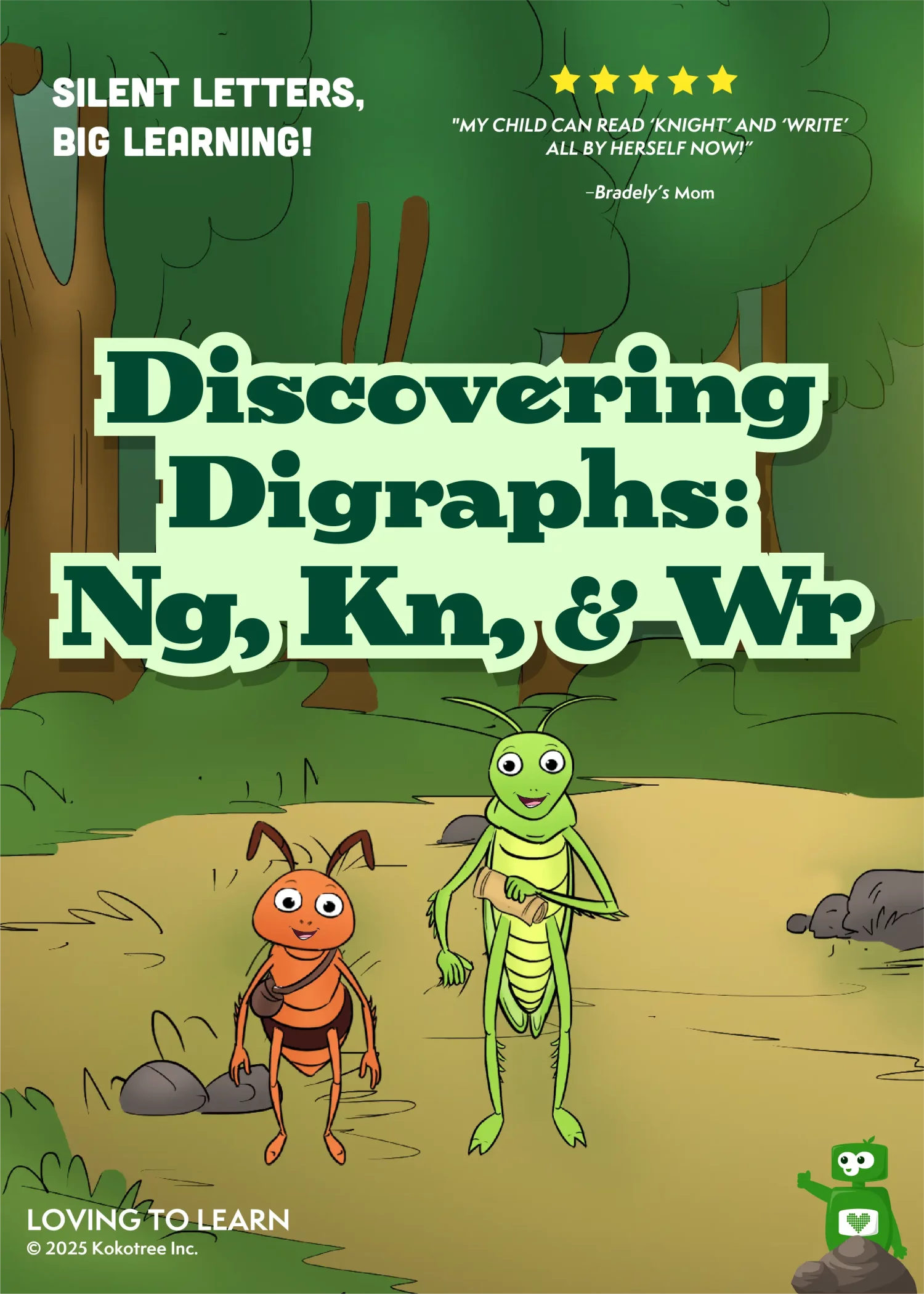
What's Discovering Digraphs Ng, Kn, & Wr About?
Your little learner joins brave jungle explorers on a quest to rescue missing sounds! They'll master three tricky digraphs (ng, kn, wr) through an exciting treasure hunt adventure.
9 minutes
Ages 4-6
Skill: Recognizing letter pairs that make special sounds
Your kid watches jungle friends solve sound puzzles and collect magical stones. You get 9 minutes to finish that cup of coffee while it's still warm.
Andy and Greg receive a mysterious map from Wise Owl—sounds are disappearing from the jungle! They climb through caves, untangle knotted vines, and scale whispering trees to find three glowing digraph stones. Each location reveals words like "ring," "knee," and "wrap" that help kids hear how these letter pairs work together.
What your child learns:
Digraphs are two letters that team up to make one sound—and they're everywhere once you know how to spot them! This adventure teaches the three trickiest digraphs in English, including two with sneaky silent letters.
- Recognizes "ng" digraph in words like ring, hang, and bang
- Identifies silent "k" in "kn" words like knee, know, and knight
- Spots silent "w" in "wr" words like wrap, write, and wriggle
- Connects letter patterns to sounds they already use when speaking
- Builds confidence decoding unfamiliar words independently
They'll use these skills when:
- Sounding out words during storytime ("Look, that says 'king'!")
- Writing notes and recognizing why some letters stay quiet
- Playing rhyming games and noticing word endings
- Reading signs at the grocery store or playground
The Story (what keeps them watching)
Wise Owl arrives with urgent news—sounds are vanishing from the Jungle of Lost Sounds! Andy and Greg grab their map and race to three magical locations. First, they discover a cave where "RING the bell" is missing its "ng." Next, they battle tangled vines in Knot Tree Forest to free the "kn" stone. Finally, they climb a twisty tree in Whispering Woods where ghostly clues lead them to "wr." With all three digraphs restored to the ancient shrine, the jungle's voice returns!
How We Teach It (the clever part)
First 3 minutes: Miss Meera's classroom introduces the adventure. Maddy's whistle gets everyone's attention, then the magical storybook opens to reveal the quest—missing digraphs need rescuing!
Minutes 3-7: Each digraph gets its own mini-adventure. Kids see incomplete words ("Ri__ the Bell"), hear the solution spoken aloud, then watch the letters magically appear. Physical actions reinforce learning—pushing with a "knee," things ending with a "bang."
Final 2 minutes: All three stones unite at the shrine. Miss Meera returns to the classroom, reviewing each digraph with real-world examples (sing, knee, wrap) that kids can find at home.
Teaching trick: The video uses broken signs with missing letters, so kids visually see the gap before hearing the complete word. This "puzzle-solving" approach makes abstract phonics feel like detective work!
After Watching: Quick Wins to Reinforce Learning
Mealtime activity: "Can you find something we could WRAP?" Point to napkins, sandwiches, or leftovers. Ask what letters make that "wr" sound at the beginning. (Practices identifying wr-words in context)
Car/travel activity: "Let's play the -ng game! I'll say SING, you say another word that ends the same way." Ring, swing, king, bring—see how many you can collect! (Reinforces ng-ending recognition through rhyming)
Bedtime activity: "Touch your KNEE, then KNOCK on your pillow." Ask which sneaky letter stays silent in both words. (Connects kn-words to body awareness and physical memory)
Anytime activity: "Be a Sound Detective! When you see a sign or book, look for our three digraphs hiding inside words." Celebrate each discovery with a quiet cheer. (Transfers learning to environmental print)
When Kids Get Stuck. And How to Help.
"My child keeps saying the 'k' sound in 'knee.'" - Totally normal! Silent letters are genuinely weird. Try whispering "nee" together, then add the silent k in front like a secret letter that watches but doesn't talk.
"They can hear the sounds but can't find them in written words." - Hearing comes first, reading comes second—this is perfect progress! Point to the letters as you say words slowly, helping their eyes catch up to their ears.
"These digraphs seem too advanced for my preschooler." - Exposure matters more than mastery right now. If they remember that "some letters work as teams," that's a win! Full understanding develops over many encounters.
What Your Child Will Learn
Prerequisites and Building Blocks
Children benefit most from this video after learning individual letter sounds (especially n, g, k, w, r) and understanding that letters represent sounds. This builds on basic phonemic awareness—hearing distinct sounds in words. It's an intermediate phonics lesson, bridging single-letter sounds and more complex decoding. Prior exposure to simple CVC words (cat, dog, sun) helps children appreciate why digraphs require special attention.
Cognitive Development and Teaching Methodology
Preschoolers learn through narrative and emotional engagement—the quest format transforms abstract phonics into memorable adventure. The video employs multi-sensory reinforcement: visual (seeing letters appear), auditory (hearing sounds emphasized), and kinesthetic cues (characters pushing with knees, pulling vines). Repetition within varied contexts helps cement pattern recognition without feeling repetitive, matching 4-6 year olds' need for novelty alongside consistency.
Alignment with Educational Standards
This lesson addresses Common Core Foundational Skills RF.K.3 (knowing letter-sound correspondences) and RF.1.3a (knowing spelling-sound correspondences for common consonant digraphs). It supports kindergarten readiness benchmarks for phonological awareness and prepares children for first-grade decoding expectations. Teachers expect entering kindergartners to recognize that some letter combinations make single sounds—this video builds exactly that foundation.
Extended Learning Opportunities
Pair this video with digraph sorting activities—children can categorize picture cards by their beginning or ending sounds. The Kokotree app offers interactive games where kids tap matching digraphs. Extend learning with a "digraph hunt" around your home, photographing words containing ng, kn, or wr. Create a simple book together featuring one digraph per page with drawings of related words.
Transcript Highlights
- "That's it—RING the bell! We're missing the '-ng' digraph!" (Andy demonstrates problem-solving by connecting incomplete words to missing sounds)
- "These vines are super knotted! Use your knee! It helps!" (Physical action reinforces the kn-word while showing teamwork)
- "Wait… these lines. They look like letters—w and r!" (Models close observation and letter recognition skills)
- "Keep looking for digraphs around you—like ng in sing, kn in knee, and wr in wrap!" (Miss Meera bridges story learning to real-world application)
Character Development and Story Arc
Andy models confident problem-solving, immediately connecting clues to solutions and encouraging Greg forward. Greg demonstrates that uncertainty is okay—his humor about being "scared of gravity" normalizes nervousness while still trying. Together they show collaborative learning: Andy spots patterns while Greg contributes physical effort. Wise Owl represents trusted guidance, and the classroom characters mirror young viewers' excitement about discovery.
Digraph Phonics Deep Dive: Why These Three Matter
Digraphs represent a crucial leap in phonics development—understanding that two letters can work as a team to produce a single sound. The three digraphs featured (ng, kn, wr) were strategically chosen because they present distinct learning challenges that build different skills.
The "ng" digraph appears at word endings and produces a nasal sound children already use naturally when speaking. Words like "ring," "sing," and "hang" feel familiar, making this an accessible entry point. Children discover they've been making this sound all along—they just didn't know it had a spelling!
The "kn" and "wr" digraphs introduce silent letters, a concept that initially seems illogical to young learners. Why write a letter you don't say? This video normalizes the quirk through adventure rather than explanation. Children accept that the "k" in "knee" is a "secret letter that watches but doesn't talk"—building tolerance for English spelling irregularities they'll encounter throughout literacy development.
Research shows that explicit digraph instruction significantly improves decoding accuracy. When children recognize these letter patterns as units rather than individual letters, reading fluency increases. They stop laboriously sounding out k-n-e-e as four sounds and instead recognize "kn" as one chunk making the /n/ sound.
The adventure format serves phonics instruction particularly well because each digraph gets its own memorable context. The cave with the bell (ng), the knotted forest (kn), and the whispering woods (wr) create distinct mental "files" where children can store these patterns. Months later, encountering "knight" in a book, they may recall the Knot Tree Forest and remember that tricky silent k.