
What's Exploring Pets & Wild Animals About?
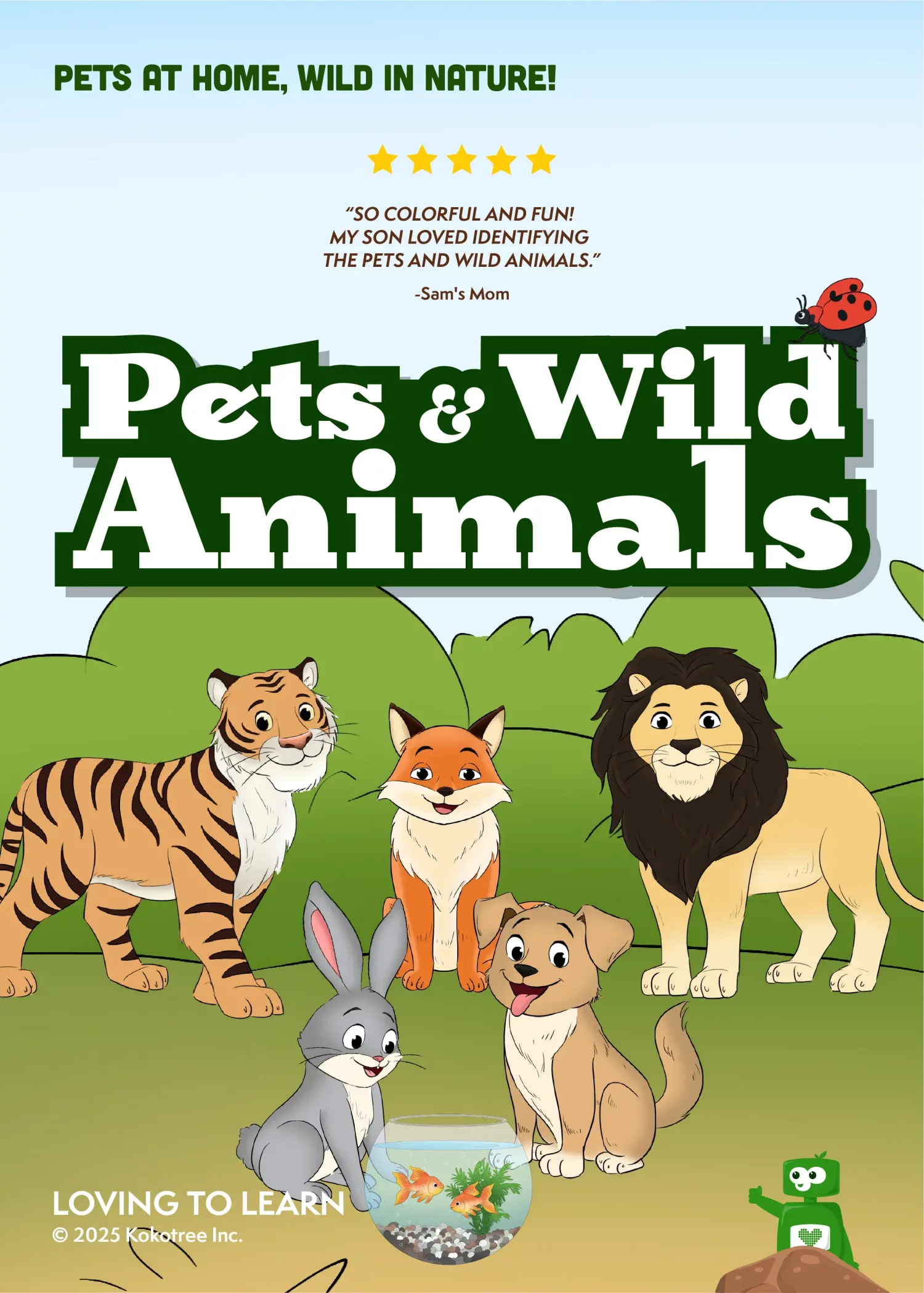
Your little one joins a classroom adventure that turns into a jungle expedition, learning exactly which animals make great pets and why wild animals need to stay wild. They'll confidently explain why a goldfish belongs in a tank while a lion belongs in the savanna!
9 minutes
Ages 3-6
Skill: Animal Classification & Habitats
Your kid watches friendly animals sort creatures by their homes. You get 9 minutes to enjoy your coffee in peace.
The video starts in Miss Elizabeth's cozy classroom where Ruby brings in a ladybug she calls her "pet." This sparks a lively discussion about what makes an animal a pet versus a wild animal. Then we zoom into the jungle where Leo and Mika help Felix the Fox understand why he can't have a chimpanzee for his birthday—and discover the perfect pet instead!
What your child learns:
Through storytelling and clear examples, children grasp the important differences between domesticated pets, wild animals, and water creatures. They'll understand that pets are animals comfortable living with people, while wild animals need their natural habitats to thrive.
- Distinguishes between pets (dogs, cats, rabbits, goldfish) and wild animals (lions, tigers, monkeys)
- Identifies water animals (dolphins, sharks, whales, octopus, seahorse)
- Recognizes animals that live both on land and in water (turtles, frogs, penguins, crocodiles)
- Understands why certain animals make safe, happy pets while others don't
- Learns that pets need proper care and appropriate homes
They'll use these skills when:
- Visiting a pet store and understanding which animals they could care for at home
- Spotting animals at the zoo and explaining why they live there instead of houses
- Finding a bug outside and knowing it belongs in nature, not in their pocket
- Watching nature documentaries and identifying animal habitats correctly
The Story (what keeps them watching)
Ruby brings a ladybug to class thinking it's her new pet—but learns that insects belong outdoors! Then Leo and Mika race to help their friend Felix the Fox, who's moping on his birthday because he wants a chimpanzee as a pet. Through patient explanations and fun examples, they show Felix why chimps are wild animals that bite and scratch, not cuddly companions. Felix discovers that goldfish are the perfect choice—they're beautiful, peaceful, and happy in a home tank. Birthday crisis solved, lesson learned!
How We Teach It (the clever part)
- First 3 minutes: The classroom scene introduces the central question—what makes something a pet?—through Ruby's ladybug discovery and peer discussion
- Minutes 3-7: Leo and Mika's jungle adventure presents clear contrasts between pet animals (dogs, cats, rabbits, goldfish) and wild animals (chimps, lions, elephants), plus introduces water animals and land-and-water animals
- Final 2 minutes: Miss Elizabeth reinforces the key categories with a memorable summary, cementing the learning
Teaching trick: The video uses a relatable "birthday wish gone wrong" scenario—Felix wanting a chimp—to show why wild animals aren't suitable pets without lecturing. Kids learn through Felix's discovery, not direct instruction.
After Watching: Quick Wins to Reinforce Learning
- Mealtime activity: "Can you name three animals that would be happy living in our home?" (Reinforces the concept of domesticated pets and appropriate animal companions)
- Car/travel activity: "I spy an animal! Is it a pet, a wild animal, or a water animal?" Point out dogs in yards, birds in trees, or fish on restaurant signs. (Practices real-world classification)
- Bedtime activity: "If you could have any pet from the video, which would you choose and why?" (Encourages reasoning about animal needs and habitats)
- Anytime activity: Draw three homes—a house, a jungle, and an ocean. Cut out animal pictures from magazines and sort them into the right home! (Hands-on habitat classification)
When Kids Get Stuck. And How to Help.
"My child insists they want a wild animal as a pet now!" - This is actually great—they're engaged! Revisit the video's message that wild animals are happiest in their natural homes, and redirect excitement toward visiting a zoo where they can see these amazing creatures safely.
"They're confused about animals that live in both places." - Turtles, frogs, and penguins are tricky! Use bath time to demonstrate: "Some animals can be in water AND walk around, just like you can play in the tub and then walk to your room."
"My child thinks all small animals can be pets." - The ladybug example is perfect for this. Remind them that even tiny creatures have homes in nature where they find food and friends—just like Lara flew back to find her ladybug buddies!
What Your Child Will Learn
Prerequisites and Building Blocks
Children benefit from basic familiarity with common animals like dogs, cats, and fish before watching. This video builds on foundational animal recognition and introduces the more complex concept of classification by habitat and domestication. It connects naturally to prior learning about nature and living things, preparing children for deeper exploration of animal needs, ecosystems, and responsible pet care in future content.
Cognitive Development and Teaching Methodology
This video leverages narrative-based learning, which is highly effective for preschoolers who naturally absorb information through stories. The dual-setting approach (classroom discussion followed by jungle adventure) addresses multiple learning styles: auditory learners benefit from dialogue, visual learners see animal examples on screen, and the emotional storyline (Felix's birthday dilemma) creates memorable anchors for abstract classification concepts.
Alignment with Educational Standards
This content aligns with NGSS K-LS1 (basic needs of living things) and kindergarten readiness standards for science, specifically understanding that animals have different characteristics and live in different places. The classification skills practiced here support early scientific thinking and observation skills that teachers expect children to demonstrate when sorting and categorizing objects and living things.
Extended Learning Opportunities
Pair this video with animal sorting activities using picture cards or plastic animal figurines. Create a simple habitat diorama with three zones (home, jungle, ocean). The Kokotree app offers related content on animal sounds, animal babies, and nature exploration. Extend learning with library books about pets and zoo animals, or a family trip to an aquarium to see water animals up close.
Transcript Highlights
- "Usually, when we talk about pets... we mean animals that have been domesticated, which means they're used to living with people, and we take special care of them in our homes."
- "Felix, chimps are definitely clever… but they can also be wild. They bite, they scratch—and they don't like being indoors."
- "Pets are like family. You want a companion who's friendly, safe, and happy living with you."
- "Wild animals like elephants, foxes, giraffes, zebras, and monkeys are meant to stay in the wild—not in homes."
Character Development and Story Arc
Felix the Fox models a common childhood experience—wanting something without understanding why it might not work. Through Leo and Mika's patient guidance, Felix demonstrates growth mindset by accepting new information and changing his mind. Ruby similarly shows emotional maturity when she lets Lara the Ladybug go, understanding that caring for creatures sometimes means letting them live where they're happiest.
Animal Classification and Early Life Science Deep Dive
Animal classification is a foundational life science concept that develops critical thinking and observation skills in young learners. This video introduces three primary categories: domesticated pets, wild animals, and water animals—plus the fascinating "both land and water" group that challenges binary thinking.
For children ages 3-6, understanding that animals have different needs based on their natural habitats builds essential scientific reasoning. The concept of domestication—that some animals have adapted over thousands of years to live comfortably with humans—is simplified here as animals that are "used to living with people." This age-appropriate explanation plants seeds for later understanding of animal behavior and evolution.
The video carefully distinguishes between what children might want (a cool chimpanzee!) and what's actually appropriate (a friendly goldfish), teaching consequential thinking. Water animals introduce basic habitat science: fish need water to breathe, just as humans need air. The "both land and water" category (amphibians and certain reptiles) introduces nuance and exceptions, preparing children for the complexity of real scientific classification.
Importantly, the video emphasizes animal welfare—that wild animals are happiest in their natural environments. This builds empathy and responsible attitudes toward all living creatures, whether they're potential pets or animals observed at a distance in nature.