
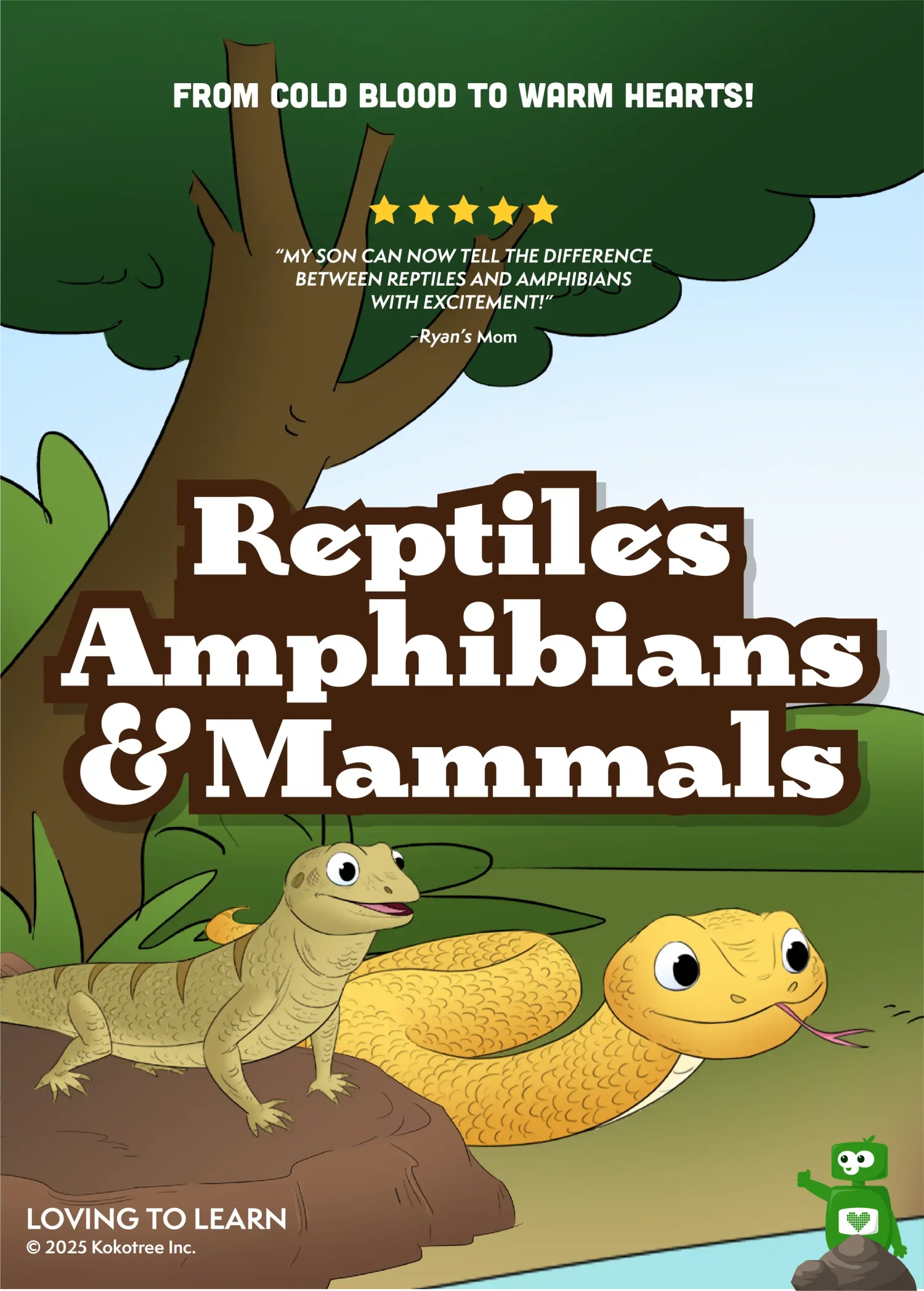
What's Reptiles, Amphibians & Mammals About?
Your little explorer joins two adventurous friends on a quest through different animal kingdoms, learning to spot the special features that make each creature unique. After watching, they'll confidently tell you why lizards love sunbathing and frogs need to stay moist!
10 minutes
Ages 3-6
Skill: Animal classification and characteristics
Your kid watches two animal friends explore different habitats meeting creatures. You get 10 minutes to finally drink that coffee while it's hot.
Kango the Kangaroo and Dally the Armadillo travel through sunny Reptile Ridge, splash near Amphibian Pond, and meet furry friends at Mammal Meadow. Along the way, friendly animals explain what makes their group special—scales, fur, feathers, fins, and more. The adventure ends at a magical fountain that only opens when the travelers prove they've learned about all the animal groups.
What your child learns:
This video introduces the five main animal groups through memorable characters and clear visual examples. Children discover that animals are sorted by specific features like body covering, how they breathe, and whether they're warm or cold-blooded.
- Identifying reptiles by their scaly skin and cold-blooded nature
- Understanding amphibians live in water as babies, then on land as adults
- Recognizing mammals have fur and feed milk to their babies
- Learning fish breathe with gills and live entirely in water
- Discovering birds have feathers, beaks, and lay eggs
They'll use these skills when:
- Spotting a lizard at the park and explaining why it's sunbathing on a rock
- Visiting an aquarium and sorting animals into their correct groups
- Reading animal books and predicting what group a new creature belongs to
- Playing with toy animals and organizing them by their special features
The Story (what keeps them watching)
When a drought hits the jungle, Kango and Dally set off to find the legendary Fountain of Life. But there's a catch—they can only unlock its water by learning about different animal groups along the way! They meet Lenny the Lizard soaking up sunshine, Freddy the Frog who started life in water, Molly the Meerkat with her fuzzy family, and Finn the Fish who never leaves his pond. Each creature teaches them something special. At the fountain, they answer three questions correctly, and water rushes back to save the jungle!
How We Teach It (the clever part)
First 3 minutes: Miss Meera introduces the concept when kids discover a snail, sparking curiosity about how we group different animals. The adventure story begins with a relatable problem—finding water during a hot summer.
Minutes 3-8: Kango and Dally visit distinct habitats, meeting animals who explain their group's key features in kid-friendly language. Each zone has clear visual differences—sunny rocks for reptiles, a misty pond for amphibians.
Final 2 minutes: The Fountain Spirit quizzes our heroes, reinforcing learning through recall. Miss Meera wraps up by connecting the story back to the classroom, celebrating what the kids discovered.
Teaching trick: Each animal explains their own features in first person ("I'm cold-blooded, that's why I love sunshine!"), making abstract concepts personal and memorable.
After Watching: Quick Wins to Reinforce Learning
Mealtime activity: "Is a chicken a reptile or a bird?" Point to eggs at breakfast and ask what other animals lay eggs. (Practices connecting food to animal groups and recalling that both birds AND reptiles lay eggs!)
Car/travel activity: "Spot a mammal!" Challenge your child to find animals with fur through the window—dogs, squirrels, cats. (Reinforces mammal identification using the key feature of fur)
Bedtime activity: "If you were an amphibian, where would you sleep?" Talk about why frogs need to stay near water. (Builds understanding of habitat needs and animal adaptations)
Anytime activity: "Animal sorting game!" Grab toy animals or picture books and sort them into piles: scaly, furry, feathery. (Practices classification skills using physical characteristics)
When Kids Get Stuck. And How to Help.
"My child keeps mixing up reptiles and amphibians" - Totally normal! Focus on one memorable feature: reptiles are dry and scaly (like a dragon), amphibians are wet and slimy (like a frog in a pond). Use touch words to make it stick.
"They think all egg-layers are birds" - This is actually great logical thinking! Gently explain that reptiles, fish, and amphibians lay eggs too. Ask: "Does a snake have feathers?" to help them see the difference.
"The vocabulary seems advanced for my 3-year-old" - Start with just "furry animals" and "scaly animals" instead of formal terms. The video plants seeds—they'll connect "mammal" to "furry" naturally with repeated viewing.
What Your Child Will Learn
Prerequisites and Building Blocks
Children benefit from basic familiarity with common animals like dogs, cats, fish, and frogs before watching. This video builds on foundational observation skills—noticing differences in how things look and feel. It connects to earlier Kokotree content about animals and nature, extending learning from simple animal recognition to understanding WHY animals look and behave differently. This classification skill prepares children for more complex sorting and categorization across all subjects.
Cognitive Development and Teaching Methodology
The narrative quest structure leverages preschoolers' natural love of stories while embedding factual content. Each animal zone provides visual contrast (sunny rocks vs. misty pond), supporting concrete operational thinking. The video addresses multiple learning styles: visual learners see distinct habitats, auditory learners hear animals explain their features, and the journey structure helps kinesthetic learners mentally "move" through concepts. Repetition through the final quiz reinforces retention without feeling like a test.
Alignment with Educational Standards
This video supports Next Generation Science Standards for K-2, specifically understanding that animals have body parts that capture and convey different kinds of information. It aligns with kindergarten readiness indicators for science inquiry and observation skills. The classification concepts prepare children for first-grade life science units on animal characteristics and habitats. Teachers expect incoming kindergarteners to sort objects by observable properties—this video practices exactly that skill with living things.
Extended Learning Opportunities
Pair this video with Kokotree's animal habitat activities and sorting games within the app. Create a simple chart at home with columns for "fur," "scales," "feathers" and add animal stickers or drawings. Visit a local pond to observe real amphibians, or watch birds at a feeder while discussing their feathers and beaks. Library books about animal babies extend the mammal concept (babies drinking milk). Nature documentaries become more meaningful when children can identify animal groups.
Transcript Highlights
- "Reptiles like us need the sun to heat our bodies. We don't make our own body heat like you mammals do." - Lenny the Lizard explains cold-blooded simply
- "We're amphibians! We're born in water with gills, but when we grow up, we breathe air and live on land too." - Freddy the Frog describes the amphibian life cycle
- "We're warm-blooded, covered in fur, and we feed milk to our babies." - Molly the Meerkat lists key mammal features
- "I may fly, but I'm still a mammal. Just a very cool one!" - Benny the Bat addresses the common misconception about flying animals
Character Development and Story Arc
Kango and Dally model ideal learning behaviors throughout their quest. They ask questions without embarrassment ("Cold-blooded? That sounds... brrrrr!"), show genuine curiosity about unfamiliar creatures, and listen respectfully to each animal's explanation. Their teamwork at the fountain—answering questions together—demonstrates collaborative problem-solving. The characters transform from confused ("that's a lot of animals!") to confident, showing children that understanding comes through patient exploration.
Life Science Classification: Understanding Animal Taxonomy for Young Learners
Animal classification represents one of children's first experiences with scientific taxonomy—the systematic organization of living things based on shared characteristics. This video introduces the fundamental concept that scientists group animals by observable features: body covering (scales, fur, feathers, skin), temperature regulation (warm-blooded vs. cold-blooded), breathing method (lungs vs. gills), and reproduction (live birth vs. eggs).
The five vertebrate groups presented—mammals, reptiles, amphibians, fish, and birds—form the foundation of zoological understanding. Each group has defining characteristics that even young children can observe and remember. Mammals are identified by fur/hair and nursing young with milk. Reptiles have dry, scaly skin and rely on external heat sources. Amphibians undergo metamorphosis, starting life in water with gills before developing lungs. Fish spend their entire lives in water, breathing through gills. Birds possess feathers, beaks, and hollow bones for flight.
The video cleverly addresses common misconceptions. Benny the Bat explicitly states he's a mammal despite flying, countering the assumption that all flying animals are birds. The comparison between birds and bats ("Bats have fur and feed their babies milk. We birds lay eggs and have feathers.") teaches children that similar behaviors don't mean similar classification.
This classification skill transfers beyond biology. Children who practice sorting animals by characteristics develop the cognitive framework for all categorical thinking—organizing toys, understanding that squares and rectangles are both shapes, or recognizing that apples and oranges are both fruits. The ability to identify defining features and group accordingly is fundamental to mathematical thinking, reading comprehension, and scientific inquiry throughout their educational journey.