
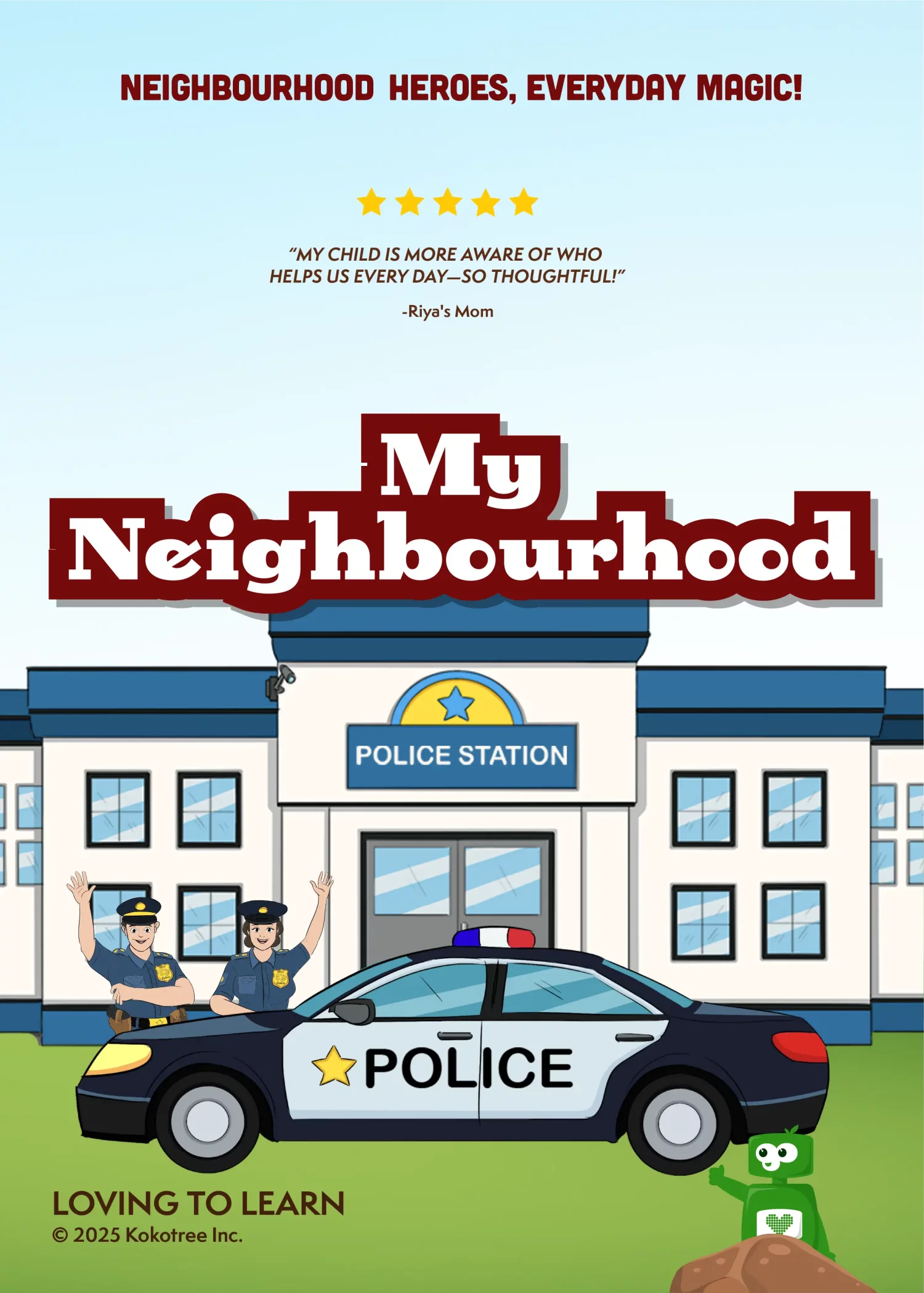
What's My Neighbourhood About?
Your little explorer joins Miss Meera and seven adorable animal friends on a walking adventure through their neighbourhood, discovering hospitals, fire stations, libraries, and more! They'll learn what community helpers do and why every place in town matters.
10 minutes
Ages 3-6
Skill: Community awareness and social understanding
Your kid watches animal friends explore neighbourhood buildings and helpers. You get 10 minutes to finish that cup of coffee.
Miss Meera leads Ronnie Rhino, Eddie Elephant, Tiki Tiger, and their friends on a cheerful walking tour. They visit the hospital, gas station, post office, fire station, bakery, supermarket, police station, pet store, library, and community park—learning what happens at each stop through conversations and discoveries.
What your child learns:
This video builds foundational social studies knowledge by introducing community places and the helpers who work there. Children discover how different locations serve specific purposes and work together to help everyone in the neighbourhood.
- Identifies 10+ community locations and their purposes
- Understands roles of community helpers (firefighters, police, postal workers, bakers)
- Builds vocabulary around neighbourhood and community concepts
- Recognizes how places serve different needs (safety, food, learning, play)
- Develops appreciation for helpers in their own community
They'll use these skills when:
- Driving past the fire station and explaining what firefighters do
- Visiting the library and understanding library behavior expectations
- Going grocery shopping and noticing different store sections
- Seeing a mail carrier and understanding where letters travel
The Story (what keeps them watching)
When Tiki Tiger shares a funny book from the new library, Miss Meera gets an idea—let's explore the whole neighbourhood! The animal friends don colorful explorer hats and set off on an adventure. They discover the hospital where Ronnie once got help after a muddy fall, watch cars "snack" on fuel at the gas station, learn that post offices can even send money, wave to brave firefighters, sniff heavenly bakery smells, and tiptoe through the magical library. The journey ends at the community park where everyone plays and reflects on their favorite discoveries.
How We Teach It (the clever part)
- First 2 minutes: Miss Meera introduces the adventure concept and builds excitement about exploring familiar places with fresh eyes
- Minutes 2-8: Each neighbourhood stop features a quick explanation plus relatable stories from the animal friends (Ronnie's hospital visit, Tiki's library giggles, Ruby's grandma's postcards)
- Final 2 minutes: Group reflection at the park reinforces learning as each character shares their favorite discovery
Teaching trick: Each location connects to something kids already know—cars "drink" fuel like snack time, the post office delivers "joy in envelopes," firefighters are "superheroes with badges instead of capes." These analogies make abstract community concepts concrete and memorable.
After Watching: Quick Wins to Reinforce Learning
- Mealtime activity: "Who made this bread?" Talk about bakers waking up early to make fresh food. Ask your child what other foods come from special helpers.
- Car/travel activity: "I spy a community helper!" Point out buildings from the video—fire stations, post offices, supermarkets. Ask "What do they do there?"
- Bedtime activity: "If you could work anywhere in our neighbourhood, where would it be?" Let your child imagine being a firefighter, librarian, or baker.
- Anytime activity: Draw a neighbourhood map together! Include your house and 3-4 places you visit. Talk about what happens at each spot.
When Kids Get Stuck. And How to Help.
- "My child doesn't understand why we need so many different places" - That's actually perfect curiosity! Use the "snack time for cars" example from the video. Just like we need different foods, our community needs different helpers for different jobs.
- "They keep mixing up firefighters and police officers" - Very common at this age! Focus on one visual cue: firefighters have big red trucks and hoses for water, police have badges and help keep peace. The video reinforces these distinctions.
- "Is this too advanced for my 3-year-old?" - Start with just 2-3 places they already know (library, supermarket, park). The video's friendly animal characters make complex ideas accessible, and repetition builds understanding over time.
What Your Child Will Learn
Prerequisites and Building Blocks
Children benefit most from this video if they've had basic exposure to their own neighbourhood through family outings. No formal prerequisites needed—this serves as an excellent introduction to social studies concepts. It builds on basic vocabulary skills and connects to videos about helpers, transportation, and daily routines. This video establishes foundational community awareness that later supports understanding of jobs, geography, and civic responsibility.
Cognitive Development and Teaching Methodology
The video leverages concrete-to-abstract learning by connecting new concepts to familiar experiences (fuel as "car snacks," post office delivering "joy"). Multiple characters asking questions models curiosity and validates not knowing everything. The walking tour format supports sequential memory development, while character testimonials (Ronnie's hospital story) activate episodic memory pathways. Visual, auditory, and narrative learning styles are all engaged through colorful animation, dialogue-based teaching, and story-driven exploration.
Alignment with Educational Standards
This video addresses early social studies standards including community awareness, understanding roles of community helpers, and recognizing how people depend on each other. It supports kindergarten readiness indicators for social-emotional development and vocabulary acquisition. The content aligns with typical pre-K benchmarks for identifying community locations and understanding basic civic concepts. Teachers expect entering kindergartners to recognize common community helpers and their roles.
Extended Learning Opportunities
Pair this video with neighborhood walks identifying real locations from the video. Create a "community helper" matching game with pictures and job descriptions. Use building blocks to construct a mini neighbourhood. The Kokotree app offers related content on transportation, helpers, and daily routines that extend these concepts. Consider visiting your local fire station or library for hands-on reinforcement of video learning.
Transcript Highlights
- "This is our neighbourhood hospital—where caring doctors and nurses help people feel their best!"
- "So… it's like snack time for cars?" / "Exactly! Some cars like a quick sip, others go for a full tank feast!"
- "Post offices deliver letters, packages, magazines, even help people send money or pay bills. They're busy helpers for our whole community!"
- "Every book is like a new journey—right at your fingertips."
Character Development and Story Arc
Each animal friend models different learning behaviors throughout the adventure. Tiki demonstrates how personal experiences (library visit) spark group learning. Ronnie shows vulnerability by sharing an embarrassing moment, then pride in receiving help—modeling that needing assistance is normal. Ruby's imaginative play ("fire bunny") validates creative engagement with new concepts. Eddie asks clarifying questions ("you can send money?"), showing that curiosity leads to deeper understanding. Miss Meera consistently validates all responses, creating psychological safety for exploration.
Community and Social Studies Deep Dive
Understanding one's neighbourhood represents a crucial developmental milestone in early childhood social cognition. Between ages 3-6, children transition from egocentric thinking to recognizing themselves as part of larger social systems. This video scaffolds that transition by presenting the community as an interconnected network where each location serves specific purposes.
The concept of "community helpers" introduces children to occupational awareness—understanding that adults perform specialized roles that benefit everyone. Research in early childhood education shows that children who develop community awareness demonstrate stronger prosocial behaviors and civic engagement later in life.
The video strategically sequences locations from most familiar (hospital—many children have visited) to moderately familiar (supermarket, park) to less familiar (post office functions, gas station mechanics). This scaffolding respects cognitive load while expanding knowledge boundaries.
Particularly effective is the use of analogies throughout: fuel as food, post offices as "helping hands that travel," firefighters as "superheroes with badges." These metaphorical bridges help young minds categorize new information using existing mental frameworks—a technique aligned with schema theory in cognitive development.
The reflection segment at the park serves dual purposes: it consolidates learning through verbal rehearsal (children hear concepts repeated in peers' voices) and models metacognition—thinking about what we learned. This "learning about learning" skill becomes increasingly important as children enter formal schooling.
Finally, the video emphasizes interdependence without complexity. Children grasp that the baker makes bread, the postal worker delivers it, and the supermarket sells it—a gentle introduction to economic and social systems that feels accessible rather than overwhelming.