
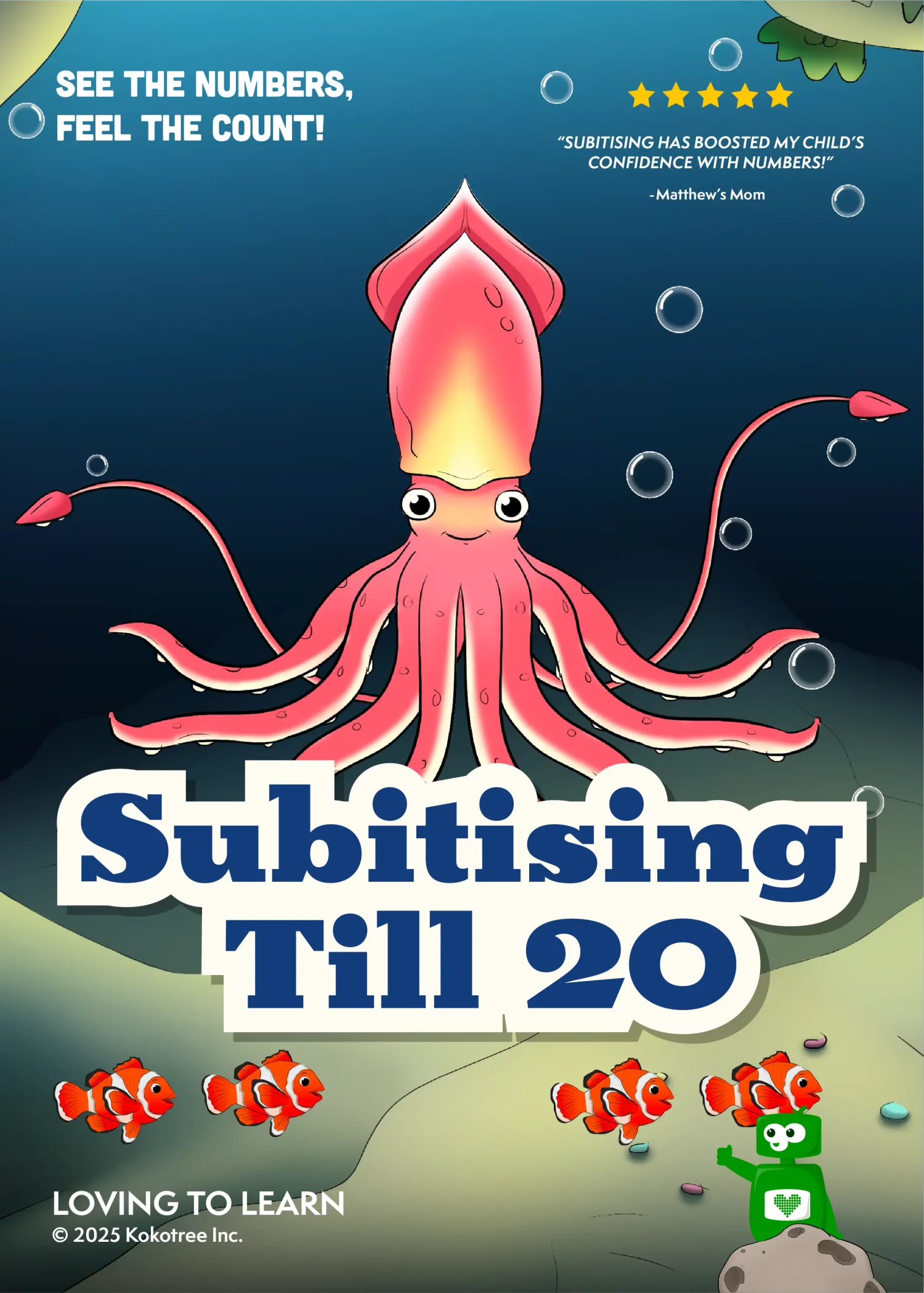
What's Subitising Till 20 About?
Your little one joins Ollie the Octopus on an underwater quest to help Mr. Squid count sea creatures—without counting one by one! They'll learn to instantly recognize numbers up to 20 by spotting clever patterns and groups.
8.5 minutes
Ages 4-6
Skill: Instantly recognizing quantities without counting
Your kid watches Ollie solve subitising puzzles with ocean friends. You get 8 minutes to [enjoy your coffee in peace].
Colorful dolphins, shrimp, jellyfish, clownfish, flying fish, and sea turtles swim across the screen in easy-to-spot groups. Friendly animal characters call out patterns like "5 plus 5 plus 2 makes 12!" while exploring a vibrant coral reef. Miss Meera bookends the adventure with classroom practice using dot flashcards.
What your child learns:
This video teaches subitising—the ability to recognize quantities instantly without counting each item. Children learn to break larger numbers into familiar smaller groups (like seeing 12 as two groups of 6) and mentally add them together.
- Instantly recognizing quantities up to 20 without counting
- Breaking large groups into smaller, manageable chunks (5+5+5+3=18)
- Identifying visual patterns in number arrangements
- Mental addition of small number groups
- Building number sense and mathematical confidence
They'll use these skills when:
- Grabbing the right number of crackers from a snack bowl without counting each one
- Quickly seeing how many books are on a shelf or toys in a basket
- Playing board games and recognizing dice patterns instantly
- Helping set the table by seeing "we need 4 more forks"
The Story (what keeps them watching)
Mr. Squid has a problem—he needs to count sea animals but doesn't know how to subitise! Ollie the Octopus and his underwater crew (Starfish, Crab, and Seahorse) swim to the rescue. Together they spot dolphins sleeping with one eye open, shrimp with hearts in their heads, brainless jellyfish, and ancient sea turtles. Each creature appears in clever groupings, and the friends call out patterns like "4 plus 4 plus 3 makes 11!" By journey's end, Mr. Squid has learned the magic of subitising, and back in the classroom, the Kokotree kids prove they've mastered it too!
How We Teach It (the clever part)
- First 2 minutes: Miss Meera connects to prior learning (subitising to 10) and introduces the challenge—going all the way to 20! The underwater adventure begins with Mr. Squid's problem.
- Minutes 2-7: Ten subitising challenges appear with increasing complexity. Sea creatures flash on screen in distinct groups, and characters model thinking aloud: "I see two groups of 5 and one group of 2."
- Final 1.5 minutes: Back in the classroom, children practice with flashcards, proving they can subitise 12, 13, and 20 independently.
Teaching trick: Animals appear in familiar groupings (rows of 3, pairs of 5, groups of 6) so children's brains can latch onto patterns they already know—then combine them into bigger numbers.
After Watching: Quick Wins to Reinforce Learning
- Mealtime activity: "Can you tell me how many grapes are on your plate without counting?" (Arrange 8-12 items in two clear groups and watch them subitise!)
- Car/travel activity: "I spy 5 red cars on this side and 5 on that side—how many total?" (Practice mental addition of familiar groups while looking out the window)
- Bedtime activity: "Let's count your stuffed animals the fast way—put them in groups of 5!" (Reinforces grouping strategy with beloved toys)
- Anytime activity: Roll two dice and ask "What's the total?" without letting them count dots. (Builds instant pattern recognition with numbers to 12)
When Kids Get Stuck. And How to Help.
- "My child still wants to count each item one by one." - Totally normal! Start with smaller numbers (groups of 3-5) and gradually increase. Point to groups and say "Look, here's a 5!" to train their eyes to see chunks.
- "They get confused when there are more than two groups." - Practice with just two groups first until it's automatic. Then add a third small group (like 2 or 3) so the mental math stays manageable.
- "Numbers above 15 seem too hard." - Focus on groups of 5 as building blocks—they're easiest to recognize. "Five fingers, five fingers, five fingers, that's 15!" makes big numbers feel friendly.
What Your Child Will Learn
Prerequisites and Building Blocks
Children watching this video should already recognize numbers 1-10 and understand basic subitising with smaller quantities (like dice patterns). This lesson builds directly on earlier Kokotree content where Mister Rocko taught subitising to 10. It bridges foundational number recognition toward more complex mental math, preparing children for addition strategies and place value concepts they'll encounter in kindergarten and first grade.
Cognitive Development and Teaching Methodology
This video leverages chunking—a proven cognitive strategy where information is grouped into manageable pieces. For 4-6 year olds whose working memory is still developing, seeing 18 as "5+5+5+3" reduces cognitive load dramatically. The underwater narrative provides emotional engagement that enhances memory encoding, while the think-aloud modeling ("I see two groups of 6") gives children explicit language for their own mathematical thinking.
Alignment with Educational Standards
Subitising is explicitly referenced in Common Core Math standards for kindergarten (K.CC.B.4) and connects to "composing and decomposing numbers" (K.NBT.A.1). Early childhood frameworks emphasize instant quantity recognition as foundational for number sense. This video supports kindergarten readiness by building the mental math fluency teachers expect when children begin formal addition instruction.
Extended Learning Opportunities
Pair this video with Kokotree's dot card flashcard activities and number grouping games within the app. Parents can create simple subitising cards at home using stickers arranged in groups. Egg cartons make excellent manipulatives—place small objects in sections and practice "seeing" quantities. Follow up with the Kokotree addition videos that build on these same grouping strategies.
Transcript Highlights
- "Subitising means seeing a number and knowing it right away—without counting each one."
- "I've seen two groups of 5 and one group of 2, my brain just knows 5 plus 5 is 10, and 10 and 2 make 12!"
- "I used to count them one by one... but seeing two sixes made it so much faster!"
- "Five plus five is ten… ten plus five is fifteen… and fifteen plus three is eighteen!"
Character Development and Story Arc
Ollie the Octopus models confident expertise while remaining encouraging to his friends who are learning. Crab represents the beginner mindset, asking "Subi-what?" and later celebrating his growth: "I used to count one by one." This progression shows children that confusion is normal and mastery is achievable. Mr. Squid demonstrates that even grown-ups need help learning new skills—a powerful growth mindset message.
The Mathematics of Subitising: Building Number Sense Through Pattern Recognition
Subitising (from the Latin "subitus" meaning sudden) is a foundational mathematical ability that develops in two stages. Perceptual subitising—instantly recognizing 1-4 items—emerges naturally in toddlers. Conceptual subitising—recognizing larger quantities by seeing them as combined groups—requires explicit teaching, which this video provides.
The video strategically uses "canonical" arrangements (patterns children already know, like dice configurations and finger patterns) as building blocks. When children see 5+5, they're not adding—they're recognizing a familiar "ten" pattern. This is fundamentally different from counting and engages different neural pathways.
Research shows strong subitising skills predict later mathematical achievement because they build robust "number sense"—an intuitive understanding of quantity relationships. Children who subitise well understand that 12 isn't just "the number after 11" but a quantity that can be 6+6, 5+5+2, or 10+2. This flexible thinking is essential for mental math, estimation, and algebraic reasoning.
The video's progression from 12 to 20 is developmentally appropriate for ages 4-6, pushing children just beyond comfortable territory while providing scaffolding through character modeling and repeated practice. The marine biology facts serve a dual purpose: maintaining engagement and providing natural "brain breaks" that allow mathematical concepts to consolidate before the next challenge.