
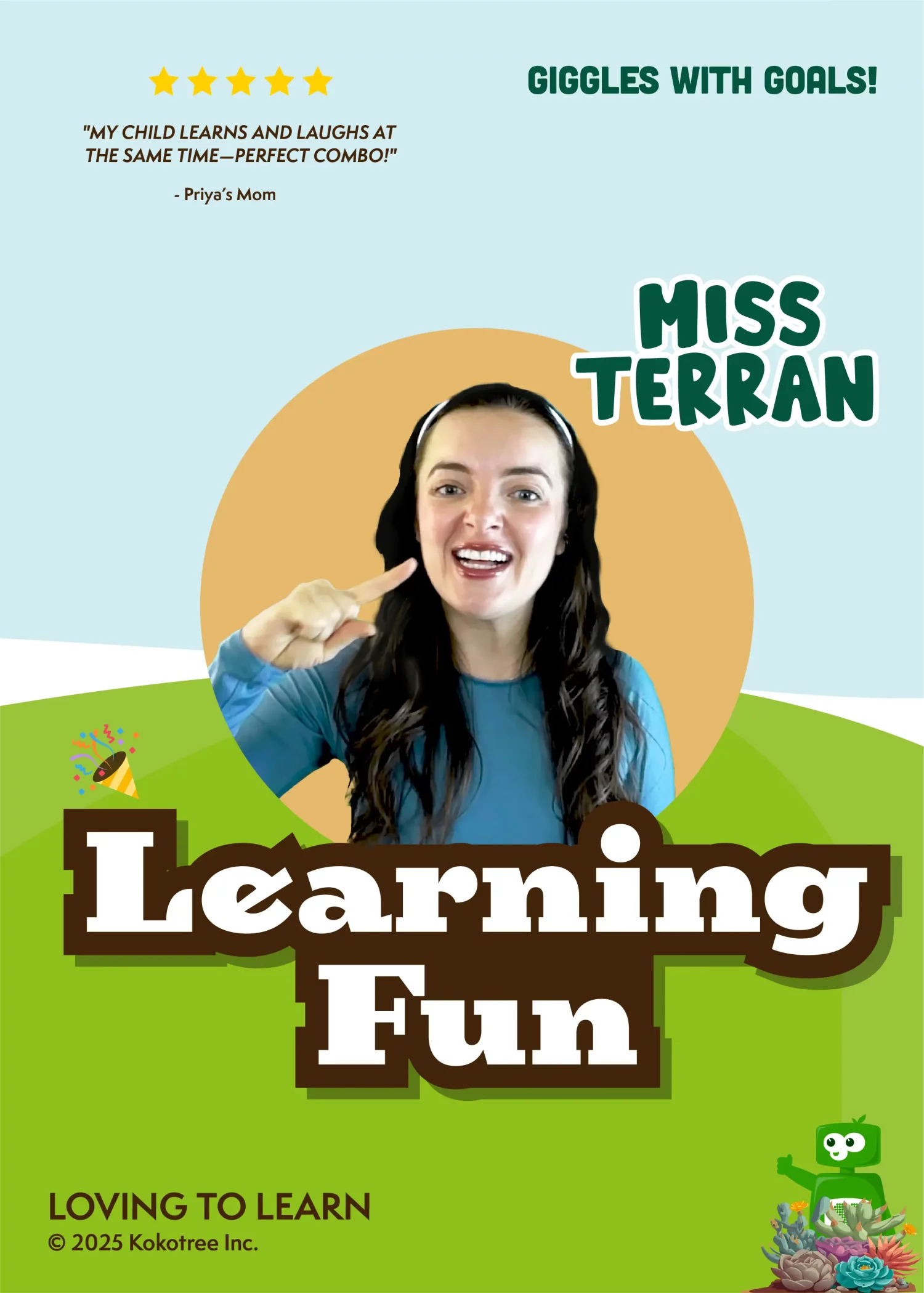
What's Learning Fun About?
Your little one gets a jam-packed learning session covering four essential early skills—all in one engaging video! They'll identify shapes, practice first words, start connecting letters to sounds, and hunt for colors in the real world.
3.5 minutes
Ages 1-3
Skill: Multi-concept early learning foundations
Your kid watches a friendly teacher introduce shapes, words, letters, and colors. You get 3.5 minutes to drink your coffee while it's still warm.
Miss Taryn appears on screen with a warm, encouraging presence. She holds up objects, makes playful sounds, and invites your child to repeat words and find things around them. Colorful images of dinosaurs, frogs, turtles, and everyday objects keep little eyes engaged.
What your child learns:
This video introduces foundational concepts across multiple learning domains. Your child practices verbal repetition, visual recognition, and real-world connection—all skills that build toward reading and math readiness.
- Identifies circles as shapes with no corners
- Practices saying "mama" and "dada" with clear pronunciation
- Connects letters A, B, and C to their sounds and familiar objects
- Recognizes the color green in animals, plants, and food
- Follows simple instructions and participates actively
They'll use these skills when:
- Pointing out circles on buttons, plates, and wheels during daily routines
- Calling for caregivers with clearer pronunciation
- Spotting letters on signs, books, and food packages at the store
- Identifying green vegetables on their plate (hello, broccoli negotiations!)
The Story (what keeps them watching)
Miss Taryn kicks things off with a friendly introduction and jumps right into circle discovery—no corners here! Then she shifts gears to practice important first words, celebrating each attempt with genuine enthusiasm. The ABCs section brings letters to life with sounds ("A-a-a-apple!") before wrapping up with a green color hunt featuring a roaring T-Rex, ribbiting frogs, and crunchy pears. The video ends with an interactive challenge: find something green around you!
How We Teach It (the clever part)
- First minute: Shape recognition starts with the defining characteristic ("no corners"), giving kids a concrete way to identify circles everywhere.
- Minutes 1-2: Word repetition builds confidence through the "say it, celebrate it, say it again" pattern with familiar caregiver words.
- Final 1.5 minutes: Letters connect to sounds AND objects (A-a-a-apple), while colors link to multiple examples—dinosaurs, food, animals, and trees.
Teaching trick: Each concept uses the "name it, show it, repeat it" method three times, which matches how toddler brains lock in new information. The final prompt to find green objects bridges screen learning to real-world application.
After Watching: Quick Wins to Reinforce Learning
- Mealtime activity: "Can you find something round on your plate?" Point to the edge of cups, bowls, and circular snacks. (Practices shape recognition in everyday contexts)
- Car/travel activity: "Let's spot green things out the window!" Count trees, cars, and signs together. (Extends color identification beyond the screen)
- Bedtime activity: "A is for apple, B is for ball... what's C for?" Pause and let them fill in "cat!" (Reinforces letter-sound connections)
- Anytime activity: Practice the animal sounds from the video—"What does the frog say? Ribbit!" and "What does the T-Rex say? Rawr!" (Builds vocabulary through playful repetition)
When Kids Get Stuck. And How to Help.
- "My child won't repeat the words back." Totally normal! Many toddlers are "input collectors" who absorb everything before speaking. Keep watching together and model the words yourself—they're learning even when silent.
- "They can't find green things around the house." Start by pointing to one green object together. Then ask, "Is THIS green?" about different items. Yes/no questions are easier than open-ended searches at this age.
- "The ABCs section seems too advanced for my 1-year-old." It is—and that's okay! Early exposure plants seeds. Focus on the sounds and animal connections ("A-a-a-apple!") rather than expecting letter mastery.
What Your Child Will Learn
Prerequisites and Building Blocks
This video works beautifully as an introduction to structured learning. Children benefit from basic attention skills (30+ seconds of focus) and some exposure to verbal interaction. It builds foundational recognition that connects to future Kokotree videos on individual letters, specific shapes, and color mixing. The multi-concept format helps identify which areas spark your child's interest for deeper exploration.
Cognitive Development and Teaching Methodology
The teaching approach leverages toddlers' natural imitation instincts through call-and-response patterns. Visual learners benefit from bright, clear images paired with each concept. Auditory learners hear sounds repeated in patterns ("A-a-a-apple"). Kinesthetic learners engage through the "find something green" challenge. The rapid concept switching matches toddler attention spans while building cognitive flexibility.
Alignment with Educational Standards
This video addresses multiple kindergarten readiness indicators: shape recognition (geometry foundations), phonemic awareness (letter-sound correspondence), color identification (classification skills), and following multi-step directions. These align with early learning standards across educational frameworks, preparing children for pre-K assessments in language, math, and following instructions.
Extended Learning Opportunities
Pair this video with shape sorting toys, alphabet puzzles, and color-matching games. The Kokotree app offers dedicated deep-dives into each concept introduced here. Create a "green hunt" scavenger list around your home. Practice the letter sounds during book reading—"Look! This word starts with B like ball!" Draw circles together using plates as stencils.
Transcript Highlights
- Shape definition: "Let's start with something round that has no corners. It's a circle."
- Phonics instruction: "A is for apple. A-a-a-apple. Open your mouth and say apple."
- Color exploration: "What else is green? A frog. Ribbit. A turtle. A palm tree."
- Interactive prompt: "Can you find something green around you?"
Character Development and Story Arc
Miss Taryn models enthusiastic learning behavior throughout, celebrating every attempt with genuine warmth ("You're doing so great!" "Way to go!"). She demonstrates patience by repeating words multiple times without frustration, showing children that practice is part of learning. Her playful animal sounds ("Rawr!" "Ribbit!") model that learning can be joyful and silly.
Multi-Domain Early Learning: Building Neural Pathways Through Variety
This video's multi-concept approach isn't random—it's strategic. Research in early childhood development shows that toddler brains form stronger neural connections when concepts are introduced in varied, short bursts rather than extended single-topic sessions. Each transition (shapes to words to letters to colors) requires the brain to shift cognitive gears, building mental flexibility.
The shape segment introduces mathematical thinking through defining characteristics ("no corners"). This attribute-based identification is the foundation of later geometry and classification skills. Children learn that shapes have rules—circles are ALWAYS round, regardless of size or color.
The word practice section ("mama," "dada") connects to social-emotional development and communication milestones. Repetition with celebration builds positive associations with verbal attempts, encouraging more speech.
Phonics instruction here uses the "embedded phonics" approach—letters aren't abstract symbols but are immediately connected to sounds AND objects. When children hear "A-a-a-apple," they're building three connections simultaneously: letter shape, letter sound, and word meaning. This triple-encoding dramatically improves retention.
The color segment demonstrates categorical thinking. Green isn't just one thing—it's dinosaurs AND pears AND frogs AND leaves. This "same but different" concept is foundational for scientific classification and flexible thinking. The final prompt to find green objects bridges passive watching to active learning, the critical step that transforms screen time into skill-building time.